
Your Next Customer May Be a Bot
What small businesses should fix before customer AI agents become normal.
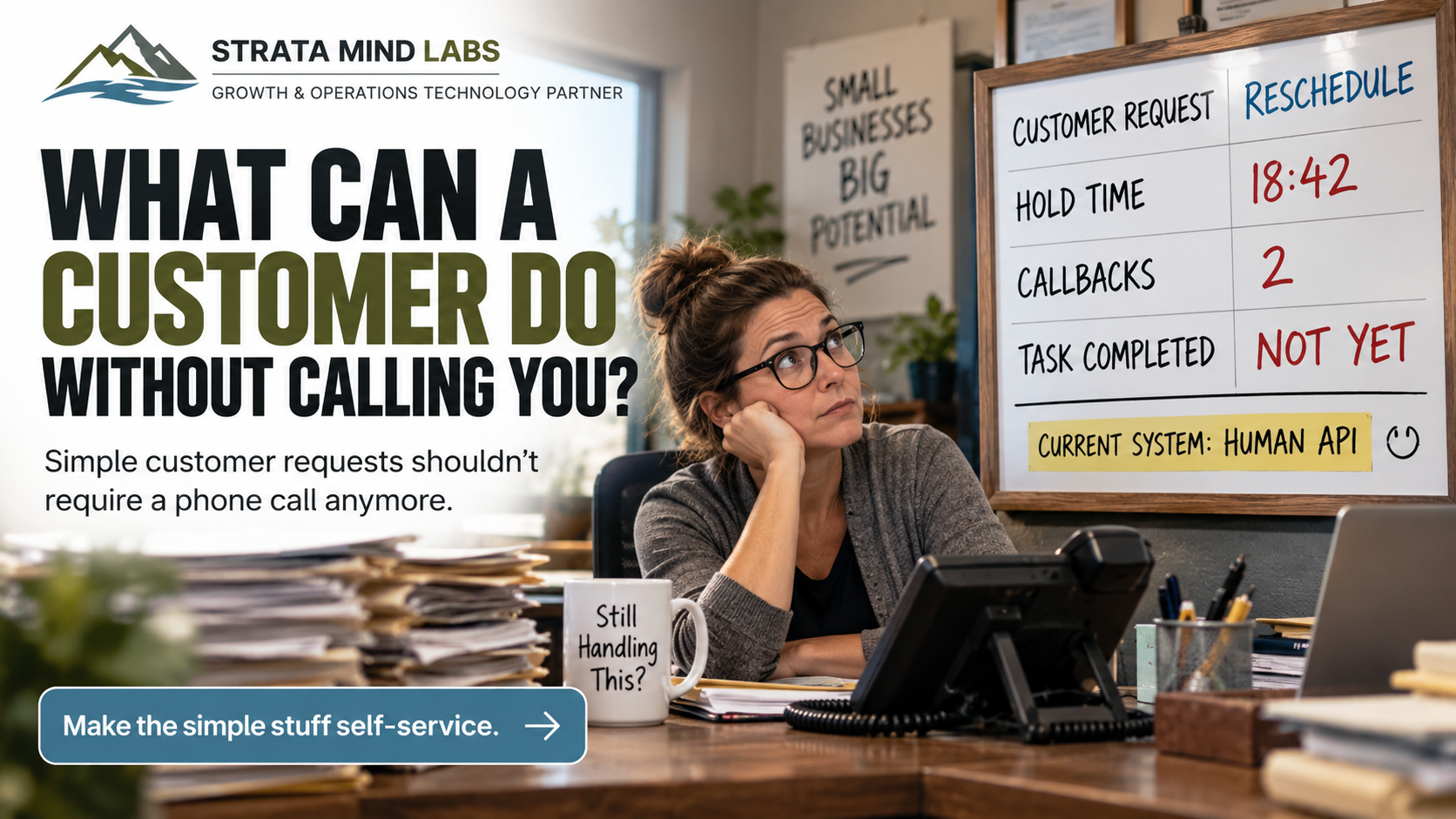
Executive decision: Pull the last 20 customer requests. Identify the three routine things customers contact you about most. Decide which one should be safe digital self-service, what must be verified first and who handles the exception.
Take a plumbing company with six trucks. At 7:15 Tuesday morning, a customer wants to move a service appointment from Wednesday afternoon to Thursday morning. Today that means a call, maybe a voicemail, a wait for a callback and an office manager who opens the schedule, moves the appointment and sends a confirmation.
The future customer may ask a personal AI agent to handle the same task. The useful question isn't whether your business is ready for agents. It's whether the business already knows what can be changed, what must be verified and where a person still belongs.
The signal this week
Personal AI agents are moving beyond answering questions and beginning to take actions for users. Sierra and Meta are working with companies including Shopify, Stripe, Walmart, Genesys and Rocket on Personal Agent Protocol, an emerging standard for personal agents interacting with businesses.
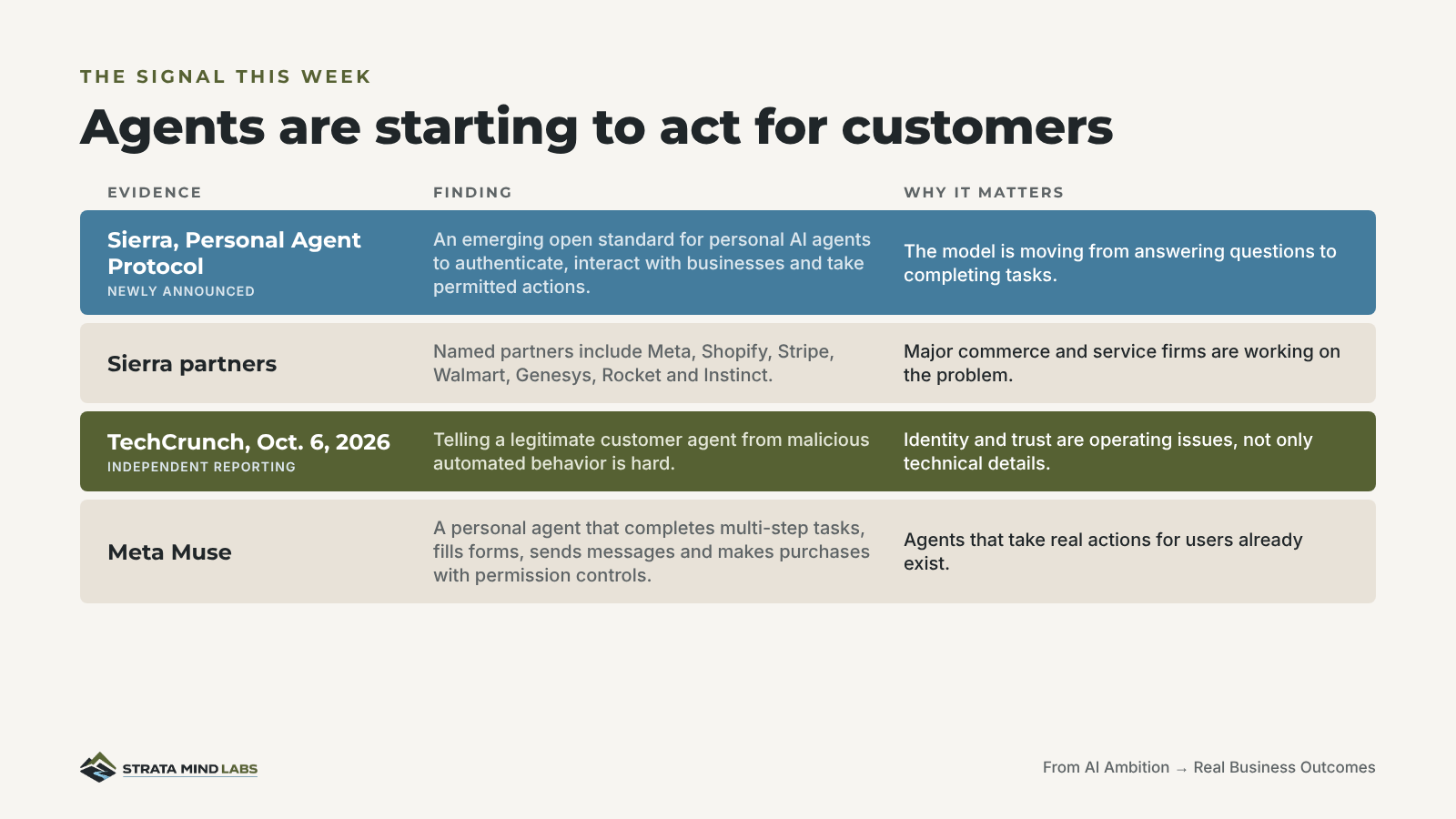
For a small business, the immediate issue isn't implementing a new protocol. The practical question is simpler. What can a customer already complete without calling you? If every booking change, status check, quote request, payment question or routine service request still needs a person, an AI agent won't make that workflow safe or available.
Start with today's customer requests
Before thinking about bots, protocols or integrations, look at what customers ask your team to do today. They book, reschedule and cancel appointments. They request quotes, check order or service status, update contact information, pay invoices, request returns, ask routine questions and escalate problems. Those requests already tell you where the business depends on employee handling.
Pull 20 recent customer calls, emails, form submissions or front-desk requests and categorize why each customer contacted you. That's useful even if customer AI agents take years to become common.
Use request, verify, complete, escalate
Every routine request moves through the same four questions. Answer them before you change anything.
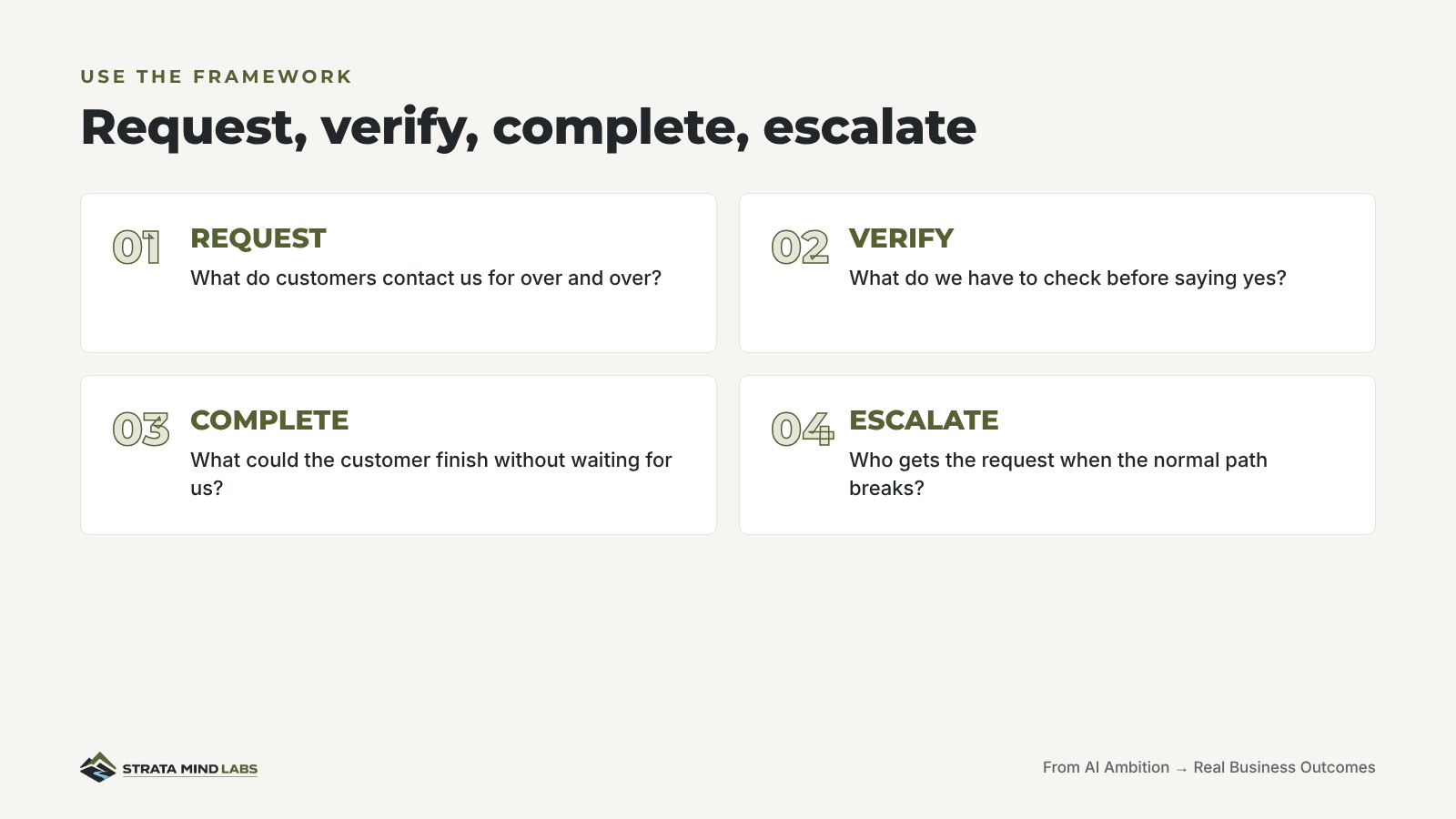
REQUEST. What is the customer trying to do, and what do customers contact you for over and over?
VERIFY. What has to be confirmed before you say yes? That might be identity, the appointment, the account, an order number, authorization, payment status or eligibility.
COMPLETE. Which routine actions can safely happen without an employee? What could the customer finish without waiting for you?
ESCALATE. Which situations need a person? Unusual pricing, schedule conflicts, complaints, refunds, safety issues, legal or clinical judgment, high-value transactions and unclear identity all belong here, along with a named owner who gets the request when the normal path breaks.
Run the Customer Self-Service Check
Review your 10 most common request types. For each one, capture the request type, the weekly volume, whether the customer can do it without calling today, what identity or account verification it needs, whether a human has to approve it, the average employee handling time, who handles it now, who handles exceptions, whether it could become safe digital self-service and the next test.
A strong candidate happens often, has a predictable outcome, has clear verification rules, consumes employee time and has a defined exception path.
What good self-service looks like
Self-service doesn't mean removing people. It means removing unnecessary waiting from routine work while keeping people involved where they add judgment or protect the business.
A good candidate is a customer rescheduling an ordinary service appointment into an open slot. The business can verify the customer, the existing appointment and the allowed scheduling window. If the new slot is available, the change completes. If it creates a conflict, the dispatcher gets it.
A poor candidate is an unusual refund, a disputed charge, a safety exception, a legal commitment or a clinical decision. That belongs with a person.
A worked example
This is an illustrative example, not a client result. A small service business receives 60 inbound customer requests each week. Twenty are appointment changes. Office staff handle all 20 at about 6 minutes each, which comes to 120 minutes of staff time a week.
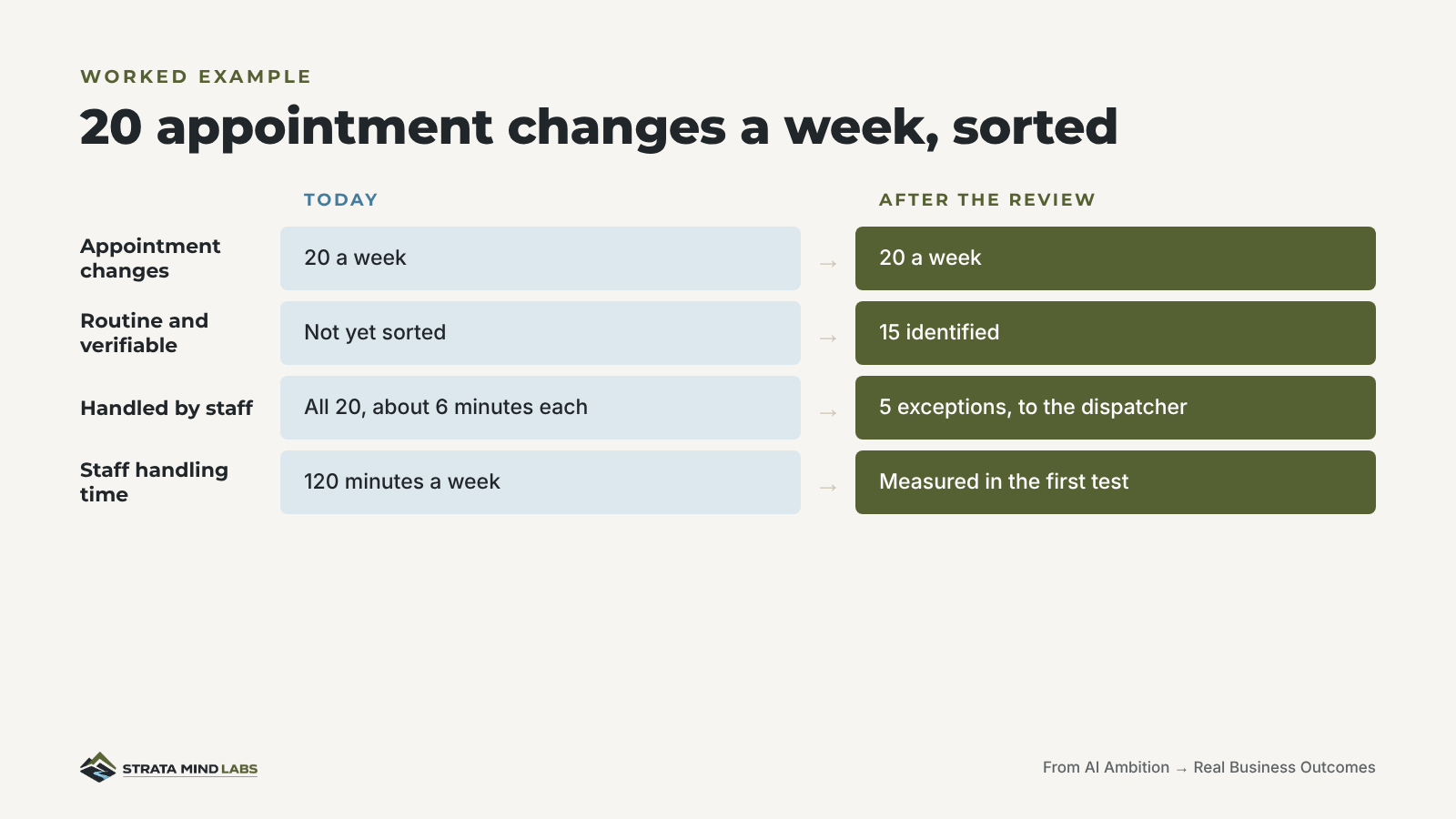
Fifteen of the 20 turn out to be simple. The customer's identity is clear, the existing appointment is known, the requested slot is open and no special technician or pricing decision is involved. Those 15 become candidates for digital self-service. The other five still go to the dispatcher.
The important result isn't "AI saved two hours." It's that the business now knows which requests are routine, what must be verified, which can complete safely and where people still belong. That operating clarity is the prerequisite for any future customer-agent interaction.
Five prompts to run this week
These work in any capable model. Run them in order on one real request type, and hold one rule. The model organizes what you give it. It doesn't invent missing information or pick a vendor.
Categorize customer requests
Copy this prompt
I will give you a list of recent customer calls, emails, messages, form submissions, or front-desk requests. Group them into recurring request types. Count each type. Do not recommend technology yet. Show which requests are most frequent and which appear routine versus exception-heavy.
Map the current handling
Copy this prompt
For the request type I select, map the current workflow from customer request to completion. Name every employee role involved, what they check, what system or information they use, where the customer waits, and what can go wrong. Flag missing information instead of inventing it.
Apply request, verify, complete, escalate
Copy this prompt
For this customer request, organize the workflow into REQUEST, VERIFY, COMPLETE, and ESCALATE. Identify exactly what must be verified before the action can complete and which conditions should force a human handoff.
Test self-service suitability
Copy this prompt
Score this request from 1 to 5 on frequency, predictability, verification clarity, employee handling time, customer waiting, consequence of error, and exception rate. Explain whether it is a good candidate for digital self-service. Do not recommend a vendor.
Design the first test
Copy this prompt
Design a small 30-day test for this customer request. Define the owner, pilot population, verification rule, completion rule, escalation rule, success threshold, failure condition, and evidence to collect. Keep a person involved wherever judgment, money, safety, legal rights, or clinical consequence requires it.
What to do this week
A fair limit on all this
Personal Agent Protocol is newly announced and isn't yet a mature or broadly deployed standard. Nothing here says most small-business customers already use personal agents or that you need to implement the protocol now. The worked example is illustrative, not a client result. The point is narrower. You don't need an agent strategy today. Look at the things customers already call you to do, make the simple ones easier, define what must be verified and keep a person where the normal path breaks.
CIO Question of the Day
What can a customer get done without calling you?
Sources
- Sierra. Introducing Personal Agent Protocol. October 6, 2026. https://sierra.ai/blog/introducing-personal-agent-protocol
- TechCrunch. The next hurdle for AI agents: getting websites to let them in. October 6, 2026. https://techcrunch.com/2026/10/06/the-next-hurdle-for-ai-agents-getting-websites-to-let-them-in/
- Meta. Muse. https://ai.meta.com/muse/
Make the simple stuff self-service.
New briefings land as soon as the signal is worth your time.