
Whose Data Is in the Answer?
A provider output-boundary check for growing businesses
Executive decision: A successful AI response can still carry another customer's material. Before you expand sensitive use of a hosted AI service, ask its owner for evidence of tenant-isolation testing, output-integrity checks and incident-notice terms. Keep higher-sensitivity expansion on hold when the answers are missing.
A response that returns on time can still belong to someone else. Find out whether your provider tests for that.
The signal this week
Cloudflare published an incident report on October 26. It says that between August 27 and September 9, 155 responses from its GLM-5.3 model on Workers AI were affected. Customers received responses that contained data from other customers' requests. Every affected prompt ran longer than 681,280 tokens.
The cause, as Cloudflare describes it, was a mismatch. The model's context window was 1,048,576 tokens, but the memory pool on its prefill GPUs had room for 681,280. A bug in how the serving engine handled the resulting over-length requests let them continue down the processing path anyway.
Cloudflare says it found no evidence of deliberate exploitation and confirmed no other Workers AI model was affected. It set the model to private on September 9 and restored it the same day after configuration and engine fixes, according to its own timeline.
The detail that matters to a buyer is how this got through. Cloudflare says its pre-launch long-context tests validated HTTP response codes and engine performance without validating model output and coherence. A green status code records that an API returned. It can't show whose information is in the answer.
What the sources show and don't
Knostic, whose researcher reported the issue, describes a black-box test. Each request carried a unique marker at both ends, and the researchers ran the same method against related models as controls. Knostic says it reported the problem on September 8. That's Knostic's own account. Cloudflare adds that the researcher supplied a reproducible script and that Cloudflare's own team reproduced the issue the next morning.
Knostic also says it couldn't inspect Cloudflare's serving infrastructure and calls its explanation a hypothesis, not a root-cause finding.
The SGLang team, which maintains the open source serving engine involved, published a coordinated disclosure the same day. It documents fixes to how requests are admitted and how cache transfers are handled. It says the race affected default configurations in a disaggregated setup across a long run of versions. It also says a deployer can't reliably tell from errors or logs whether it was exposed. It doesn't say any host other than Cloudflare was affected. It doesn't say none were.
So the honest read is narrow. One model, one provider, one reported incident, now fixed. A claim that every AI provider leaks customer data would be wrong. A claim that you have nothing to ask would be just as wrong.
NIST's generative AI risk profile, published in July 2024, lists data privacy among its risk categories and points to incident response and disclosure processes. It's general lifecycle guidance. It doesn't validate the questions or the timing in this briefing.
Four owners, one decision
Treat the output boundary as a vendor performance question. The framework has four steps, and each has one owner. The application owner records where sensitive data enters hosted AI. The vendor manager asks how the provider tests isolation and response integrity. The security owner reviews what comes back. The business owner accepts, limits or pauses the use case.
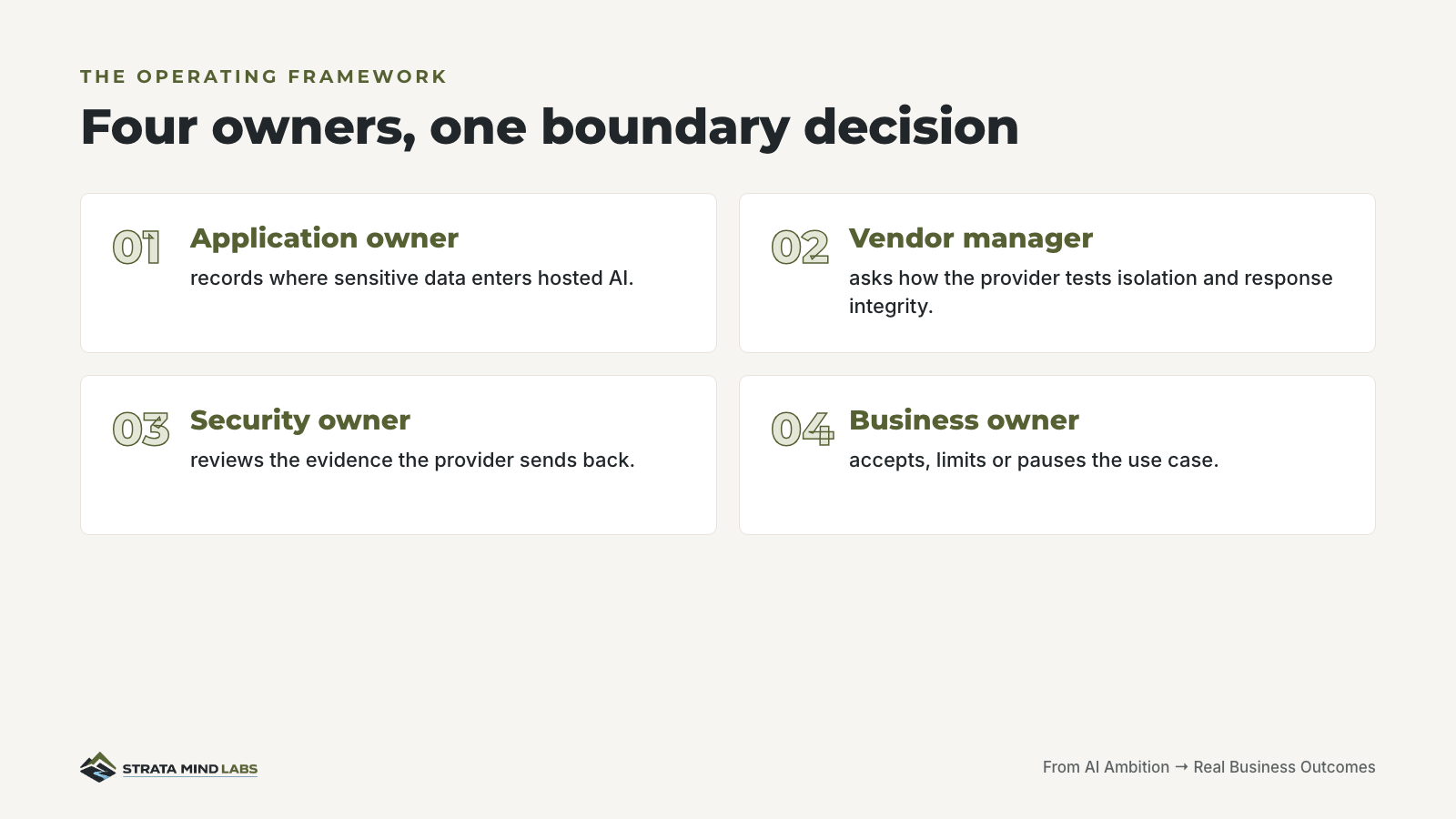
This is Strata Mind Labs operating practice, not a measured industry standard. Apply the 80/10 Operator Test: pick one consequential workflow and give the review a short, fixed window. Don't turn one incident into a standing committee for every prompt.
Run the card on one service
Use the Output Boundary Card on one hosted service this month. Record the provider, the model, the data class, the application owner and the intended workflow. Then send three written questions. How do you test tenant isolation at the longest supported context? How do you detect a plausible but wrong-customer response? What notice applies if cross-customer output is discovered?
Ask for test scope, dates and the accountable provider role. A policy statement doesn't answer a test question.
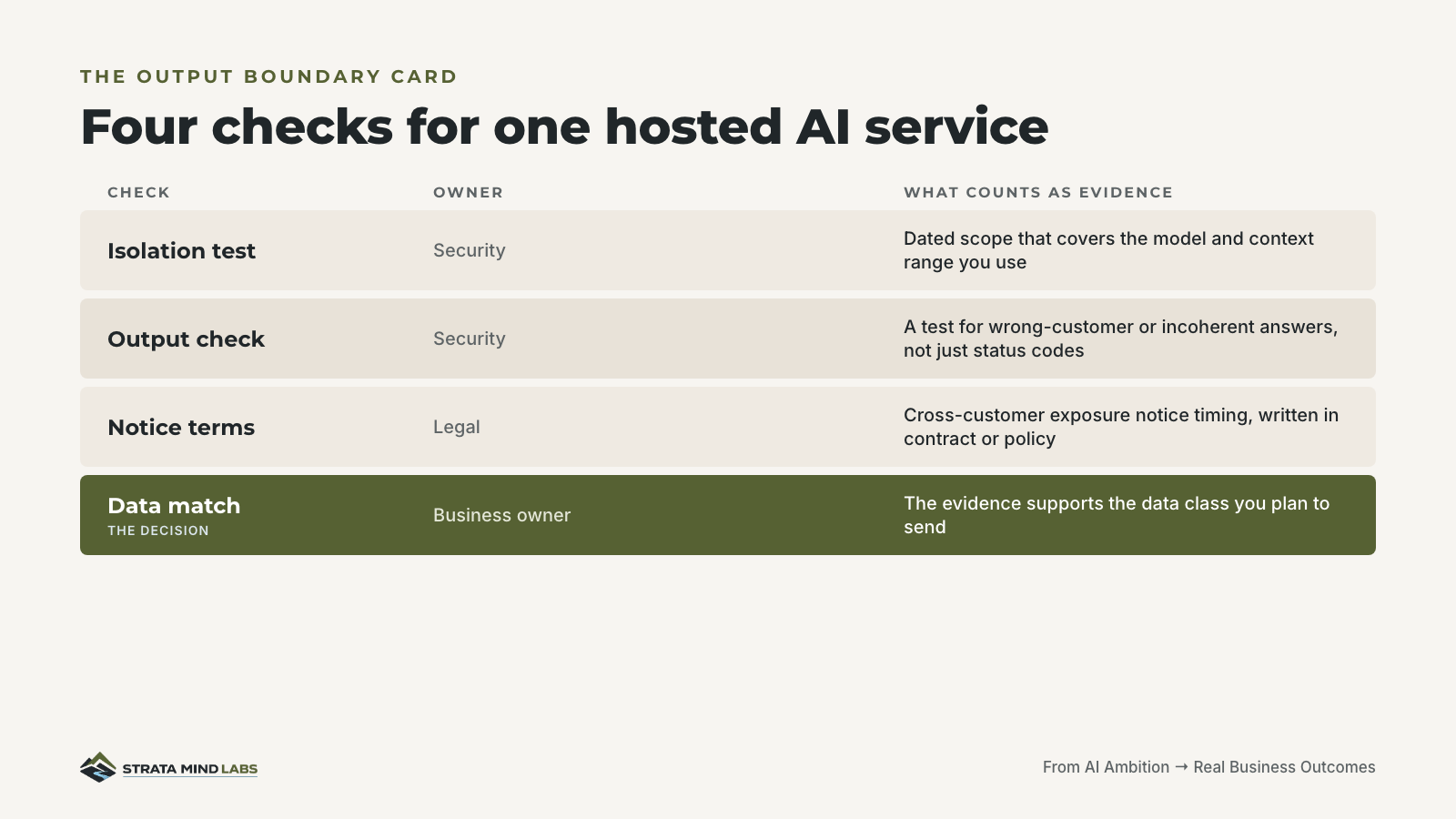
Give the vendor manager ten business days to collect the response. That's a proposed management window, not a vendor performance claim. Security reviews the technical evidence and legal reviews the notice language. Don't use a live customer payload as a probe without authority. Use synthetic or redacted examples in any authorized test.
Five prompts to run this week
Run these in order on one service. Use approved inventories, redacted notes and the provider's own documents only. A person checks every result against the source.
Map the data boundary
Copy this prompt
Using only the approved service inventory and redacted workflow notes below, list each hosted AI service, model, owner, input data category and output recipient. Mark every missing field as UNKNOWN. Do not infer a vendor control. Return a table and a short list of unknowns that could change the use decision.
What this should tell you: what data goes where, and who owns it. Watch for missing model names, unowned workflows and sensitive data categories, and make sure UNKNOWN stays visible. Decision: pick one consequential service for review once the owner and data category are confirmed.
Extract provider claims
Copy this prompt
From the provider's supplied security documents only, extract verbatim claims about tenant isolation, long-context testing, response-integrity checks and incident notice. For each claim give document title, date and page or section. Put MISSING where the documents say nothing. Do not treat a generic certification as proof of a specific inference test.
What this should tell you: what the provider says, which isn't the same as what the controls did under failure. Watch for undated assertions, generic security language and absent test scope. Decision: mark which claims need supporting test evidence and which questions stay open.
Draft the evidence request
Copy this prompt
Draft a concise email for human review asking this provider for the scope and date of its longest-context tenant-isolation tests, its output-coherence checks, the owner of those tests and its cross-customer exposure notice process. Ask for a redacted test summary or equivalent evidence. Use no allegation about this provider. Add a response date ten business days out as a proposed management target, clearly labeled for human confirmation.
What this should tell you: whether you've asked a fair, narrow question. Watch for accusations you can't back up, a missing contact owner and a deadline nobody has checked. Decision: the vendor manager approves and sends the request under normal company process. Nothing goes out on the model's say-so.
Test the response against your use case
Copy this prompt
Compare the provider's actual written response and attached evidence with this approved workflow's data category. Separate FACTS IN DOCUMENTS, UNVERIFIED CLAIMS and MISSING EVIDENCE. Check whether test conditions cover the model and context range we use, whether output content was checked and whether notification timing is stated. Give no pass score where evidence is absent.
What this should tell you: whether the evidence matches the way you use the service. Watch for a test on a different model, a smaller context range or a status-code-only check. Decision: security and legal decide whether the evidence supports the planned data class. Run this only after a real response arrives. Don't invent a reply.
Prepare the owner decision
Copy this prompt
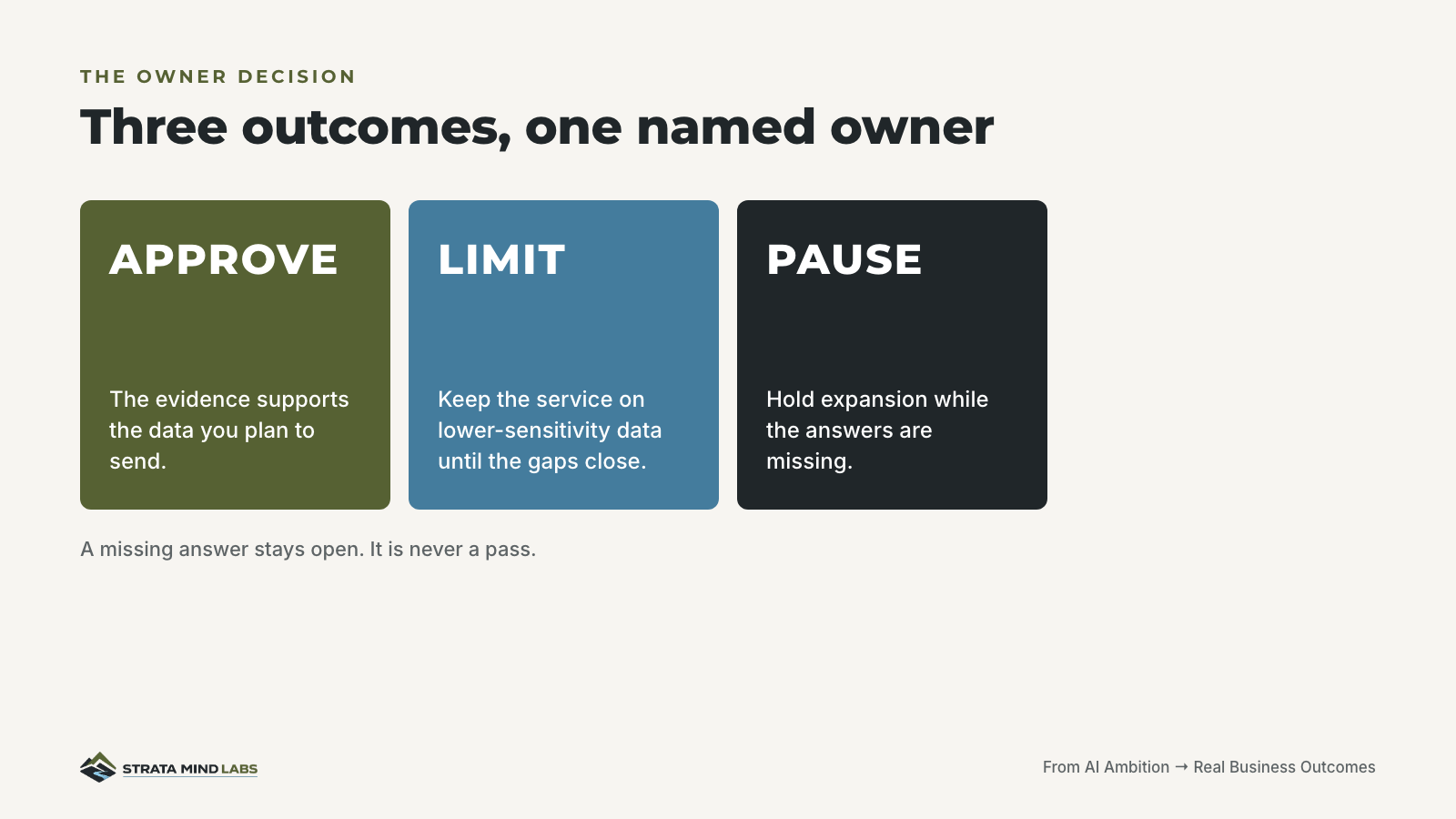
Prepare a one-page decision record for the business owner. Show the workflow, data category, provider evidence, unresolved questions, security view, legal notice view and three choices: approve the current scope, limit it to lower-sensitivity data or pause expansion. State what new evidence would change the decision. Leave the final choice and signature blank for the human owner.
What this should tell you: whether the review changes or confirms a boundary. Watch for unresolved items that got quietly closed, a signature a model filled in and choices with no conditions attached. Decision: the named business owner records the call after security and legal have reviewed.
A finished sequence shows where your data flows, what the provider has demonstrated and which decision stays with a person. The value is a defensible use boundary, not a promise that leakage is impossible. Missing evidence is an open question, never a pass.
What to do this week
A fair limit on all this
One case isn't a frequency. Cloudflare reported one model, one provider and 155 responses, and says the fault is fixed. Knostic's account is its own, and it calls its explanation a hypothesis. The SGLang post doesn't say whether any other host was exposed. NIST's profile is general guidance.
The four owners, the card and the ten business day window are Strata Mind Labs proposed practice, not a measured standard. Vendor statements about their own testing are vendor claims until a dated test summary backs them. No return from this review is assumed. The goal is a decision you can defend.
CIO Question of the Day
For the hosted AI service that touches your most sensitive data, what evidence do you hold that its answers can't carry another customer's information?
Sources
- Cloudflare. (2026, October 26). Cross-request KV cache exposure in the GLM-5.3 Workers AI model, and our remediation with SGLang. Cloudflare Blog. https://blog.cloudflare.com/kv-cache-exposure-remediation/
- Evron, G. (2026, October 27). Hallucination or cross-tenant: When an LLM answers with another user's context. Knostic. https://www.knostic.ai/blog/hallucination-or-cross-tenant-when-an-llm-answers-with-another-users-context
- SGLang Team. (2026, October 26). SGLang security update: Improving request isolation. LMSYS Org. https://www.lmsys.org/blog/2026-10-26-cf-security
- National Institute of Standards and Technology. (2024, July). Artificial intelligence risk management framework: Generative artificial intelligence profile (NIST AI 600-1). https://nvlpubs.nist.gov/nistpubs/ai/NIST.AI.600-1.pdf
A status code tells you the call returned. It doesn’t tell you whose data came back.
New briefings land as soon as the signal is worth your time.