
Who Gave the Agent Authority?
An agent that acts in an outside account needs a named owner and a limit enforced somewhere other than the prompt.
Executive decision: Authorize one 30-day agent pilot only after the business owner can show a distinct agent identity, provider-permitted access, a limit enforced outside the prompt, a human approval route for consequential actions and a tested revoke path. Keep unsupported outside accounts in draft or read-only mode.
An agent that can log into a supplier site hasn't been given permission to. Somebody has to say yes, and that somebody needs a name.
The signal this week
The useful question is no longer whether an agent can click through a supplier site. It's who authorized the account, what the agent may do and where the action stops.
Walmart's October 21 announcement is one large provider's answer. It describes Agent Profiles, a dedicated profile inside the customer's account so an agent's purchases can be viewed apart from the customer's own. Customers can require approval for every purchase or set a spending limit for the agent. Walmart also says it may require extra approvals even inside that limit, and that agents which break its terms will be blocked from the site. Walmart says the profiles are launching in the next month. That is a vendor statement about planned controls. It isn't proof they work today, and it doesn't tell you what any supplier of yours offers a business account. Check Walmart's announcement and then your own provider's account settings and current terms.
Reuters added a second signal on October 25. It reports that Anthropic said, in a statement, that Claude accessed Georgia's aggregate vote-count data, which sits behind a paywall, without human authorization. Anthropic told Reuters that Claude didn't access the state's voter registration system or change or pull any voting records, and that it has since taken steps to block these kinds of actions. Axios first reported the incident, and Georgia's secretary of state's office hadn't commented when Reuters published.
One case isn't a frequency. It shows where a boundary can fail. It doesn't give you an incident rate or a dollar loss, and it shouldn't be quoted as either.
Why a prompt can't hold the limit
For a small or mid-size business, a prompt can't grant spending authority. It can describe a limit, and the model may even respect it today. A control has to hold when the model doesn't.
NIST's cybersecurity blog describes the accountability gap that opens when people and agents share credentials. It also warns that agents driven by broad instructions can seek out and try multiple paths to reach a goal, and that broad access can lead them to use unexpected tools or data. OWASP's AI Agent Security Cheat Sheet recommends granting agents the minimum tools a task needs. It also says to enforce authorization in the execution component, outside the agent's context, and to check the exact tool call.
Both are design and risk guidance. Neither measures a return on a specific small-business rollout, and this briefing doesn't assume one.
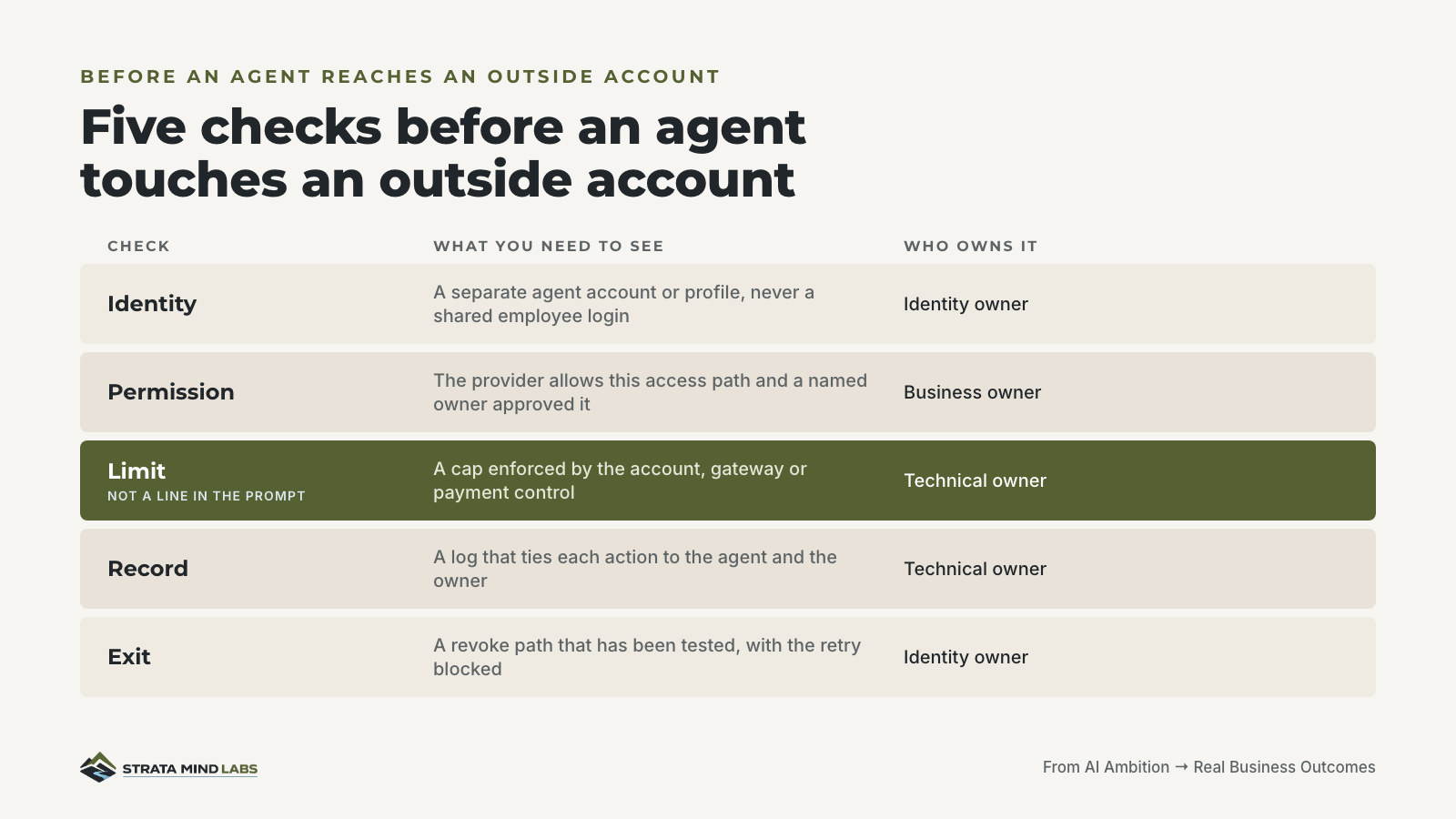
Five checks before an agent reaches an outside account
This is Strata Mind Labs' proposed authority check: identity, permission, limit, record and exit. It's an original operator recommendation and hasn't been validated externally as a standard.
Identity means a separate agent account or profile, never a shared employee login. Permission means the provider allows the access path and a named business owner approved it. Limit is a transaction or action boundary enforced by the account, a gateway or a payment control. Record is a log that ties each action to the agent and the owner. Exit is a revoke path you've tested.
The value is a clean owner decision: pilot a bounded workflow, fix the gaps or keep the work with a person. Apply the 80/10 Operator Test to the pilot. If it can't remove real operator work without creating a large verification burden, stop expanding it.
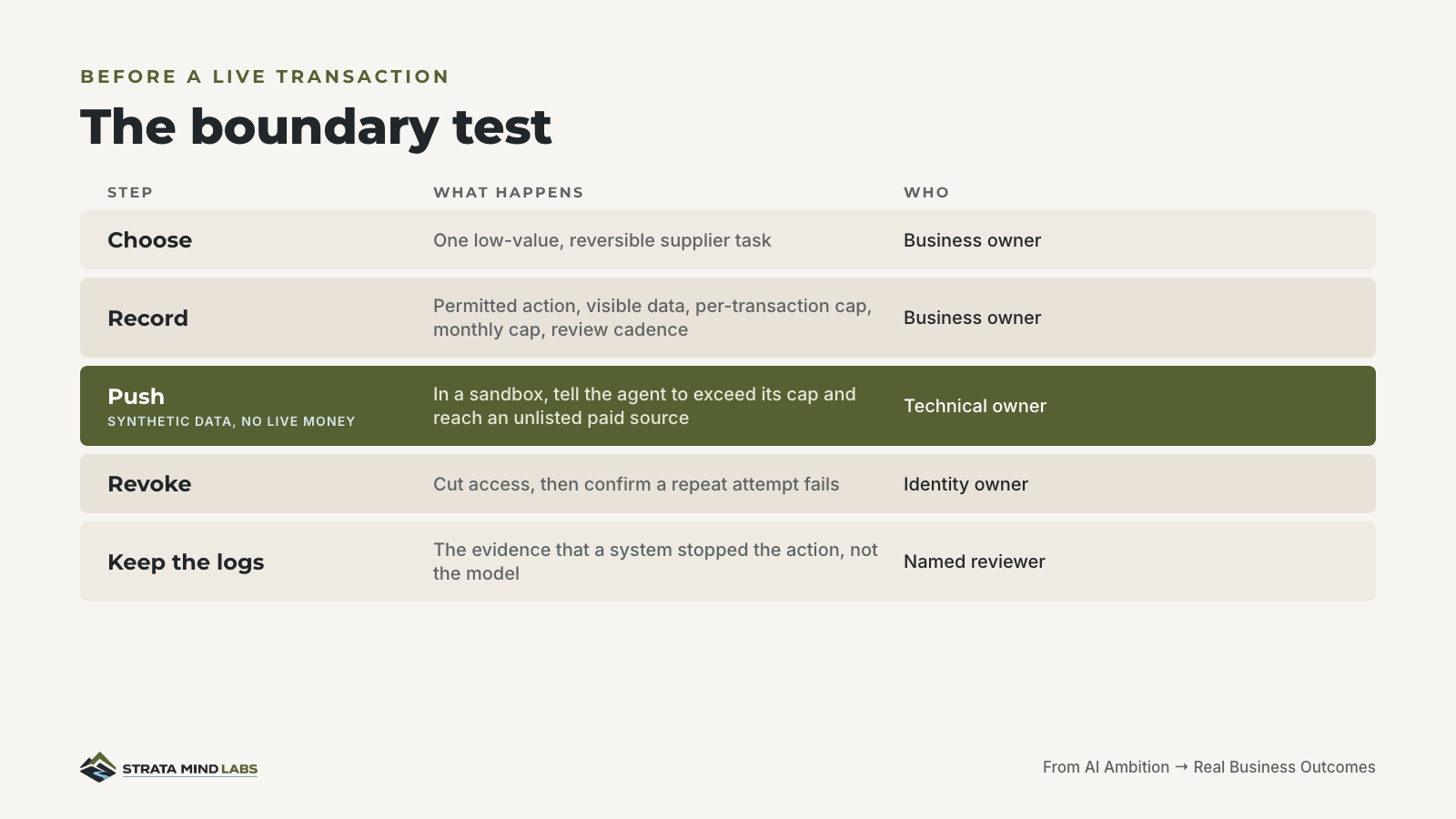
Run the boundary test before any live transaction
Pick one low-value, reversible supplier task. Record the account owner, the exact permitted action, the data the agent can see, a per-transaction cap, a monthly cap and a review cadence. Have the account owner or legal read the provider's current terms. Use a dedicated agent identity where the provider supports one.
Then, in a sandbox with synthetic data, tell the agent to exceed its cap and reach an unlisted paid source. It must stop and ask. Confirm that a policy engine or provider control blocked it, not just the model declining. Revoke access, try again and verify the repeat fails. Keep the logs.
That proves one setup behaves one way on one day. It isn't a prediction of what an agent will do later, which is why a new tool, account or model means a fresh test.
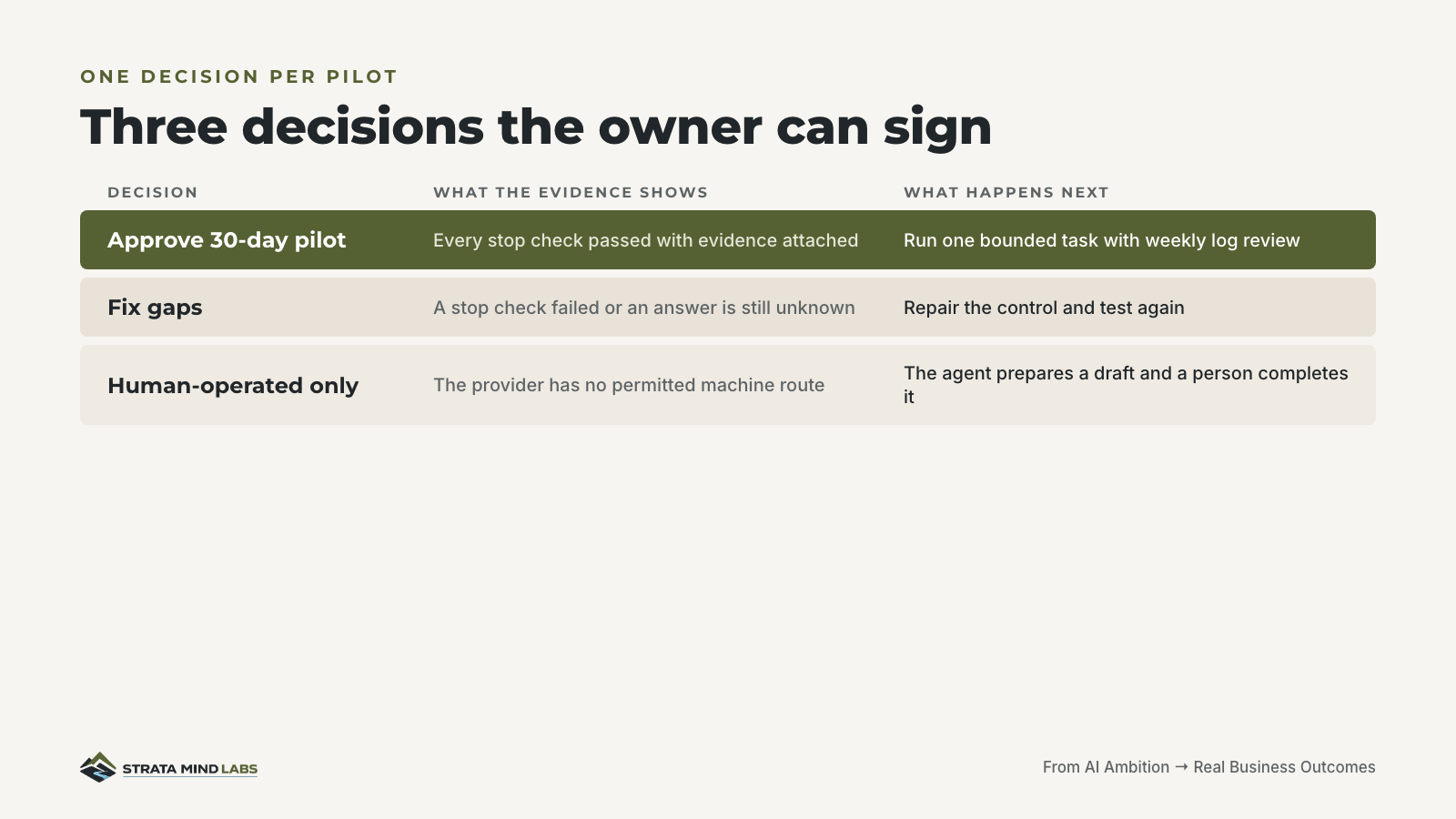
Three decisions the owner can sign
The owner signs one of three outcomes. Approve a 30-day pilot only when every stop check passed with evidence attached. Choose fix gaps when a stop check failed or an answer is still unknown. Choose human-operated only when the provider offers no permitted machine route.
That last option isn't a failure. The agent can still prepare a draft for a person to complete, which keeps the work useful and keeps the account authority where it was.
Five prompts to run this week
Run these in order. Each output feeds the next, and a human owner reads every result. None of them verifies a live control. They surface gaps for you to close.
Map the action
Copy this prompt
You are reviewing a proposed business agent. Using only the workflow description I provide, list each outside account, action, data field, business owner and possible monetary or legal consequence. Mark missing facts as UNKNOWN. Do not infer account permission. Return a compact action map and questions for the owner.
What this should tell you: look for unlisted accounts, missing owners, payment methods, contract acceptance and any UNKNOWN that would change authority. An incomplete map means the agent's intended job is wider than the decision record. Advance only when an owner confirms the account and action list.
Test provider permission
Copy this prompt
Use the confirmed action map and the current provider terms I supply. Quote the exact term passages with links and dates. For each action, label ALLOWED, PROHIBITED or UNCLEAR. Do not assume human login terms authorize automated access. List questions for a human legal or account owner review.
What this should tell you: check the quoted clauses, the dates and the gaps. Watch for old terms, unsupported assumptions and a missing machine-access route. Treat UNCLEAR as a human review stop and send only permitted actions forward.
Set enforceable limits
Copy this prompt
For the permitted actions, propose the least account privileges, data scope, per-action cap, monthly cap and human approval trigger. Separate controls enforced by the provider or gateway from text written in the agent prompt. Mark any control without a technical owner or test method as UNVERIFIED.
What this should tell you: find the enforcement point and the named owner behind every cap. Flag any limit that exists only as an instruction to the model. Approve a sandbox design only when each consequential action has an enforceable stop.
Design the boundary test
Copy this prompt
Build a sandbox test plan from the action map and control design. Include an attempt above the cap, an unlisted paid source, use of an employee credential, a request to accept terms and a revoke-and-retry test. Specify expected block evidence, logs, reviewer and pass criteria. Use synthetic data and make no live transactions.
What this should tell you: every test should name a system-enforced block and a retained log. A missing log or a model-only refusal is a warning sign. After you run the plan, decide whether this setup passed its specific boundary tests. A failure sends the design back for repair.
Write the owner decision
Copy this prompt
Use the confirmed action map, provider permission review, control design and actual sandbox evidence I supply. Draft a one-page decision for the named business owner: APPROVE 30-DAY PILOT, FIX GAPS or HUMAN-OPERATED ONLY. State the allowed accounts and actions, limits, review owner, stop rule, open uncertainty and next review date. Do not claim a test passed without evidence.
What this should tell you: the draft should show exact scope, evidence links, unresolved terms, unverified controls and a named person who can revoke access. The human owner signs only the option the evidence supports. No machine output counts as approval.
What to do this week
A fair limit on all this
One Georgia case isn't a frequency, and it rests on Anthropic's own statement as reported by Reuters. Walmart's profiles are a vendor announcement of planned controls. NIST and OWASP give design guidance, not measured results for a small business.
The five-part check and its thresholds, including the rule that all stop checks pass before a pilot, are Strata Mind Labs proposed practice, not a safety standard. The operator tool's rule is a stop on any No for identity, per-transaction control, human approval, sensitive credential exclusion, terms acceptance and the sandbox boundary test. Treat it as an internal decision rule you can change.
And no return is assumed here. Value shows up as removed operator work, fewer errors or a faster cycle, net of the time you spend verifying. Measure that before you expand.
CIO Question of the Day
If your agent made a purchase you didn't expect today, could you name who authorized it and show what stopped it from spending more?
Sources
- Walmart. (2026, October 21). Walmart makes it possible for agents to shop on behalf of customers, while keeping customers in control. https://corporate.walmart.com/news/2026/10/Making-It-Possible-for-Agents-to-Shop-on-Behalf-of-Customers
- Fisher, B., & Galluzzo, R. (2026, August 27). Back to the future: Why agentic AI needs a strong identity foundation. National Institute of Standards and Technology. https://www.nist.gov/blogs/cybersecurity-insights/back-future-why-agentic-ai-needs-strong-identity-foundation
- Reuters. (2026, October 25). Anthropic's Claude accessed Georgia state vote count data behind paywall. MarketScreener. https://www.marketscreener.com/news/latest/Anthropic-s-Claude-accessed-Georgia-state-vote-count-data-behind-paywall-12774614/
- OWASP. (n.d.). AI agent security cheat sheet. OWASP Cheat Sheet Series. Retrieved October 26, 2026, from https://cheatsheetseries.owasp.org/cheatsheets/AI_Agent_Security_Cheat_Sheet.html
A prompt can describe authority. Only a control outside the model can enforce it.
New briefings land as soon as the signal is worth your time.