
Who Can Instruct Your AI Helper?
A one-page route register for one AI helper, and the questions that decide which connections stay
Executive decision: List the actual routes one AI helper uses to take instructions, then decide which connections stay. Keep payments, customer messages and system changes with the people who already own them. If a route has no owner, pause it.
The chat window is one door into your AI helper. Your work laptop may have others.
The signal this week
On November 5, Mercury published a post describing a feature it calls Agent Controls. The company says an owner can see every agent connected to an account and who it belongs to. A user's role sets the ceiling on what an agent can do, and an agent "can prepare a payment or transfer, but it can never send one on its own without a human in the loop." The post also describes a record of what each agent did, tied to the person behind it (source 1).
Those are Mercury's descriptions of its own product, and the post cites no independent audit. It also states a limit that matters more here than the controls do. The controls cover agents connected the official way, through Mercury's MCP connection. When an agent reaches the bank through unofficial channels, such as your browser, Mercury says it's difficult for both the bank and you to keep track of which actions are person-led and which are agent-led.
The same day, The Register reported a researcher's demonstration. Per the article, Gal Weizman of Forever Security showed that a browser extension with access to a logged-in AI session could find the session of a desktop agent running on the same machine and send it instructions. In the proof of concept the article describes, the payload had the agent install a malicious package (source 3).
That's one researcher's work reported by one outlet. I haven't reproduced it and haven't confirmed the vendor's response. Treat it as a lead worth checking on your own machines. It doesn't tell you how common the route is, and it doesn't prove every tool has it. To judge the details yourself, read the article.
Read together, the two stories point at one gap. A tool's controls cover the routes the tool knows about. An owner who checks only the chat window, or only the vendor's control page, can miss a route that changes what the helper can do.
What the evidence adds, and where it stops
Cloudflare's November 5 post argues that when an agent acts for a person, a site needs to know who the agent acts for, not just that a human is somewhere in the loop. It proposes shared building blocks under the name Trusted Agent Delegation and says a few related features are already in production (source 2). That's a vendor's design proposal. It isn't evidence that a shop or an office has any such control.
NIST's AI Risk Management Framework says its Map function establishes the context for framing the risks of an AI system. It also says AI systems should be tested before deployment and regularly while in operation (source 5). The Generative AI Profile is the companion document for generative AI (source 4). Together they support mapping the context and repeating the review. They don't validate this card, this sequence or a 45-minute first session.
The strongest objection is proportion. A shop with one read-only assistant and no connected accounts may have no action route to close, and a full browser audit would waste that owner's afternoon. Check the helper actually in use and stop when the register covers its visible connections.
A clean list still depends on the owner reaching the right settings. Mercury's own post shows why, since it concedes the browser route is hard to track. A personal account or a hidden connection can escape the first pass.
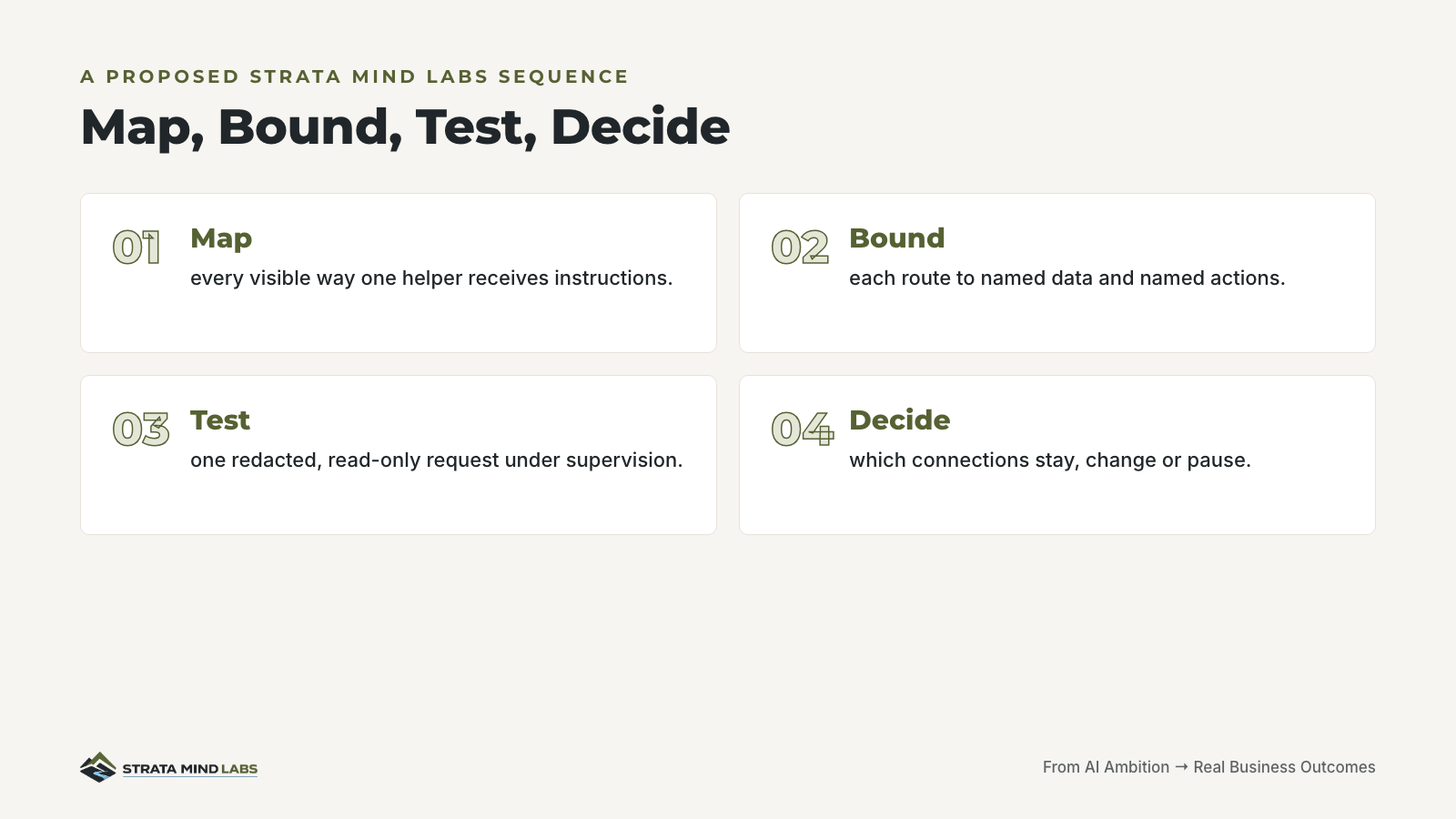
Map, Bound, Test, Decide
This is a proposed Strata Mind Labs sequence, not a standard. The outside sources support scoped permissions and review. They don't say this sequence works.
The owner is accountable for the business decision. The office manager can keep the register. A bookkeeper signs off on any route into banking or accounting, and whoever administers the tool changes the permissions. A tool's approval screen doesn't prove that every instruction upstream of it was safe.
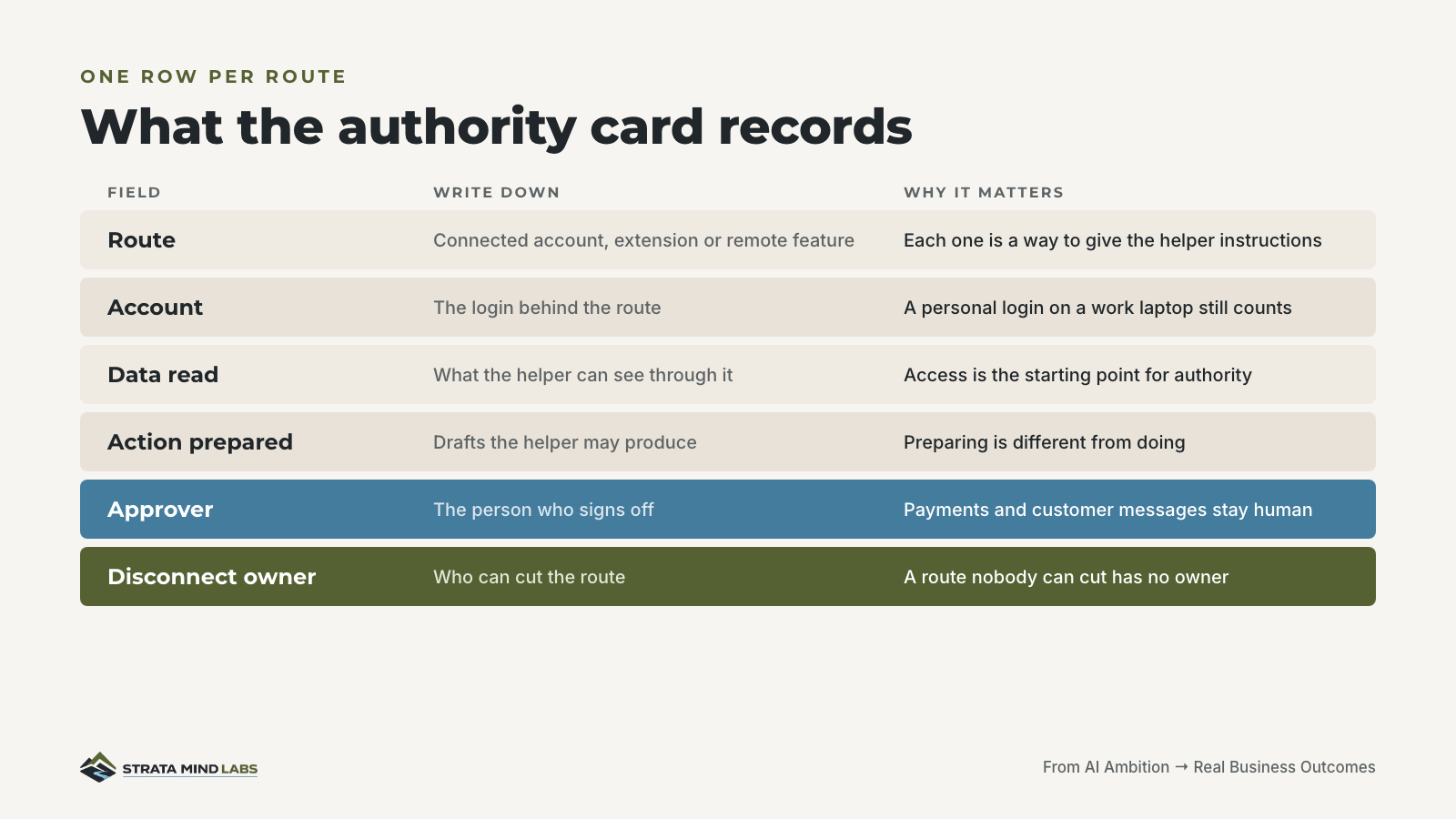
The Agent Action Authority Card keeps those roles in writing. It's a proposed tool with three parts: a path register with one row per route, a one-action boundary and a short test log. A spreadsheet or a sheet of paper works. A route without a named owner goes on the exception list and stays paused until the administrator explains it.
A first session for this afternoon
Bring the company laptop, the owner, the office manager and a blank sheet. Ask the bookkeeper to review any financial connection. Don't paste passwords, tokens or customer records into an AI tool.
Open the helper's connected-account page and the browser extension list. Record one row per route: tool, route, connected account, data read, action prepared, the person who approves, who can disconnect it and the last review date. Then compare the list with what the owner thought the helper could do.
Next, test with a redacted request such as a draft summary of unpaid invoices. Don't connect live bank data just to run it. Ask the helper to name the data it used and to leave payment and customer contact untouched. The reviewer compares the draft with the redacted input and checks an activity log where one exists.
If a route or an action can't be explained, pause it and take the exception to the administrator.
The first useful output is a register and a list of unresolved routes. A 45-minute first session is a planning estimate, not a measured time. It needs no new software, but it does need access to the real settings, a person allowed to disconnect a connection and a private place to record the results.
Five prompts to run this week
Paste only redacted notes. Each prompt hands its checked result to the next one.
Map visible instruction routes
Copy this prompt
Using only the redacted notes below from one helper's connected-account page and browser extension list, make a table with one row per visible instruction route. Include route, account, permission shown, evidence note and unknowns. Do not infer hidden permissions. Do not request passwords or tokens.
What this should tell you: Check that each row traces to a note you supplied, and mark any missing account name, unclear permission or route the answer invented. A visible path list is a starting map. It doesn't show that every route has been found, so collect the missing screen or ask the administrator if the capture looks thin. Carry the checked list and your corrections to prompt 2.
Separate preparation from approval
Copy this prompt
From the checked route list and this owner policy, draft an Agent Action Authority Card. For each route, separate data the helper may read, drafts it may prepare, actions reserved for a person and actions to prohibit. Put unknown where the policy is silent. Do not grant a permission.
What this should tell you: Payments, customer messages and account changes should still sit with named people. Look for any permission the draft added without an owner rule. The card makes the gap between access and authority visible. Approve a boundary for a supervised test only when a reviewer and a disconnect owner have names, then take the card and one redacted request to prompt 3.
Test one read-only request
Copy this prompt
Apply the reviewed card to the redacted request below. Produce a draft summary and cite the input line for every factual statement. List missing data separately. Do not send a message, change a record or prepare a payment. Stop and explain if the request exceeds the card.
What this should tell you: Compare the draft with the redacted input and flag invented invoice facts, a missing line citation or any action outside the card. A bounded draft can be inspected without giving the helper production authority. Continue only if the reviewer can explain every statement and the action stayed inside the boundary. Take the reviewed draft and any defect to prompt 4.
Inspect the exception
Copy this prompt
Compare the reviewed draft and the card with this second redacted case that includes a missing account owner. Identify the exact route or action that cannot be approved. Propose one narrow card change and name the person who must decide. Do not claim the change fixes unseen routes.
What this should tell you: Look for the specific missing owner, the affected route and a stop recommendation. A generic caution is a failed result. The exception shows whether the card sends a real handoff to a person when the evidence is incomplete. Pause that route until its administrator and the business owner resolve it, or keep the task manual, then take the corrected card and both cases to prompt 5.
Prepare the owner decision
Copy this prompt
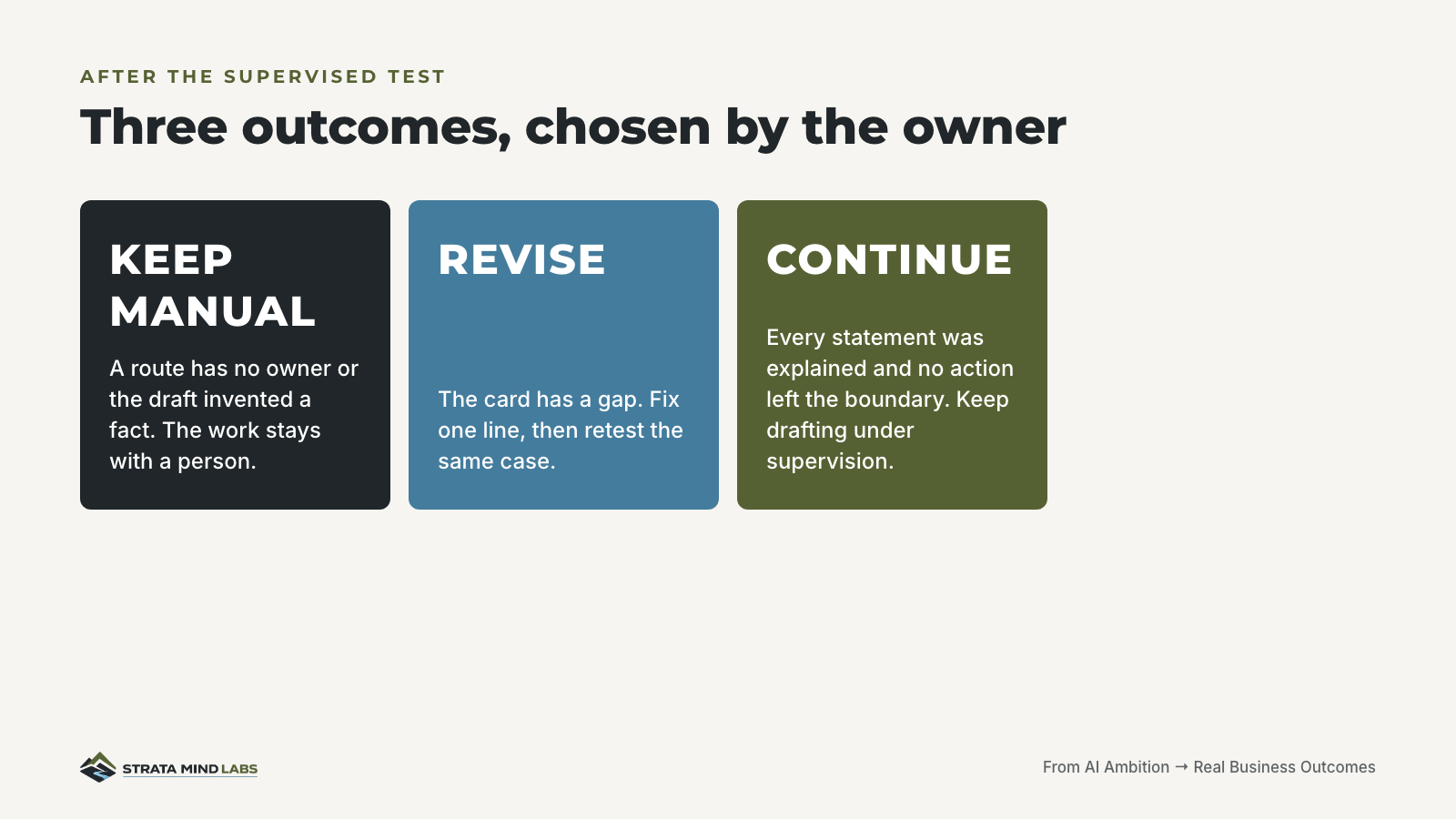
Using the checked route list and two supervised cases, prepare three choices: keep manual, revise and retest or continue supervised drafting. For each, name the evidence, unresolved route, reviewer, data boundary, disconnect owner and stop rule. Claim no savings or deployment readiness.
What this should tell you: Check that the proposed choice cites both case records and leaves unresolved routes visible. Reject a confident answer that has no human decision owner. The output is a decision record, not permission for the helper to act on its own. The owner chooses once the administrator has confirmed the actual settings. Record the decision, date the next review and keep any exception open until it's verified.
Reading the full result
The register makes an access boundary reviewable. Its value would be avoided rework and clearer ownership, and neither has been measured here. Later value would take a count of review effort, missed routes and rework avoided, compared with the current manual process.
An unknown permission stays unknown. Live access needs the administrator to confirm the actual settings and the owner to approve the data boundary.
What to do this week
A fair limit on all this
One case isn't a frequency. The Register describes a single researcher's demonstration, and nothing I read says how common that route is. Mercury and Cloudflare describe their own systems or proposals, and a vendor's description stays a vendor's description until you test it against your own setup. Mercury also publishes support documentation on managing connected agents. I couldn't open it from here, so nothing above rests on it.
NIST supports mapping context and repeating the review in general terms. It doesn't validate this card. The four-step sequence, the card, the 45-minute estimate and the five prompts are Strata Mind Labs proposed practice. No standard requires them and nobody has measured them. And no return is assumed. What you get from the first session is a register and a list of what nobody could explain.
CIO Question of the Day
Which route into your AI helper does nobody in the office own?
Sources
- Powers, S. (2026, November 5). Agentic banking is here to stay. Here's how Mercury keeps you in control. Mercury. https://mercury.com/blog/introducing-mercury-agent-controls
- Cloudflare. (2026, November 5). Agents aren't humans (but they kinda are). Cloudflare Blog. https://blog.cloudflare.com/trusted-agent-delegation/
- Lyons, J. (2026, November 5). Anthropic won't fix a Claude Dispatch flaw that could let attackers execute remote commands across corporate boundaries. The Register. https://www.theregister.com/research/2026/11/05/anthropic-wont-fix-a-claude-dispatch-flaw-that-could-let-attackers-execute-remote-commands-across-corporate-boundaries/5307684
- National Institute of Standards and Technology. (2024, July 26). Artificial Intelligence Risk Management Framework: Generative Artificial Intelligence Profile (NIST AI 600-1). https://www.nist.gov/publications/artificial-intelligence-risk-management-framework-generative-artificial-intelligence
- National Institute of Standards and Technology. (2023). AI RMF core (AI Risk Management Framework 1.0). NIST AI Resource Center. https://airc.nist.gov/airmf-resources/airmf/5-sec-core/
List the routes first. Then decide which ones stay connected.
New briefings land as soon as the signal is worth your time.