
Vendor Defaults Change on a Date
GitHub, Microsoft and Anthropic each published a dated change to a default setting this month. None of those notices can tell you whether your account is affected. One row in a register can.
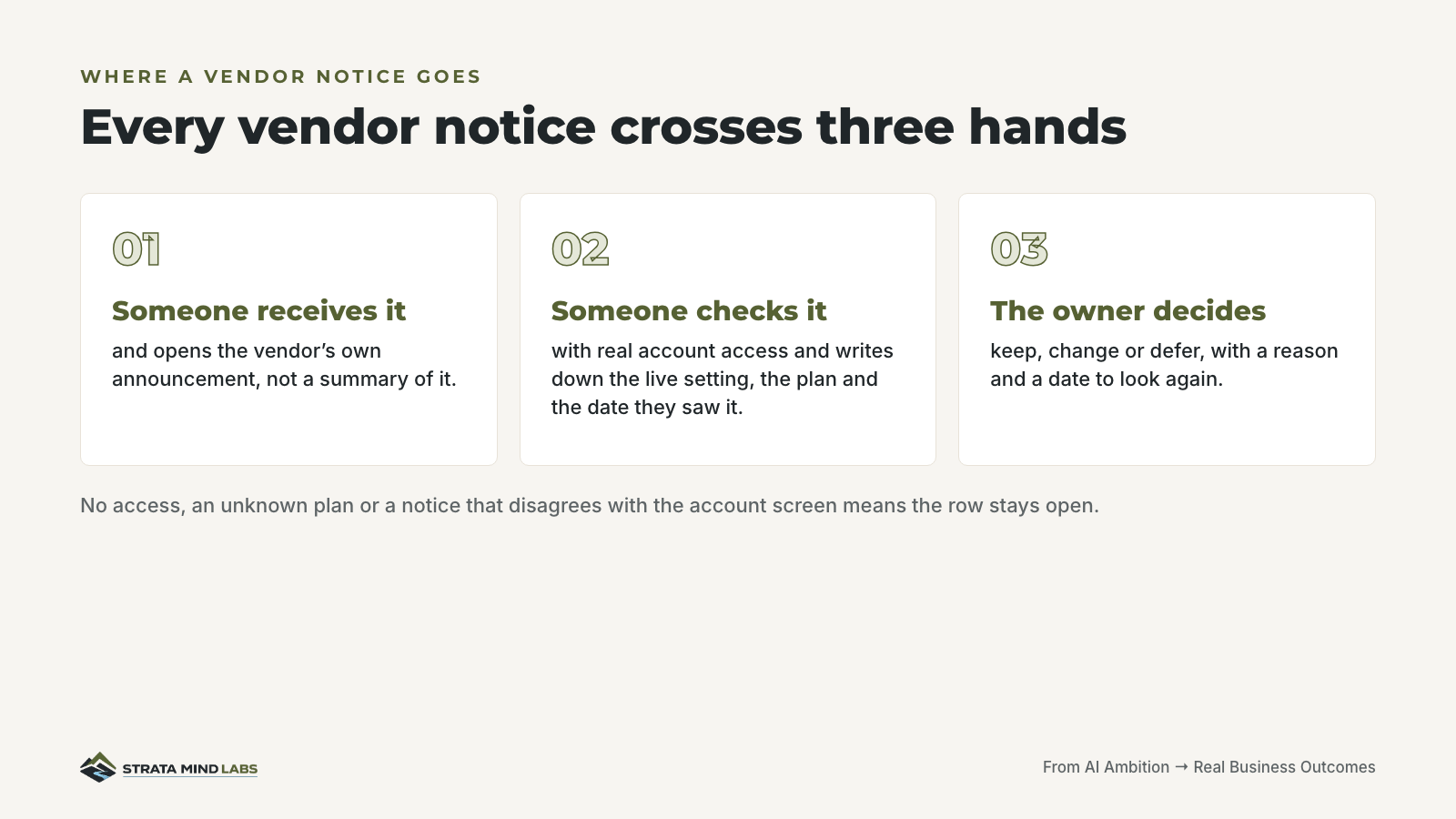
Executive decision: Assign one person to check the next relevant vendor notice against the live account, record what they saw and date it. The owner then keeps, changes or defers the setting. Plan on about 30 minutes for the first notice if access and the announcement are ready. That's a planning estimate, not a measured result.
The vendor picks the date. Somebody inside your business has to notice it before it arrives.
The signal this week
On November 25, GitHub posted a changelog entry for organizations and enterprises on Copilot Business or Copilot Enterprise (source 1). If nobody has chosen how to bill Copilot code review for members with a Copilot license, those reviews "will be billed to your organization starting December 30, 2026." Until then, an unset setting shows as Default (Member) with a notice about the change.
The conditions matter more than the headline. GitHub says a saved Member or Organization choice stays in effect. Accounts without AI Credits paid usage, with a billing lock or with no billable customer get set to Member instead. GitHub also says plainly that organization billing "can increase your organization's spending." Where an enterprise manages the setting, an enterprise owner makes the call.
Microsoft is running a slower version of the same pattern. Its support article KB5135557, published November 10, lays out NTLM signing in two phases (source 2). In the first, Windows clients start offering signing on all connections by default, servers still accept unsigned clients and audit events flag the clients that don't sign. In May 2027, Windows servers begin requiring signing by default and reject clients that don't offer it. The article lists affected versions of Windows 11, Windows 10 Enterprise LTSC 2021 and Windows Server 2016 through 2025.
Anthropic's November 10 launch post for Claude Whiteboards, Claude Sheets and Claude Data sets defaults by plan (source 3). On Team plans all three are on. On Enterprise plans, Whiteboards and Sheets start off, and the post says Claude Data "turns on by default on November 20, 2026." Admins can change these in Organization settings under Artifacts.
All three statements come from the vendors' own pages, and each was checked there for this briefing. None of them says which setting is live in your account today.
Three products, one gap
Each notice tells you what changes and when. It can't tell you whether you have the product, which plan you're on or what someone already chose. That answer lives in the account screen, and it only gets read if someone is assigned to read it.
The effect lands somewhere different each time. GitHub's change lands on the bill. Microsoft's lands on logins, and its own article added a known issue on November 20: some third-party proxies, single sign-on tools and packaging tools may fail authentication after the update. Microsoft describes the registry override for that as a temporary workaround only. Anthropic's changes which features your people see switched on.
A bookkeeper can judge the first. The IT provider owns the second. The third needs whoever approves what your AI tools can touch.
The fair counterargument is duplication. A competent IT provider may already track vendor notices and record account changes. Ask to see one recent dated decision. If it exists and it reached the owner, use that process and skip this one.
One row per notice
The register is a sheet or a paper table. One row holds the vendor and plan, the notice link and date, the setting someone actually saw, the announced default, the possible effect on the bill or on logins or data sharing, who checked, where the evidence lives and what the owner decided, with a reason and a review date. A last column carries any open exception and the next person to contact.
Here's a reconstruction for illustration, not a client account. A shop with an eligible Copilot Business organization asks its admin whether the code review billing choice is saved. If it is, the row records the saved value and the owner moves on. If it's unset, GitHub's notice says it may move to organization billing on December 30, subject to the conditions above. The shop's actual plan, paid usage state and choice stay unknown until the admin looks.
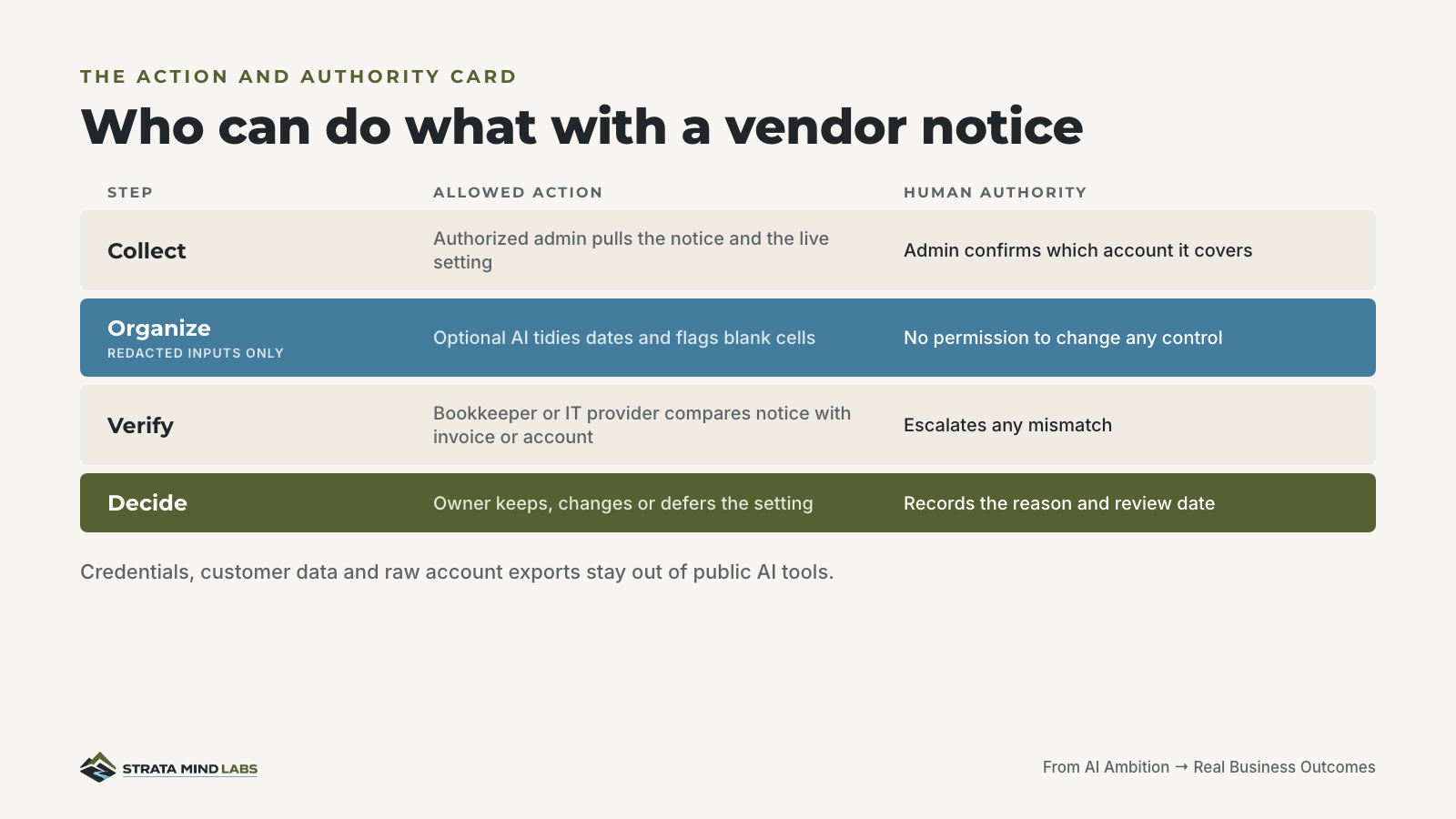
An AI tool can help, within limits. Fed redacted notes, it can format dates and flag blank cells. It can't see a live setting unless an authorized person supplies it, and it can't approve a billing or security change.
If the vendor notice and the account screen disagree, stop the routine decision. Keep both records and ask the vendor or the account administrator to reconcile them. Don't apply a security workaround from a summary, including this one.
Five prompts to run this week
Run these in order in the AI tool you already use, with redacted notes only and no credentials or customer data.
Capture the notice
Copy this prompt
Using only the redacted vendor notice I paste, return a row with vendor, product, plan, exact setting, current default, announced future default, effective date, direct source URL and any conditions. Write UNKNOWN for missing fields. Do not infer that our business has the product. Input: [paste notice excerpt and URL].
What this should tell you: Check the effective date, the plan scope and the source URL, and treat missing conditions or a secondary link as warnings. The row describes a possible change. It says nothing yet about your account. The owner decides whether an authorized account check is worth doing because the product and plan might match.
Compare the live account
Copy this prompt
Compare the notice row with this redacted note from an authorized person viewing the live account. Return product, plan, observed setting, observation date, checker and evidence location. Mark mismatches and UNKNOWN fields. Do not claim direct access to the account. Input: [paste redacted account note].
What this should tell you: Look for the checker's name, the observation date and the live value. A guessed plan or a stale screenshot leaves the row open. Proceed only if the notice and the account refer to the same product and plan.
Map the consequence
Copy this prompt
Use the matched row and the reviewer's redacted notes to list the possible bill, login or data-sharing consequence. Label each point FACT from the vendor, LOCAL OBSERVATION or INFERENCE. List the missing evidence. Do not invent costs, user counts or outage estimates. Input: [paste reviewed notes].
What this should tell you: Every consequence should trace to the vendor or to something someone saw in the account. A dollar figure with no invoice behind it is a warning. The owner decides what more evidence is needed before accepting the effect.
Route the exception
Copy this prompt
From the redacted row, list every unresolved item, the person with access or authority to resolve it, the evidence needed and a proposed follow-up date. Keep security and billing changes with authorized humans. Input: [paste exception notes].
What this should tell you: Every UNKNOWN needs a named person and an evidence request. A blank contact is an open exception. The owner decides whether to hold the decision until the vendor or administrator answers.
Draft the owner decision
Copy this prompt
Draft one decision row from the verified notice, live account check, consequence review and written exception disposition. Include source link, date, observed setting, choice to keep, change or defer, reason, approver and next review date. Separate facts from inference and leave unsupported fields UNKNOWN. Input: [paste approved redacted notes].
What this should tell you: Check the source trace, the choice, the named approver and the open items. Strike any claim of savings or reduced risk that has no measured evidence behind it. The owner signs only after the authorized reviewer has confirmed the account and the exceptions.
What to do this week
A fair limit on all this
Three vendor notices in one month show that dated defaults are a live operating pattern. They don't measure how often businesses miss one, and they don't put a dollar figure on missing it. Vendor statements are vendor statements about their own products. Microsoft's NTLM phases matter only if you run the affected Windows versions.
The register, the authority card, the prompts and the 30-minute estimate are Strata Mind Labs proposed practice, not an external standard. They haven't been measured at a client. No savings or risk reduction is assumed. One complete row proves the handoff ran once. Whether it earns a place in your routine depends on whether that first row catches a real decision.
CIO Question of the Day
When your checker opened the live account, did the setting match what the vendor's notice assumed?
Sources
- GitHub. (2026, November 25). Copilot code review billing will default to the organization. GitHub Changelog. Retrieved November 27, 2026, from https://github.blog/changelog/2026-11-25-copilot-code-review-billing-will-default-to-the-organization/
- Microsoft. (2026, November 10). NTLM signing security improvements in Windows (KB5135557). Microsoft Support. Retrieved November 27, 2026, from https://support.microsoft.com/en-us/help/5135557
- Anthropic. (2026, November 10). Introducing Claude Whiteboards, Claude Sheets, and Claude Data. Claude. Retrieved November 27, 2026, from https://claude.com/resources/articles/sheets-whiteboards-data
The notice says what changes. Your account says whether it's you.
New briefings land as soon as the signal is worth your time.