
The spending cap is also a service decision
A first-session brake sheet for usage-billed software: one sheet, five prompts and an owner decision on alerts or a pause

Executive decision: Choose a hard cap only after someone maps every workflow that depends on the capped product and names the person who can restore it. Until then, an alert keeps service running while a human reviews the spend. The owner decides whether a possible overrun costs more than an interruption to bookings, messages or other customer work.
A cap protects the bill by stopping the work, and the work is what your customers pay for.
The signal this week
Cloudflare's post dated November 13 introduces Spend Management in beta for pay-as-you-go Workers and Durable Objects. Owners can set a spending limit and alert thresholds in the dashboard (Billing, then Spend limits), through a command line tool or through an API. Once a cap is enforced, new invocations of that product are rejected. Cron Triggers and Queue consumers on Workers pause, while static assets keep being served. The pause ends when the owner raises the limit above the spend already accumulated, turns off or deletes the policy, or the next billing cycle begins (source 1).
The billing documentation narrows that claim. A Workers limit counts Workers usage across the whole account and leaves out Durable Objects, Workers AI, KV, R2 and the other products an application might also use. It can't target one Worker, one Durable Object namespace or one billing metric (source 2).
Three more lines in the documentation change how you'd use it. "A limit does not guarantee a maximum invoice amount," because usage reporting and blocking take time and some charges continue during a pause. A limit created in the dashboard doesn't automatically get an email recipient, and the docs describe adding one through the command line. And a new limit applies to usage already recorded in the current period. The docs' own example: a $50 limit saved after $60 has accrued can trigger a pause as soon as Cloudflare evaluates it (source 2).
Two smaller details matter too. The status "Limit reached" records a threshold event and doesn't confirm that blocking has finished spreading. And the invoice, not the dashboard estimate, is the final record of charges (source 2). The blog says cost data appears in near real time, under 10 minutes (source 1). My read: that's a reporting interval, not a promise of a cutoff to the dollar.
Take a shop whose booking page, quote form and text-message handler all run on Workers. This is an illustration, not a known case. One product-wide cap would stop all three at once, and nobody chose that trade for each path separately.
Anthropic's November 13 guide to always-on agents adds one point for any automation that works unattended. Such runs use the user's access, and the guide recommends keeping real credentials in a proxy outside the agent and says user review is still necessary for the most important decisions (source 3).
Alert or pause is the owner's call
Two questions, in order. First, which work relies on the billed product? The product scope matters more than the service name on the invoice, because one cap can touch several applications. Second, what happens at the threshold: a person gets an alert while work continues, or operations block and a restoration plan starts.
The administrator checks permissions. The bookkeeper supplies the bill. The owner decides whether an interruption is acceptable and who can lift it. Four answers go on the sheet before any cap goes live.
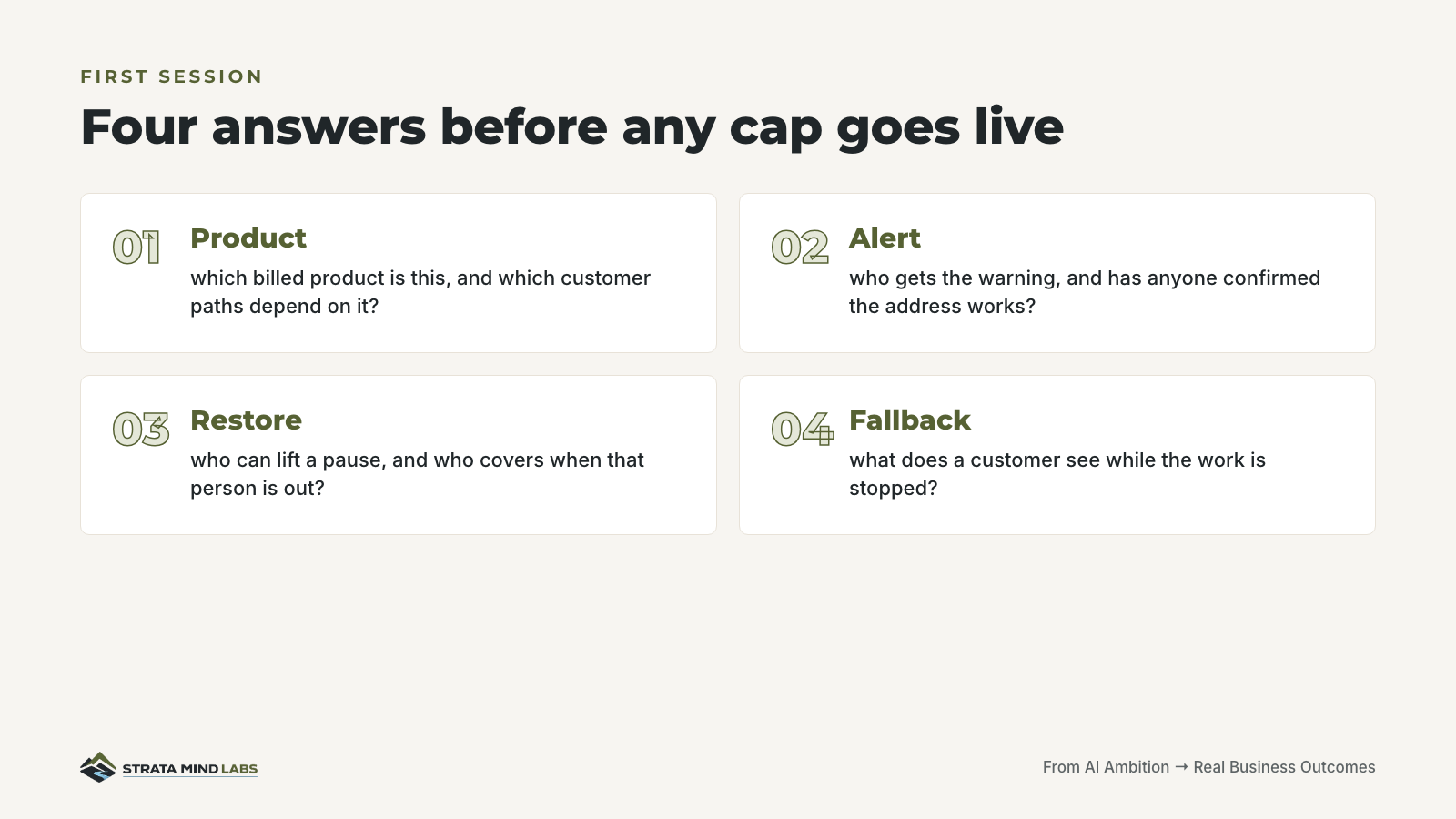
This is a Strata Mind Labs operating framework. It isn't a Cloudflare endorsement and it isn't a validated savings model. A blank cell is a reason to delay the hard cap.
Forty-five minutes with the billing page
The setup below is a reconstruction of a shop office reviewing a usage bill. It's an exercise, not client work and not a measured result. You need the billing page, the last invoice, a list of the customer-facing workflows and three people: the administrator, the bookkeeper and the owner. Forty-five minutes is a planning estimate for one account with accessible billing history. No live limit changes in this session.
In the first ten minutes, the administrator copies the product scope, billing cycle and current usage from the billing page. The bookkeeper compares them with the last invoice. In the next fifteen, the owner lists every customer path that uses the product and writes down what a customer would see if it paused. The last twenty go to the choice: alerts only, a proposed cap for later approval or no change until the dependencies are checked. Put the restore owner and a backup next to the choice.
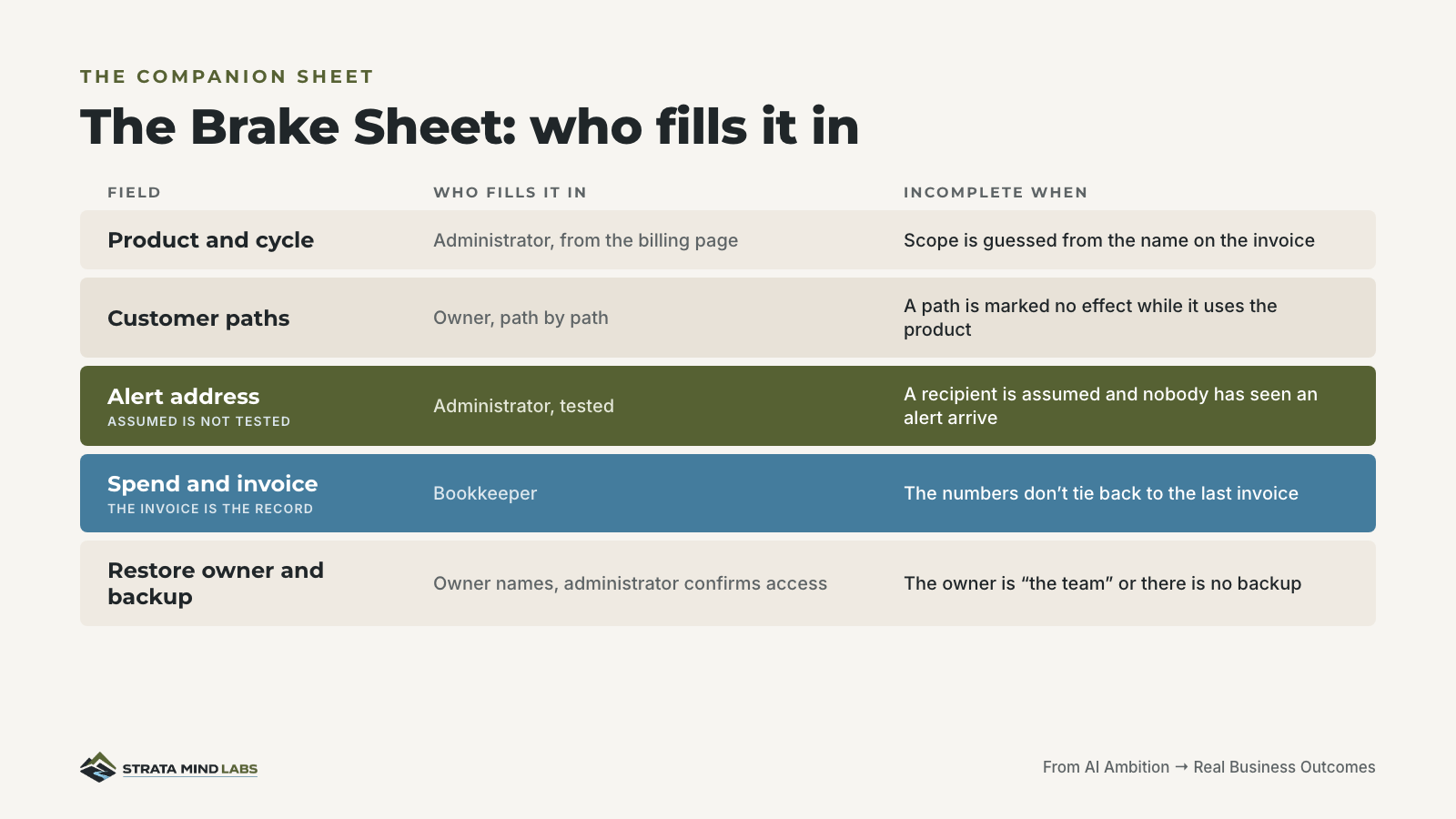
The full sheet has fifteen fields, one row per billed product. The graphic groups them into five. Keep credentials and customer data off it.
A sample row, and it's synthetic. Product: a sample Workers account. Billing cycle: unknown. Current spend: unknown until someone opens the page. Customer paths: booking page and quote form. Alert address: unverified. Restore owner: blank. Choice: hold. Evidence missing: every dependency. That's a normal first pass.
A passing first output is one reviewed decision row with the gaps still visible. It doesn't certify that you've found every dependency, and it doesn't mean any limit is set correctly.
Don't test a hard cap on a live booking or checkout path. If the account scope is unclear, stop at the inventory and ask the administrator to trace dependencies. If a limit is already active, confirm the alert recipient rather than assuming the dashboard set one.
Five prompts to run this week
Use these with the Brake Sheet and redacted billing information. The machine can organize evidence. A person verifies every product setting and owns every change.
Map the billed product
Copy this prompt
Using the attached redacted invoice, current usage screenshot and service list, make a table with product, account, billing cycle start, current period spend, included usage, known dependent workflows and missing evidence. Distinguish what the documents state from what you infer. Leave unknown fields blank. Do not recommend a cap yet.
What this should tell you: Check the product and account columns for exact names, and look for blank dependency fields or a billing cycle assumed to start on the first of the month. Missing dependencies mean the cost of an interruption is still unknown. Proceed only if the administrator confirms the scope.
Trace the customer path
Copy this prompt
Using the verified product table and a list of booking, checkout, messaging, scheduled jobs and internal tasks, map each workflow to the billed product. For each, state the customer-visible effect of blocked operations, fallback method, recovery owner and the evidence that supports the link. Mark any dependency without evidence as unconfirmed. Do not invent a client incident.
What this should tell you: Look for rows that say no effect while still using a capped product, and flag missing fallbacks and recovery owners. A cap on a shared product can interrupt several paths at once, so the risk sits in those paths and not in the policy name. The owner decides whether any customer path makes a live hard cap unacceptable without a tested fallback.
Compare alert and pause options
Copy this prompt
Using the verified dependency map, last invoice and the owner's stated tolerance for an overrun, compare alerts only, a product-wide hard cap and no change pending more evidence. Show what continues, what stops, who is notified and what cannot be inferred from the source data. Do not invent cost savings or a universal threshold. Treat the provider invoice as the final charge record.
What this should tell you: Warning signs are a comparison that claims the cap guarantees a maximum bill or isolates one Worker, or one that never states an unknown overrun amount. The control trades continued service against spending exposure, and the lag in measurement rules out an exact cutoff promise. If the overrun and the cost of a pause can't be compared, keep alerts and gather data.
Write the restoration path
Copy this prompt
For the provisional control, draft a one-page action card with alert address, primary and backup contact, account permission needed, steps to review a limit event, approved ways to restore service, customer communication owner and next review date. Label every step that requires a human. Use only documented provider actions and the supplied roster. Leave any missing permission or backup blank.
What this should tell you: Inspect the named contacts and permissions. A generic "team" owner, an absent backup or a restoration command nobody has verified is a warning sign. A cap without a reachable operator is a planned outage with no recovery desk. The administrator confirms access and the owner approves the path before any live cap is enabled.
Set the human decision record
Copy this prompt
Combine the verified product table, customer path map, option comparison and restoration card into a decision record. Include source links, facts, assumptions, remaining unknowns, a first-session output, an owner decision field and a separate implementation approval field. State that no live setting was changed in this exercise. Recommend a reversible next test in a noncustomer environment where possible. Do not mark an unapproved cap as active.
What this should tell you: Look for unsupported "approved" or "active" labels, missing source links and any test that could interrupt customers. The machine organizes the record but can't accept the business consequence. The owner chooses alerts, a later approved cap or more investigation, and implementation waits for the administrator's verified scope and access.
The owner decision
Complete one Brake Sheet today. If any customer-facing path depends on the capped product and has no fallback, choose alerts while the owner and administrator map the recovery path. If the path is internal and can pause safely, record a proposed cap with a named restoration owner. Any production change needs a separate approval and a check on who actually receives the notification.
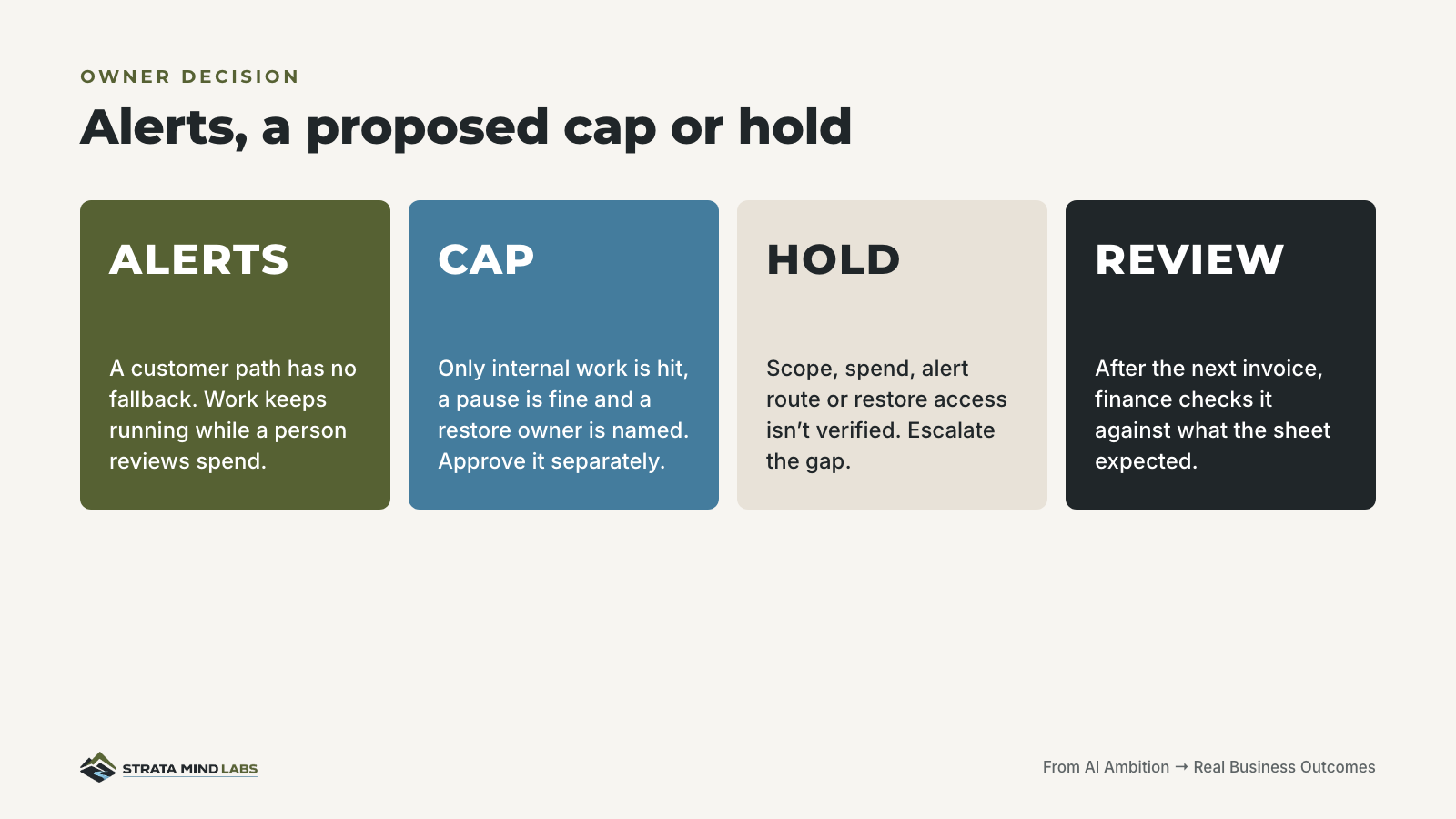
Finance checks the next invoice against the expectation on the sheet. The strongest argument against a hard cap is plain arithmetic: a paused customer path can cost more than the overrun it prevents. Only the owner can price that, from real jobs and real recovery options.
What to do this week
A fair limit on all this
Cloudflare's post and documentation describe Cloudflare's own control, which is in beta. This briefing has no independent measurement of how it behaves in practice and no evidence of a small business saving any stated amount. Anthropic's guide is vendor architecture advice. It doesn't show that any shop runs those components or that they reduce a bill.
The sheet, the alerts-first rule and the forty-five minute estimate are Strata Mind Labs proposed practice, and the time is a planning estimate, not a measured result. No dollar threshold follows from the sources. The owner sets one from actual bills and the cost of interruption. The prompts are drafts and haven't been run against your records.
Other providers have their own settings, so check each one's terms. No return is assumed. What you get is a sheet that names the product, the dependent work, the alert route and the person who can restore service. To check the Cloudflare claims yourself, open the two Cloudflare pages below and compare them with what your own billing page shows.
CIO Question of the Day
Which usage-billed service in your business could stop customer work at a limit, and who can lift the stop on a Friday evening?
Sources
- Cloudflare. (2026, November 13). Introducing Spend Management: Spending limits and alerts for Cloudflare. Cloudflare Blog. https://blog.cloudflare.com/spend-management/
- Cloudflare. (n.d.). Spending limits and alerts. Cloudflare Billing docs. Retrieved November 16, 2026, from https://developers.cloudflare.com/billing/manage/spend-management/
- Hu, W. (2026, November 13). Building always-on agents. Claude by Anthropic. https://claude.com/resources/articles/building-always-on-agents
Don’t cap what you can’t restore. A cap without a reachable operator is a planned outage.
New briefings land as soon as the signal is worth your time.