
The Finance Agent Needs an Authority Gate
A practical first session for a single invoice exception workflow
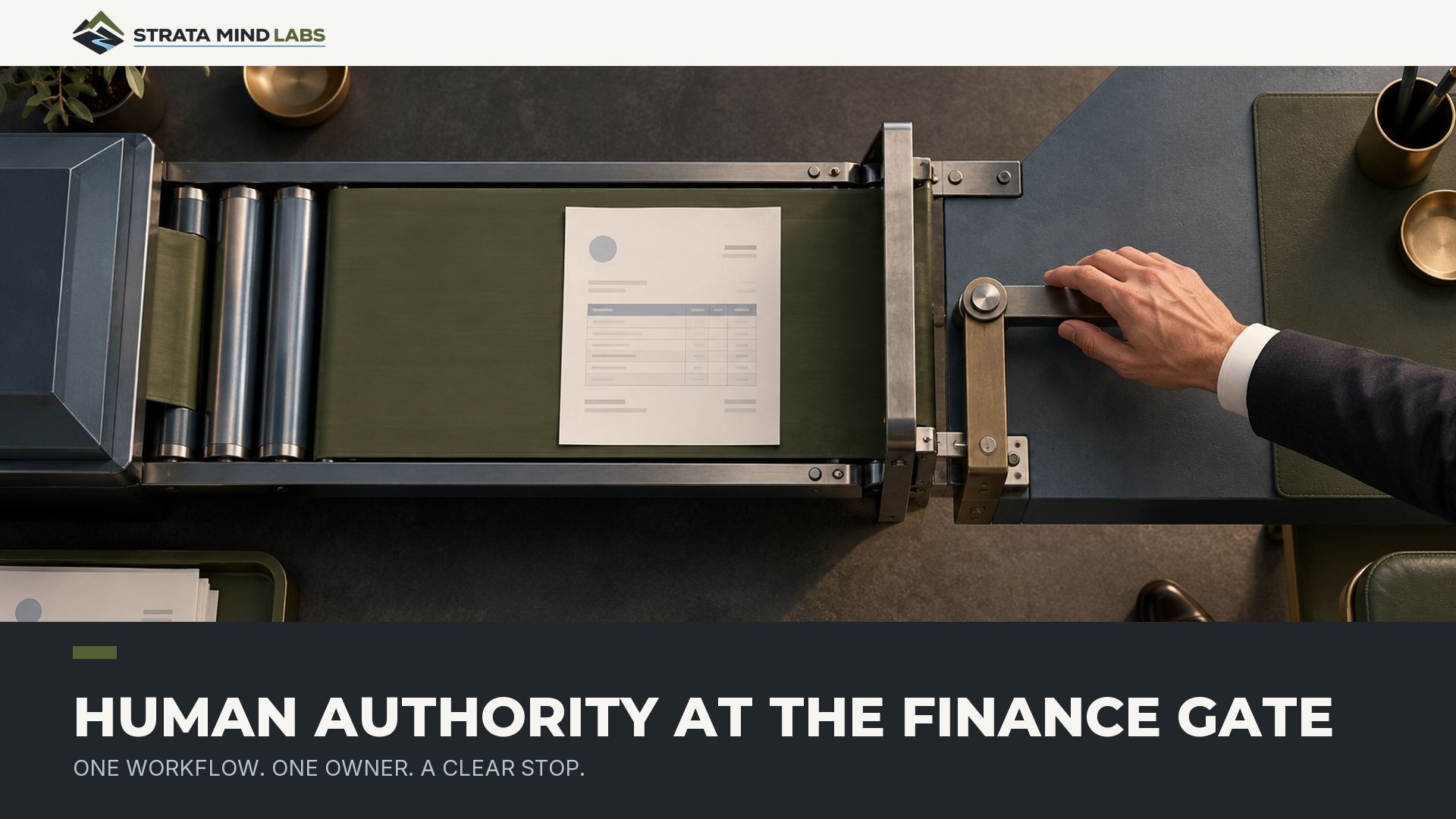
Executive decision: Approve a 90-minute planning-estimate exercise on one invoice exception using redacted records and an existing spreadsheet. Keep the assistant view-only for the exercise. The controller decides whether any draft step deserves a controlled test. No invoice is posted by the assistant in this first session.
Putting a chat window in front of your ERP doesn't change who owns the ledger. Decide what the assistant may touch before anyone asks it to.
The signal this week
Oracle announced a collaboration with OpenAI on October 27. Per Oracle's announcement, plugins in ChatGPT on Oracle AI Workspace would let employees access information, complete approved business workflows and take action alongside Oracle systems. Oracle says the workspace is designed to connect Fusion Applications, NetSuite and other enterprise tools, and that it keeps governance, approvals and controls in place.
Read the fine print before you read the headline. Oracle's own disclaimer says the development, release, timing and pricing of the features it describes may change, and that the announcement shouldn't be relied on in purchasing decisions. NetSuite's documentation adds that some agent capabilities exist only in NetSuite Next, which is being made available in phases, so those features "may not yet be available in your account."
Slack made a smaller but related move the next day. Its October 28 post on event-triggered tasks says "You choose between 'ask me first' and auto-approval." Approval mode is becoming a setting you pick. That's a useful signal about where the market is heading. It says nothing about what Oracle's planned features will do for you.
What the sources show and don't
NIST's Generative AI Profile, published in July 2024, says generative AI may call for different levels of oversight or different human-AI configurations to manage its risks. It adds that an organization's use may warrant additional human review, tracking and documentation. That supports the idea of matching oversight to the job. It doesn't say a staged ladder reduces errors or improves throughput in an invoice workflow.
Three of these four sources are vendor materials describing vendor plans and products. None documents a buyer who ran this and got a measured result. To check availability for your own account, ask your Oracle representative for written confirmation. A NetSuite Administrator can also look at the AI settings page the documentation points to, under Setup, then Agent Management.
The strongest counterargument is operational. Your normal approval queue may already be fast and auditable. An assistant adds review, permission and logging work. If the first session can't find a real delay or a quality gap, keep the existing workflow and drop the agent proposal.
Four rungs, one owner
The question is concrete. What may an assistant read, what may it prepare and which person can authorize a financial change? SML's proposed answer is an Agent Authority Ladder with four rungs. Rung 0 is no connection. Rung 1 reads only records the authorized user can already see. Rung 2 prepares a draft that a controller reviews in the system of record. Rung 3 executes only a named, tested action after explicit approval.
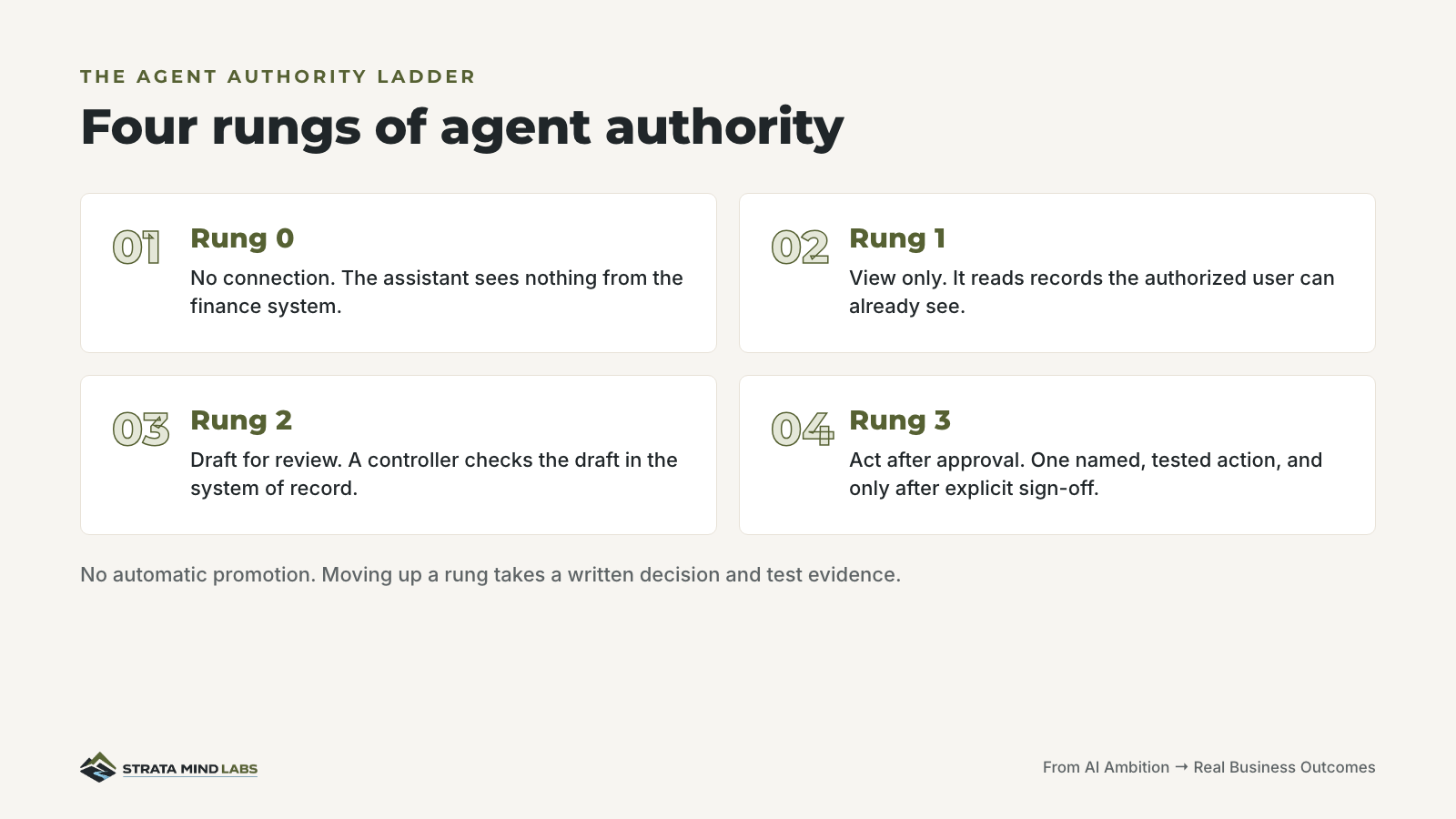
A later autonomous rung would need separate audit evidence and written authorization. Nothing promotes itself. Finance owns the transaction, the ERP stays the record of truth and the controller owns exceptions.
The first useful output isn't an integration. It's an authority card. This only counts as an Intelligence-First Operating Model if it makes the next human decision clearer.
One invoice exception in 90 minutes
This is a labeled reconstruction built from public sources and a redacted invoice scenario. It isn't client work and it doesn't claim measured savings.
You need a written invoice exception policy, three synthetic or redacted examples, the current approval steps, a controller and a blank authority card. Use a local file or an existing spreadsheet. Don't paste live account numbers, names, payment details or confidential records into a tool your company hasn't approved.
Pick one exception, such as a duplicate invoice number with a mismatched amount. Record the source fields and the current owner. Mark which fields a view-only assistant may inspect. Ask it to draft a discrepancy note with source references and missing fields. Then have the controller compare the note with the policy and each source record.
Last, fill in the card. It carries the allowed action, the forbidden action, the approver, the evidence log and the stop condition.
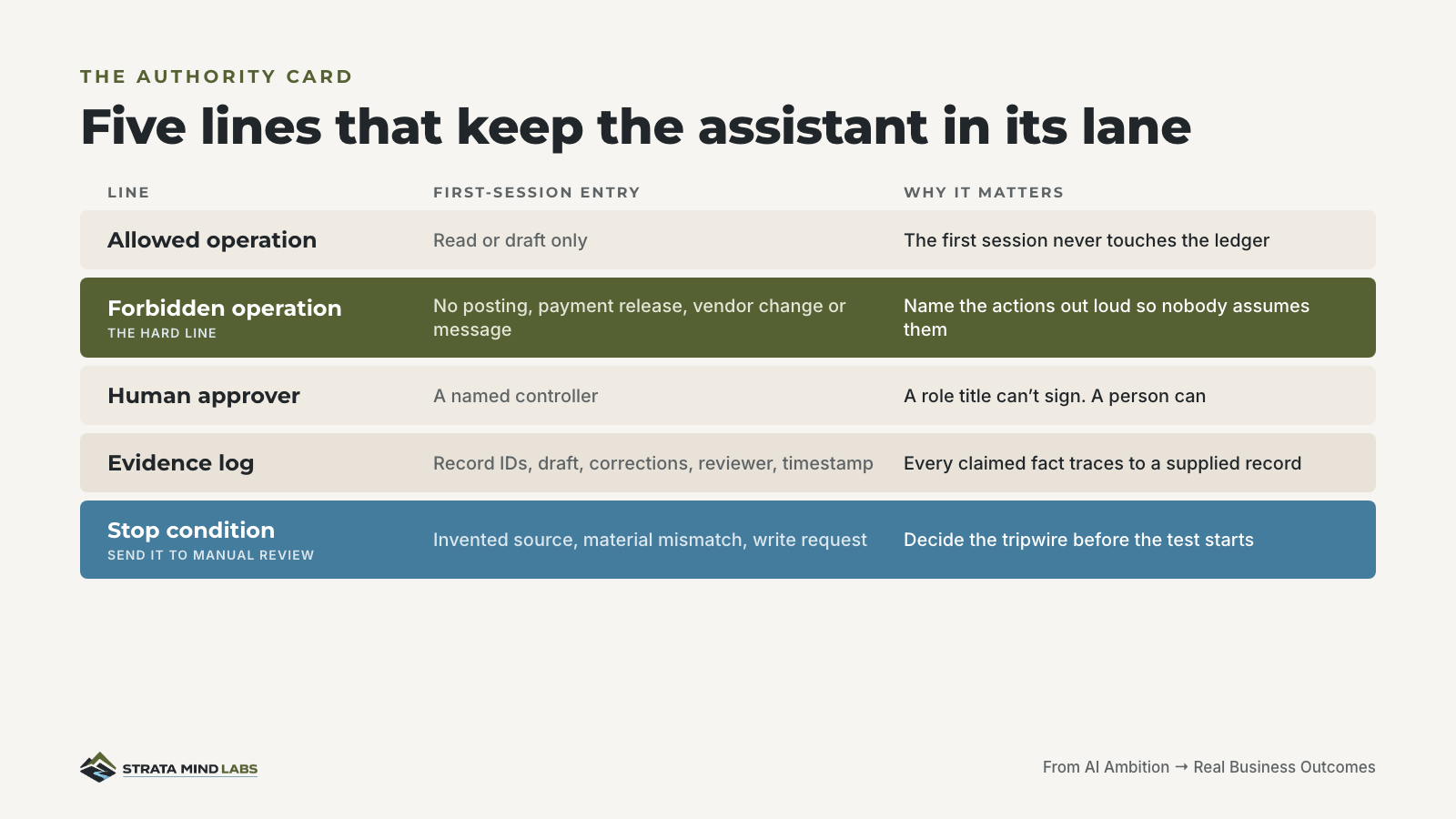
The expected first output is one signed card and a redacted discrepancy note where every claimed fact traces to a supplied record. Ninety minutes is a planning estimate, not an observed result. Stop if the assistant invents a record, misses a material mismatch or suggests posting. The exception path is manual review in the ERP.
Who decides what
The CIO or owner confirms data access. The controller signs the action boundary. The ERP administrator confirms actual permissions before any connected test. A promotion needs a written test set, an observed error record, the review effort and a rollback path. Nothing in this briefing grants a live connection.
Five prompts to run this week
Run these in order on one exception. Use redacted records only and have a person check every result against the source.
Map the current path
Copy this prompt
Using only this redacted invoice exception policy [paste] and current workflow description [paste], list the source fields, current approval steps, owner and missing information. Cite the supplied line or record for each fact. Do not infer a policy that is absent.
What this should tell you: whether every field and approval step points to supplied material. Missing policy text or an invented approver is a warning. The map shows where authority already sits and where an assistant might add work. Decision: the controller accepts the map only if it matches the system of record.
Set the data boundary
Copy this prompt
Given the approved process map [paste], the redacted sample records [paste] and the approved data policy [paste], separate fields into allowed for this test, restricted and missing approval. Explain each choice using supplied policy. Do not request live identifiers.
What this should tell you: whether the model claims a field is safe to share without policy text to back it up. Missing policy means restricted by default. A useful draft doesn't justify copying sensitive finance data into an unapproved tool. Decision: the CIO or data owner signs the allowed field list before the test continues.
Draft the discrepancy note
Copy this prompt
For this approved redacted invoice example [paste] and exception policy [paste], draft a discrepancy note. Show the source field for each statement, list unanswered questions and state that no posting or payment action is authorized. Do not make up a vendor response.
What this should tell you: whether each sentence matches the supplied record. A made-up amount, approval or payment instruction is a stop signal. The draft earns its keep only if the controller can verify it faster than writing it by hand. Decision: the controller accepts the draft for review or records the error and stops.
Test the authority rung
Copy this prompt
Using the verified draft [paste], the process map [paste] and the allowed field list [paste], complete an authority card with current rung, permitted operations, forbidden operations, named approver, evidence log, exception path and stop trigger. Propose no live write access.
What this should tell you: that a named human still sits at the posting gate and the log captures source records and the reviewer's decision. A missing owner or rollback is a warning. A permission boundary only works when a person can enforce it. Decision: the controller signs a view-only or draft-only rung if every required field is filled.
Frame the next decision
Copy this prompt
Given the signed authority card [paste], the three redacted test outcomes [paste] and review minutes [paste], draft a one-page keep manual, repeat draft-only test or request controlled integration decision. Separate observed facts, calculations, inference and prediction. State open evidence and a stop condition. Leave the decision to the human owner.
What this should tell you: whether you can trace each claim, how long review took and which errors are still open. Reject any claimed saving or readiness score that has no measured record behind it. The first session earns a decision about the next test, not production authority. Decision: the controller and the CIO choose the next rung only after reviewing errors, effort and permissions.
How to read the result
The value is a traceable draft and a clear authority decision. What stays uncertain is real product access, the error rate and the review cost. The controller owns the finance action.
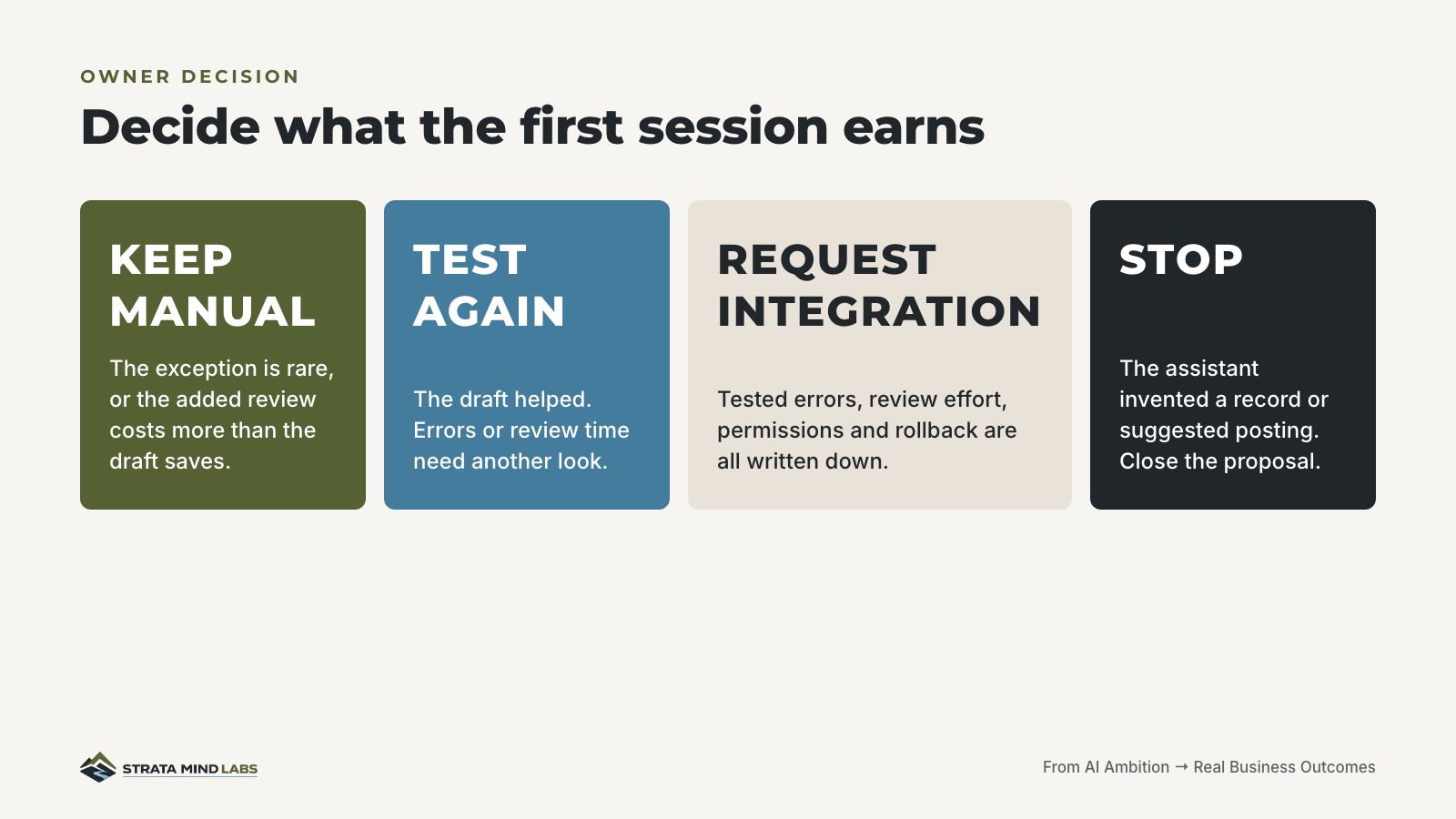
The next human decision is simple to state. Keep the current process, or fund a controlled draft-only test with a defined error and time record. Pick that rule before you see the results, or every reader will interpret the same session their own way.
What to do this week
A fair limit on all this
One exception in one session is one case. It isn't a frequency, and it proves nothing about savings. Oracle, NetSuite and Slack describe their own products and plans. They don't measure what any buyer got. The four-rung ladder, the 90-minute session and the stop conditions are SML proposed practice, not sourced benchmarks. No return is assumed anywhere in this method.
If the exception is rare or the existing queue already works, the right result is a signed card that says keep it manual. That's a fine outcome. It cost you 90 minutes and it settled the question.
CIO Question of the Day
If an AI assistant touched one finance workflow tomorrow, could you name the highest rung it's allowed to reach and the person who signed for it?
Sources
- Oracle. (2026, October 27). Oracle reinvents enterprise computing for the AI era with OpenAI. https://www.oracle.com/news/announcement/ai-world-oracle-reinvents-enterprise-computing-for-the-ai-era-with-openai-2026-10-27/
- Oracle. (n.d.). Managing AI in NetSuite. NetSuite Applications Suite. https://docs.oracle.com/en/cloud/saas/netsuite/ns-online-help/article_8155834768.html
- Autio, C., Schwartz, R., Dunietz, J., Jain, S., Stanley, M., Tabassi, E., Hall, P., & Roberts, K. (2024, July). Artificial intelligence risk management framework: Generative artificial intelligence profile (NIST AI 600-1). National Institute of Standards and Technology. https://nvlpubs.nist.gov/nistpubs/ai/NIST.AI.600-1.pdf
- Slack. (2026, October 28). Slackbot: Delegate more work, in more places. https://slack.com/blog/news/slackbot-proactive-ai-updates
The interface changed. The owner of the ledger didn’t.
New briefings land as soon as the signal is worth your time.