
The AI Provider Behind Your Software
A three-tool register for the owner who needs to see where customer information goes
Executive decision: An AI feature can send a customer note through a provider the shop did not select directly. Put the office manager on a three-tool provider map this week. The owner decides which features may handle customer information after reviewing the map's unknowns. A 45-minute first session is a planning estimate, not a measured result.
A customer note typed into one app can end up with a company the shop never chose.
The signal this week
Notion's advisory, updated November 9, says one of its vendors, Fireworks AI, notified it on November 6 of a security incident affecting fewer than 1% of Notion workspaces. Notion used Fireworks for classification jobs behind its Insights feature and as a general inference provider for open-weight models inside the product (source 1).
The timeline has two parts. On the evening of November 2, Fireworks told Notion that a small set of data had been accessed. Notion says that set held synthetic AI testing data and no customer data, and that it disconnected from Fireworks by the next morning. On November 6, Fireworks said customer data may have been accessed. On November 8 it confirmed a new dataset. Notion says that dataset included Notion AI chat transcripts used for Insights, and that for the vast majority of affected workspaces the chats carried no author or workspace label (source 1).
Notion has disabled Insights while it investigates and says it is no longer serving open-weight models through Fireworks. Its advice is narrow. If Notion hasn't contacted you, it hasn't identified your workspace as affected and no action is needed right now. Affected customers should treat the data as exposed and rotate any passwords, API keys or credentials they pasted into Notion AI during the incident timeframe. The notice doesn't define that timeframe, and it says the investigation is ongoing.
Fireworks tells its own story on its own page, first published October 9 and last updated November 9. A third-party cloud provider that hosted Fireworks research machines had a security incident on October 23. On October 24, Fireworks says, an unauthorized party used that access to reach its development machines and run a workload that led to additional customer data impact. Fireworks reports effects on account and billing information, on resource metadata and, for a limited set of accounts, on secrets, datasets and incomplete models. It says payment card numbers aren't stored and weren't affected. It also says it has detected no impact to Inference, Training SDK and Nexus, which are zero data retention by default. Its investigation is ongoing (source 2).
The two pages don't line up neatly. Fireworks' bulletin doesn't mention Notion, and Notion's advisory sends readers to Fireworks for the latest. Neither page I read says which Fireworks product held the dataset Notion describes, or whether it came from the October 24 intrusion. That gap is a good picture of what an unknown looks like on a register row.
What the two accounts establish is a real provider chain. Notion ran a feature through Fireworks, and when Fireworks had an incident, Notion AI chat transcripts were in the data involved. They don't establish how common this is, and neither says your shop's software was involved.
What a vendor page does and doesn't tell you
Notion's own help page on AI security is a fair example of the material your office manager will be reading. It says Notion AI runs on a mix of large language models. Some come directly from the company that built them and others reach Notion through inference providers. It says that list changes over time, so the authoritative provider list lives on a separate subprocessor page (source 3).
Data terms sit in a third place, and they vary by plan. For Enterprise workspaces the page says most models offer zero data retention, a small number don't, and those are off by default until the workspace owner opts in. For Free, Plus and Business plans it says the AI provider retains data for 30 days or fewer, then deletes it (source 3).
So one vendor gave three separate answers on three separate pages, and the help page carries no date I could find. A register row needs the provider, the data terms for your plan and the date you read them. A bare vendor name is not a finished row.
Provider, data, control, decision
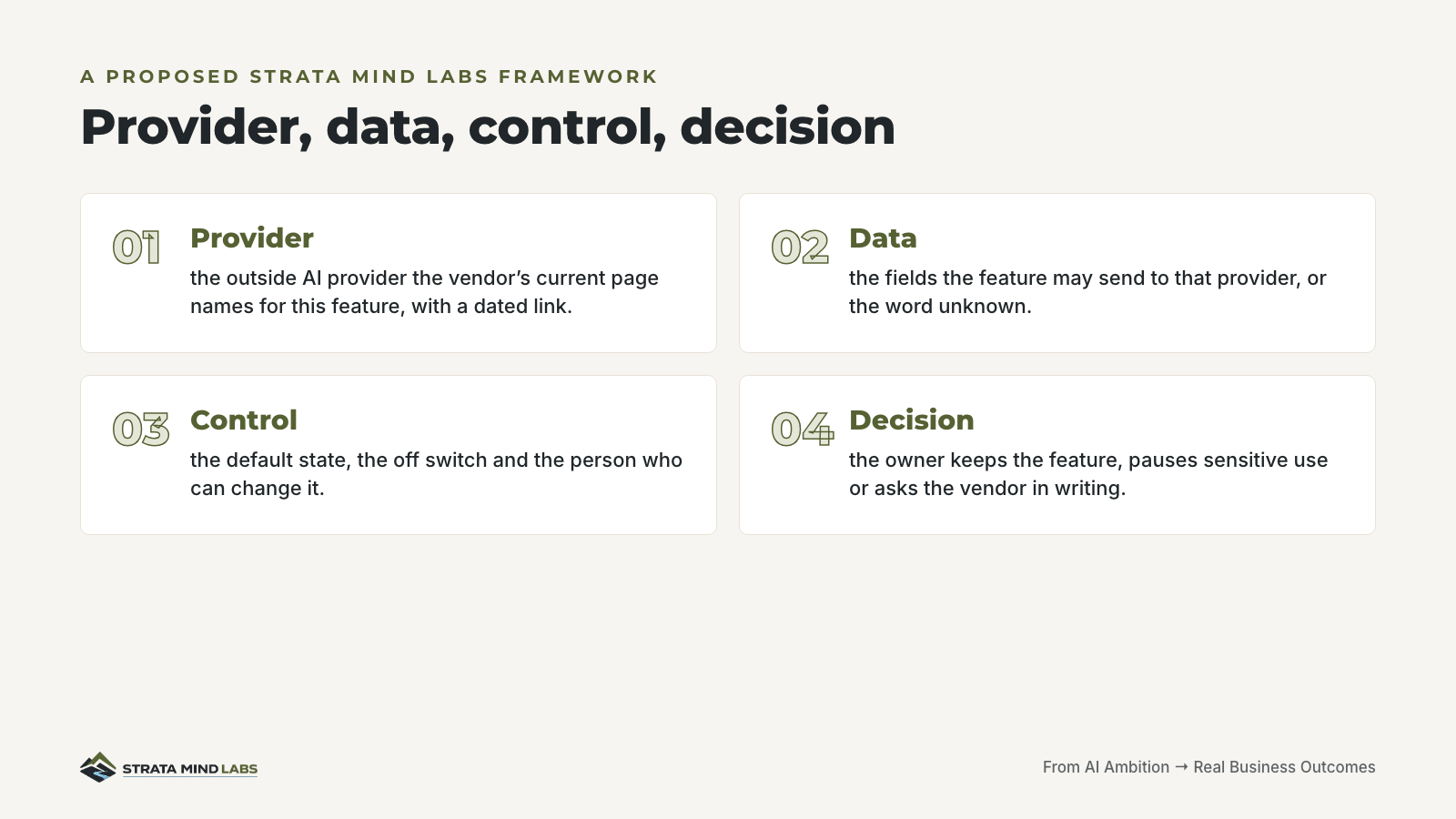
This is a proposed Strata Mind Labs routine, and it hasn't been measured. Each row has four parts: the provider the vendor's current page names, the data the feature may send, the control that switches it off and the owner's decision about use.
The office manager records the first three from vendor documents and admin screens. The owner makes the fourth. If the vendor has to supply a missing fact, it supplies it in writing.
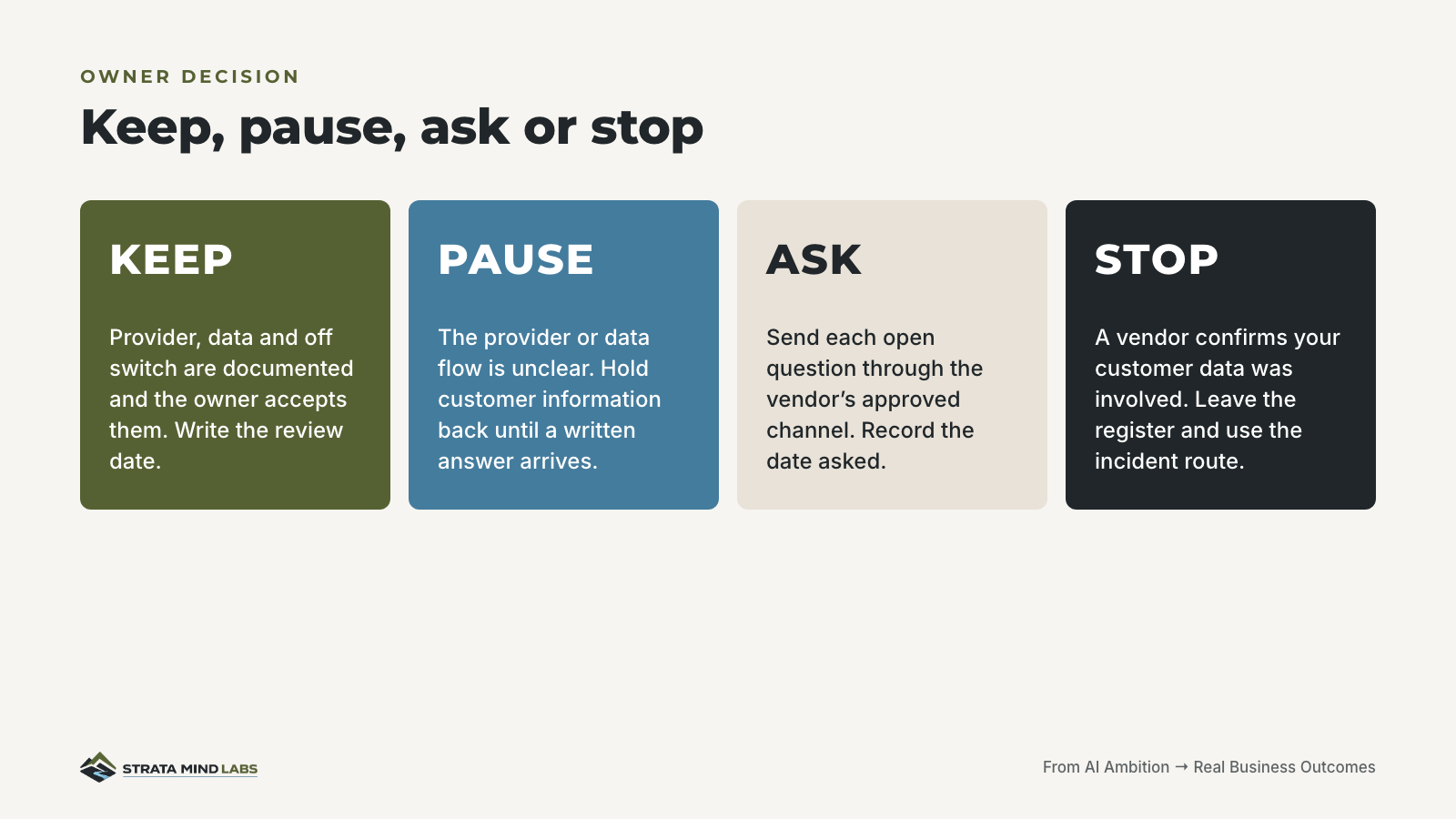
The common failure is a tidy list of vendor names with no data flow behind it. If nobody can say whether customer notes, attachments or credentials reach the outside provider, the row stays open. The owner can pause sensitive use while the answer is obtained.
A first session for this week
Pick the three tools most likely to hold customer notes, job records or billing details. Use an existing spreadsheet, vendor trust pages, contracts and admin screens. No new software is required, and plan 45 minutes for the first pass. That's an estimate for planning, not an observed result.
Start with one tool. Open its AI feature page and its vendor trust or subprocessor page. Copy the provider name and a direct link into a row, along with the date you read the page. Then have an admin check the default state and who can switch the feature off. Write down each unanswered question as unknown. Repeat for the other two tools.
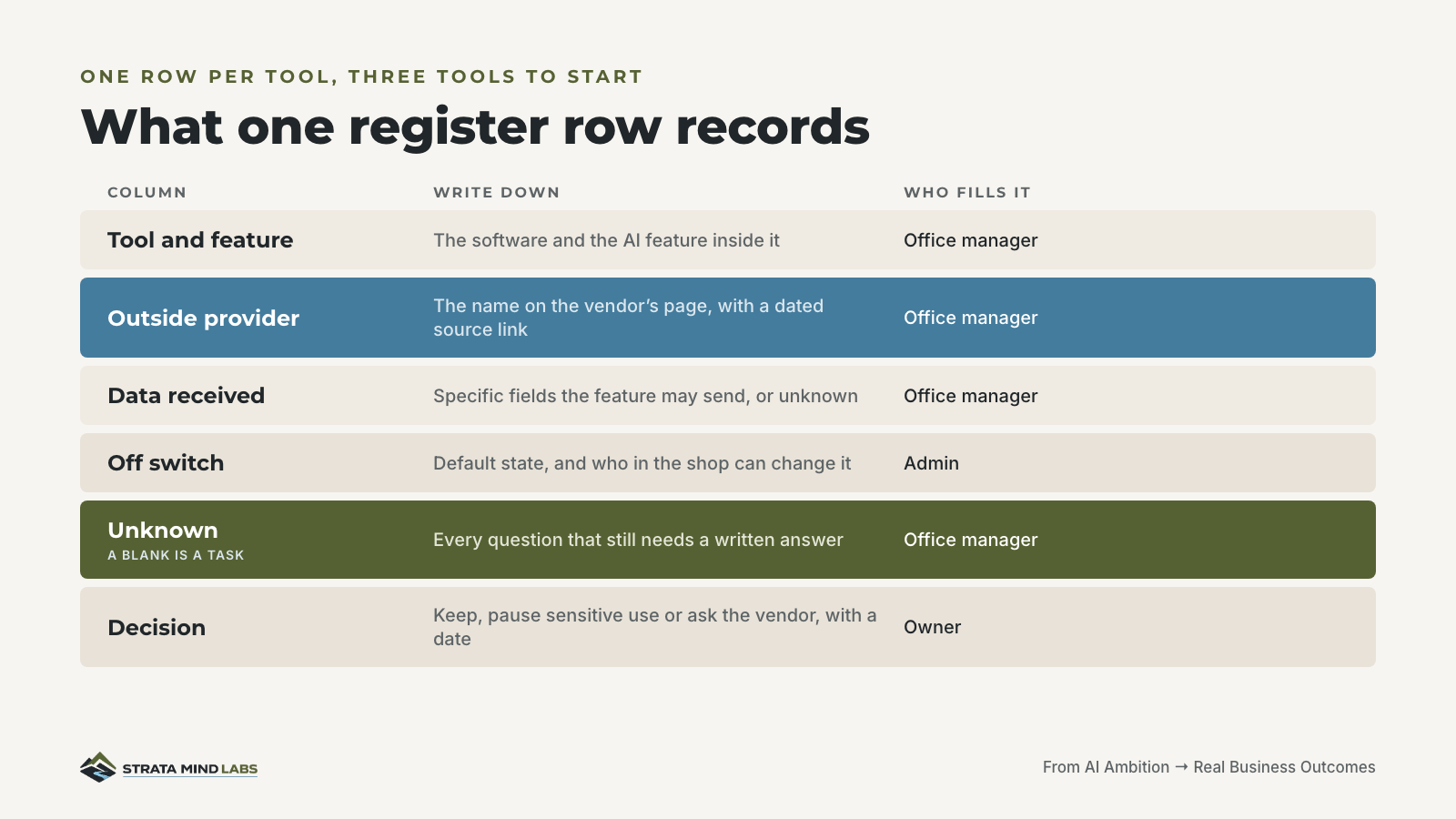
The first useful output is a dated three-row map with every unknown plainly marked. Read it for missing provider names, vague data descriptions and switches that only the vendor controls. Those gaps are questions for the vendor. They aren't proof of a breach.
Keep the roles apart. The office manager gathers the links and dates. The admin reports what the screen shows. The owner decides which features may handle customer information. Nobody in that chain gets to assume an unknown provider is safe. Keep live customer records and credentials out of any public AI chat while you do this.
If a vendor confirms that your customer data was involved in an incident, stop the register and use the business incident route. If Notion is one of your three tools, check the admin mailbox first. Notion says it has contacted affected customers directly.
Five prompts to run this week
These prompts use only vendor documents and redacted descriptions. Each step produces a draft for a person to review. Keep all five results together so the owner can trace the final decision back to its evidence.
Inventory the three tools
Copy this prompt
Using the three software names and the redacted feature descriptions I provide, create one row per tool with columns for owner, AI feature, source URL and evidence date. Mark missing fields unknown. Do not guess at a provider or data flow. Return a table and a short list of questions for the office manager.
What this should tell you: Check the three rows and the unknown list. A provider name nobody supplied or a row with no source URL is a warning sign. The inventory shows where the first search effort belongs, and it doesn't show where customer data went. Move on when each row names a tool and a person who can find its documents.
Trace the outside provider
Copy this prompt
Read only the vendor pages and contract excerpts I supply. For each AI feature, extract the named outside AI provider, the exact supporting page or clause and its date. If the page lists several providers without mapping a feature to one, write ambiguous. Do not infer a relationship from a logo or marketing partner list.
What this should tell you: Look at each provider name beside its source excerpt. An ambiguous mapping or an undated page keeps the row open. A named provider reveals one handoff and says nothing yet about what crosses it. Where the link from feature to provider is missing, the office manager has a precise question to put to the vendor.
Describe the data boundary
Copy this prompt
Using the supplied vendor data-flow description and a redacted example of the feature's inputs, list the categories of information the feature may send to each outside provider. Separate documented facts from assumptions. Do not reproduce customer names or credentials. Mark retention and training terms unknown unless the supplied documents state them.
What this should tell you: Check each data category against its evidence link. Watch for a confident statement about retention with no clause behind it. The owner needs the category to judge whether the feature fits current customer promises. If sensitive fields may travel and the documents are thin, the owner can set a temporary boundary until a written answer comes back.
Find the available controls
Copy this prompt
From the supplied admin screen notes and contract terms, record whether each AI feature is on by default, who can switch it off and how the business receives notice of provider changes or incidents. Write unknown where evidence is absent. Do not claim a setting was changed. Return a control table and the exact questions an admin should verify in the live console.
What this should tell you: Compare the proposed table with the live admin screen. A claimed off switch that no administrator has confirmed is a warning sign. A control matters only if someone in the shop can use it when needed. Assign an admin to verify each setting before the owner approves sensitive use.
Prepare the owner decision
Copy this prompt
Use the verified provider, data and control rows I supply. Draft a decision record for each feature with choices to keep current use, pause sensitive use pending a written vendor answer or activate the established incident route if an actual notice confirms customer-data involvement. List the evidence, unknowns, responsible person and review date. Do not choose for the owner or invent a numerical risk score.
What this should tell you: See whether each recommendation cites its own row and leaves unresolved facts visible. Reject any invented approval or incident conclusion. The register supports a bounded use decision and is not proof that a vendor is safe. The owner signs only after the office manager and admin have checked the evidence, then saves the dated record and revisits it at renewal or when a provider list changes.
Reading the full result
Five drafts come back: an inventory, a provider trace, a data boundary, a control table and an unsigned decision record. The value is a visible provider chain with a named owner for each gap. Where vendor documents are silent or an investigation is open, the uncertainty stays on the page.
The next decision is whether each feature keeps handling customer information while a written vendor answer is pending. That call belongs to the owner.
What to do this week
A fair limit on all this
One case is not a frequency. Notion's advisory and Fireworks' bulletin are accounts from the companies themselves, both describing an investigation still open. I haven't confirmed either with a third party, and both pages can change, so check the dates against what's live. They show that a provider chain exists. They say nothing about how often one fails.
The strongest objection is cost. A small shop can burn a lot of hours rebuilding a supplier management department. That's why the register starts at three tools. Widen it when the first rows expose a real gap or when a vendor changes its list of AI providers.
The provider, data, control and decision routine and the 45-minute estimate are Strata Mind Labs proposed practice. Neither company has reviewed them, nobody has tested them and no standard requires them. No return is assumed. What you get is a dated map with the unknowns marked and a named person for each one.
CIO Question of the Day
Which three tools in your shop hold customer notes, and can anyone say today which outside AI provider sits behind each one?
Sources
- Notion. (2026, November 9). Fireworks AI incident. Notion Security Advisories. https://www.notion.com/en-gb/security/advisories/security-incident-involving-a-third-party-ai-vendor
- Fireworks AI. (2026, November 9). Update on October 2026 security incident. Fireworks AI Security Bulletins. https://fireworks.ai/security/bulletins/october-2026-security-incident-update
- Notion. (n.d.). Notion AI security & privacy practices. Notion Help Center. https://www.notion.com/en-gb/help/notion-ai-security-practices
A list of provider names says who. A data row says what left the shop.
New briefings land as soon as the signal is worth your time.