
The AI Bill Needs an Owner
A practical budget control for variable AI use
Executive decision: Variable AI usage needs a named business owner, a ceiling and a route for approved exceptions. Decide this month which two workflows get a completed-task cost measure. Have finance and the workflow owner approve the base allowance and the escalation path together.
An AI bill nobody owns is a decision made by accident.
The signal this week
404 Media reported on October 15 that Accenture told employees they can now spend only $29 a month on Claude. The report's summary says some employees who spent as much as $1,000 a month are scrambling to keep access.
The full report sits behind a paywall. We could confirm the headline and the opening, not the effective date, how overage is charged or whether anyone lost access, so this briefing doesn't lean on those details. It's one firm's policy. It isn't an SMB benchmark and it shouldn't become yours by imitation.
The operational signal is narrower and more useful. Someone has to decide which budget funds usage beyond the base allowance. Waiting for the invoice makes that decision by accident.
What the sources show and don't
A license count no longer tells the whole spending story. A coding or agent workflow can consume far more than the base seat, often while doing work leadership asked for. The control that helps is a budget decision tied to work, with a warning before a limit interrupts a task.
The FinOps Foundation's guidance on AI says allocation is harder because it's difficult to identify who consumes a model's output. It says forecasts are less predictable and costs more volatile, because AI use can be bursty. It names unit economics as a key area. Its unit economics page defines the idea as bringing together what you spend on technology and the value that spending creates.
OWASP's September release of its 2026 Top 10 for LLM applications also announced an Agent Control Standard aimed at runtime enforcement on agent systems. That's context for controlling agents. It's not a measure of your financial exposure.
These sources support managing allocation and control. They don't prove the card in this briefing will save money.
Five fields, one record per workflow
Use a proposed decision record for each material workflow: business purpose, accountable owner, base allowance, exception path and cost per completed task. A completed task is a defined output a human owner has accepted. Count review time and rework in the discussion, so a faster draft doesn't pass for a cheaper finished job.
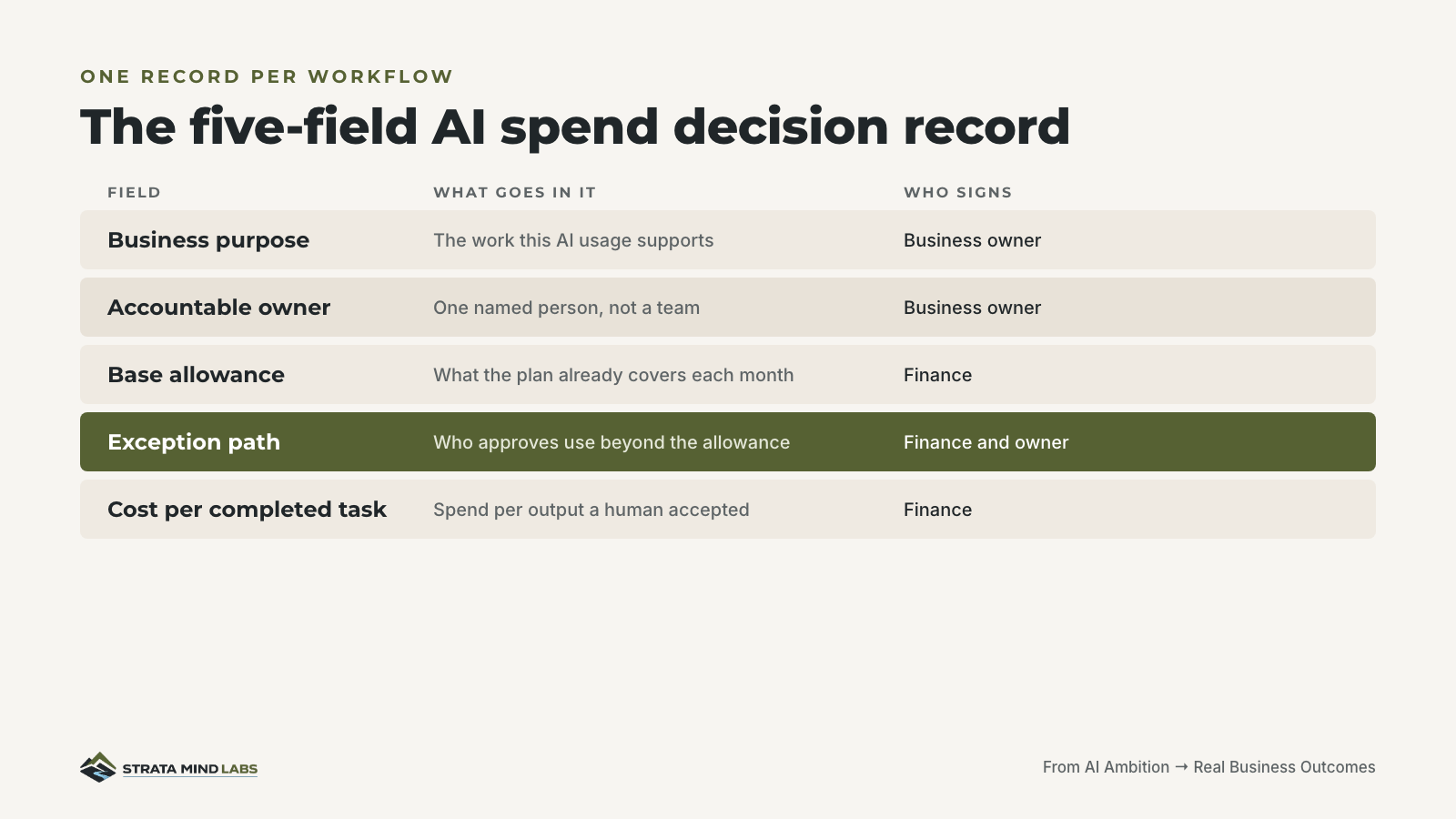
Put the guardrail at the platform or gateway when the tool supports it. An alert gives you visibility but it doesn't stop a runaway run. Where hard caps exist, design the warning and the exception path before you switch the cutoff on.
One month, two workflows
Pick two high-use workflows. Finance exports a month of vendor usage, with person-level data limited to the people who need it. The business owner writes down the completed-task definition and the maximum acceptable cost. Engineering shows what happens at the limit in a test environment. The owner then signs the cap, the warning and the exception route.
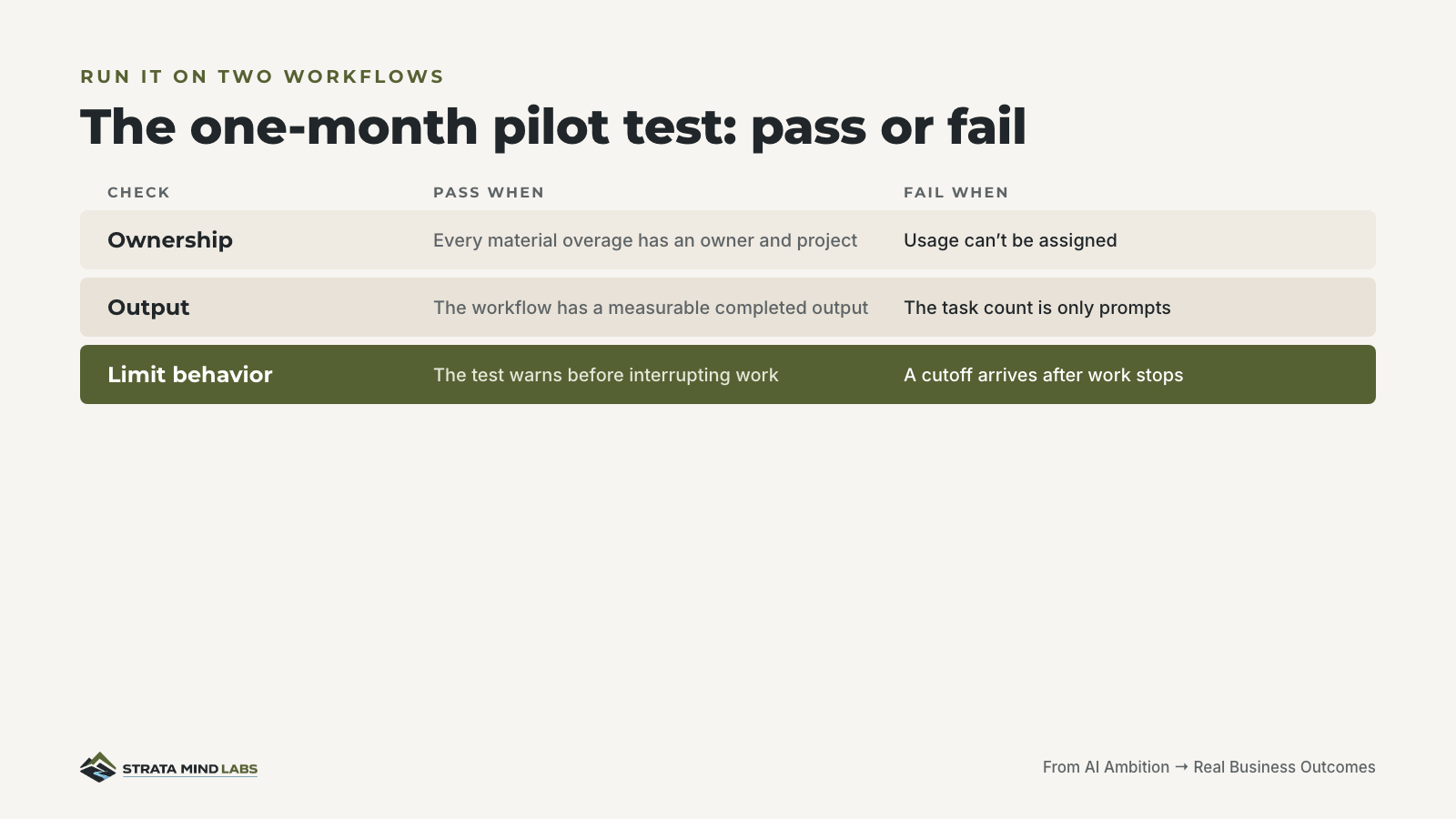
Review after ten real runs, then monthly. Finance owns cost accuracy, the business owner owns value and engineering owns control behavior.
Five prompts to run this week
Use these in sequence on one workflow. Use a redacted vendor export and approved records only. A person checks every result against the source.
Inventory the spend
Copy this prompt
Using only the attached redacted vendor export for the last complete month, list each AI tool, charge type, billing period, team, project code and total billed cost. Separate fixed seats from variable use. Show unmapped charges and missing fields in a separate table. Do not infer owners or fill missing amounts. Return the source row IDs behind each subtotal.
What this should tell you: whether you can attribute the cost. Check that subtotals reconcile to the invoice and watch for charges with no team or project, duplicate seats and unpriced usage rows. Gaps in the export are a data problem, not evidence of low spend. Decision: finance signs the reconciliation before anyone proposes a cap.
Map work and ownership
Copy this prompt
Using the reconciled allocation from Prompt 1 and the supplied approved workflow list, map each material variable charge to a named workflow, accountable business owner and project code. Show unmatched charges and conflicts. Do not identify an owner from job title alone. Ask for a human decision where the mapping is ambiguous.
What this should tell you: which charges have an owner. Watch for unmatched charges, conflicting project codes and workflows nobody owns. Decision: the owner signs the mapping and you pick the two workflows that qualify for a control pilot.
Define a completed task
Copy this prompt
For each selected workflow, use the supplied process description to draft a completed-task definition, acceptance check, review effort field and rework field. Distinguish a generated draft from accepted work. Return a blank measurement sheet for ten runs. Do not claim actual performance or calculate savings without observed run records.
What this should tell you: whether each task ends with a human acceptance event. Reject definitions based only on prompts or tokens, because review cost can erase a token saving. Decision: the business owner accepts the definition and the measurement method.
Set the control options
Copy this prompt
Using the approved owner mapping, ten observed run records and the vendor's current control documentation supplied here, compare a base allowance, a hard ceiling and a warning plus exception route for each selected workflow. Show median and range of observed cost per accepted task, review time and interrupted runs. Flag missing documentation. Do not invent platform features or a savings forecast.
What this should tell you: which control fits how the workflow actually runs. Check the source rows, the arithmetic and any control the vendor documentation doesn't support. Watch for ranges that hide costly outliers. Decision: set the pilot ceiling and approver, or defer if the sample or the evidence is too thin.
Prepare the owner decision
Copy this prompt
Draft a one-page decision record from the verified outputs of Prompts 1 through 4. State the workflow, budget owner, ceiling, warning, exception approver, data access boundary, observed cost per accepted task, unresolved evidence and next review date. Separate facts, calculations, inferences and predictions. Include a stop condition. Leave signature fields blank for the business owner, finance and engineering.
What this should tell you: whether the evidence supports a decision. Check every number against the source rows and confirm the model filled in no signature, approval or savings claim. Decision: approve a time-limited pilot only when the owner, finance and engineering sign the same record. Otherwise defer and close the evidence gaps.
What to do this week
Value shows up when an owner can explain what accepted work costs and decide whether the workflow deserves more capacity. Missing invoices, attribution or task acceptance is uncertainty, not a pass. The next decision is yours: approve the two-workflow pilot, defer it for missing evidence or stop it.
A fair limit on all this
The Accenture report is one firm's reported policy and the full article was behind a paywall when we read it. It doesn't establish what an SMB will face. The FinOps and OWASP sources are practice guidance and don't validate this card.
The five-field record, the pass and fail checks and the ten-run review are SML operating practice. No savings figure is claimed and none should be assumed until you've measured finished work against a baseline.
CIO Question of the Day
Who in your business owns the overage on your AI bill today, and who approved the limit?
Sources
- Cox, J. (2026, October 15). Accenture tells employees they can now spend only $29 on Claude per month. 404 Media. https://www.404media.co/accenture-tells-employees-they-can-now-spend-only-29-on-claude-per-month/
- FinOps Foundation. (n.d.). FinOps for AI. https://www.finops.org/framework/technology-categories/ai/
- FinOps Foundation. (n.d.). Unit economics. https://www.finops.org/framework/capabilities/unit-economics/
- OWASP GenAI Security Project. (2026, September 1). OWASP GenAI Security Project unveils 2026 Top 10 for LLM applications, new Agent Control Standard and sponsors as community tops 30,000 members. https://genai.owasp.org/2026/09/01/owasp-genai-security-project-unveils-2026-top-10-for-llm-applications-new-agent-control-standard-and-sponsors-as-community-tops-30000-members/
An AI bill nobody owns is a decision made by accident. Name the owner before the invoice arrives.
New briefings land as soon as the signal is worth your time.