
Test the Job Before AI Takes It Over
A three-job baseline for the part of an estimate you'd hand to an AI helper
Executive decision: Choose one repeatable part of the estimate process for a supervised AI draft. Keep price, scope and the customer promise with a named person. If your task card doesn't describe an exception, or the draft invents a missing fact, stop the test and revise the card.
A draft that reads well can still be missing the step that decides the price.
The signal this week
Gauge, an open-source command-line tool, describes a loop developers will recognize. In local mode it starts fresh Docker sessions, lets an agent change the product or its guidance, then reruns the affected test cases against the new version. The README says the whole loop runs on your own machine with your own agent credentials.
That's a vendor describing its own product, and the product is built for teams making tools easier for coding agents to use. It isn't evidence about what happens in a shop. The page shows no publication dates. To check any of this, open the README on GitHub (source 4).
The loop is still worth borrowing. Rerun the same task against a fixed test and see what changed. For a shop owner the missing piece is the test itself. What would count as a correct intake draft, and who would catch a wrong one? No source I read says three jobs is enough to answer that for every shop.
What the evidence adds, and where it stops
NIST's Generative AI Profile (AI 600-1, July 2024) says test, evaluation, validation and verification processes can be applied iteratively and documented in the early stages of the AI lifecycle. That's Appendix A.1.4, on pre-deployment testing. NIST's AI Risk Management Framework adds that AI systems should be tested before deployment and regularly while in operation.
The UK Department for Science, Innovation and Technology published its AI risk management guidance on September 8, 2026. Appendix 4 suggests policies on the level of human involvement in AI-augmented decision-making. It also suggests regular and consistent monitoring and testing, and a procedure to bypass or deactivate the AI solution. The guidance calls its suggestions "inexhaustive and illustrative," so read them as options and not rules.
These are general control principles. They support running a supervised test. They don't show that this estimate method saves time or raises accuracy, and neither do we.
The strongest objection is sampling. Three jobs may all look routine and miss the unusual service call that causes a bad quote. Add known exceptions from the owner's memory and review later misses against the card.
Customer data changes the work too. Use redacted or synthetic details in the first test, and read the tool's data terms before any real record goes into it.
Capture, Map, Test, Decide
This is a proposed Strata Mind Labs sequence, not a standard. Each step is small on purpose.
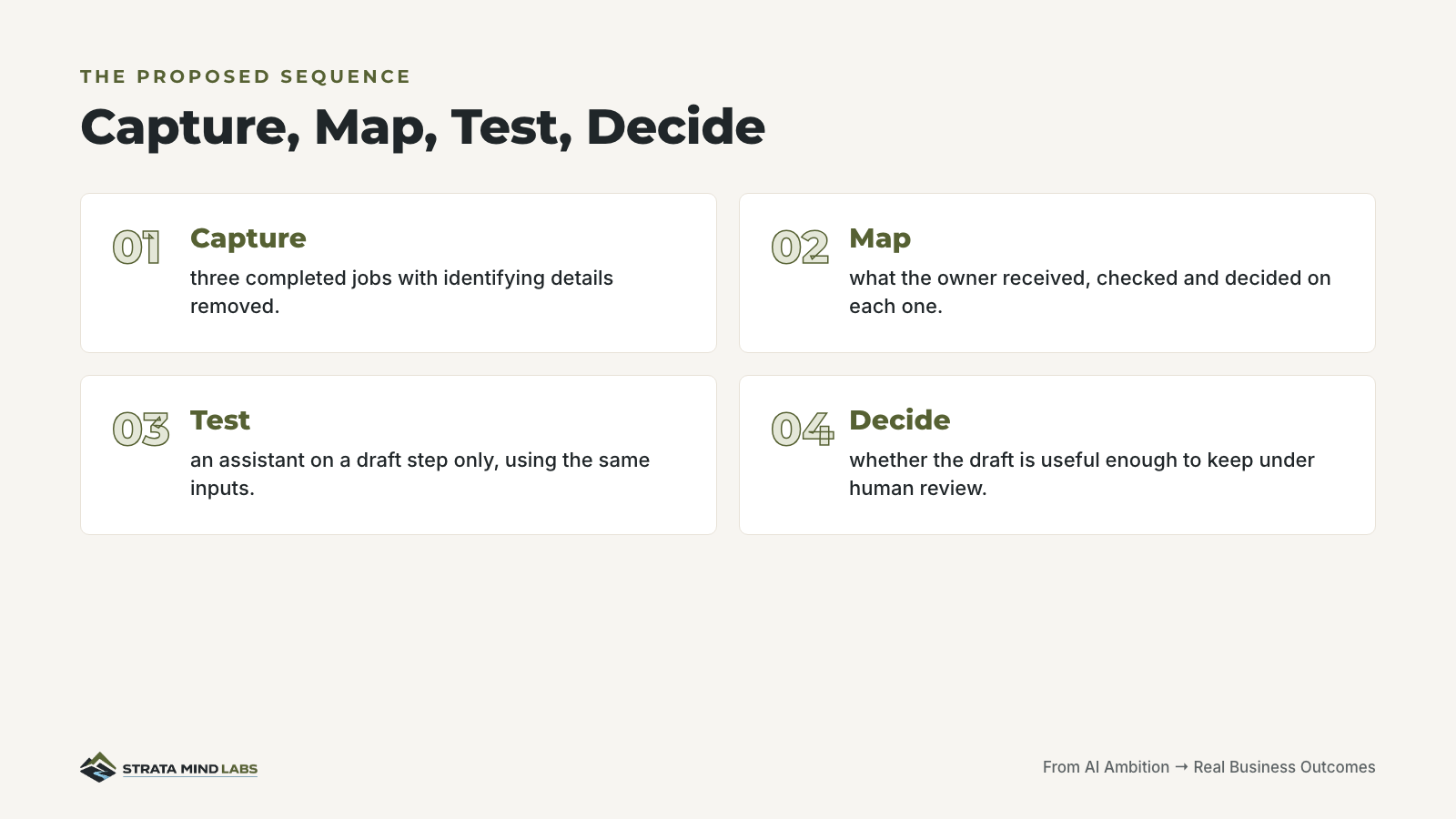
An estimate crosses several boundaries before it reaches a customer. In an illustrative shop, a request arrives with incomplete job details. Someone checks the service area, identifies the equipment and decides whether a site visit is needed. Only then does a price or scope go out. A fluent draft can skip any of those steps without changing its tone.
The owner supplies the business rule. A dispatcher or estimator records the handoffs. Whoever approves prices stays the approval owner. A vendor's model can format and compare information, but it doesn't inherit authority to change a quote, send a message or promise a date.
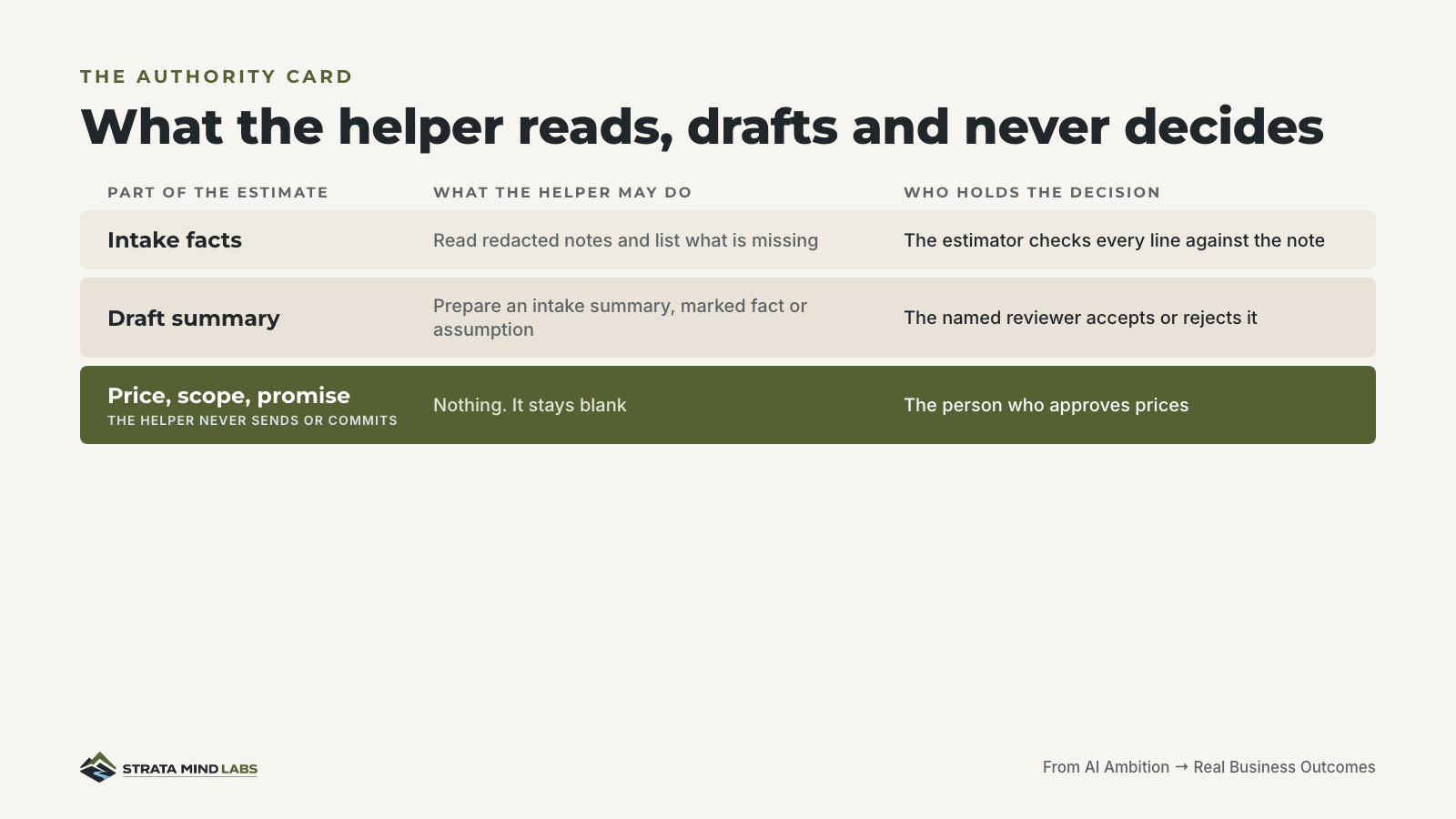
The companion Agent Action Authority Card keeps those lines in writing. It's a one-page record for one task, and it's a proposed tool, not an external standard. The fields are the task and its accountable owner, three redacted examples with note IDs, the inputs the helper may read, the data excluded from the test, repeatable steps, judgment reserved for a person, known exceptions, the draft expected, forbidden actions (sending and pricing included), the reviewer, the stop rule, any defect observed and the next owner decision with a date. A notebook page with those labels works.
A first session for this afternoon
You need three recent estimates, a blank card and no new software. For each estimate, record the intake facts, the missing fields, the repeatable steps, the judgment calls, the exceptions and the approver. Mark the customer details that stay out of any prompt.
Then take one redacted case. Do it by hand, run an assistant on the same inputs and compare. Write down every omission and every invented detail.
Inspect the output, not its confidence. Does the draft ask for a missing equipment model? Does it flag an out-of-area job? Does it leave the price blank when the card says the owner sets it?
If a draft adds facts, sends anything or ignores a stop rule, end the trial. A first pass takes about 60 minutes as a planning estimate, not a measured time. The first useful output is a one-page map of the handoffs, with the gaps visible.
Five prompts to run this week
Paste only redacted notes and made-up details. Each prompt hands its checked result to the next one.
Map the manual work
Copy this prompt
Using only the three redacted estimate notes below, make a table of inputs, repeated steps, judgment calls, exceptions and missing information. Quote the note identifier for every row. Do not infer a price, scope or customer promise. If the notes do not support a row, mark it unknown.
What this should tell you: Check that each row points to a real note, and watch for invented steps, prices or assumptions. A task map with visible gaps shows what you've actually taught the helper. If key decisions are missing, collect another example before you write any instruction. Carry the checked map and your corrections to prompt 2.
Separate action from authority
Copy this prompt
From the checked task map below, draft an Agent Action Authority Card. Separate information the helper may read, a draft it may prepare, decisions reserved for the owner, prohibited actions and the person who reviews the draft. Use unknown for anything not supported by the map.
What this should tell you: Price, scope, scheduling promises and sending should all sit with a person unless you've written an explicit owner rule. A useful draft can still cross a business boundary when authority is left implicit. Approve the boundary for a supervised test only when the reviewer and the stop rule have names. Take the approved card and one redacted case to prompt 3.
Test a redacted case
Copy this prompt
Apply the approved authority card to the redacted estimate case below. Produce a draft intake summary and a list of missing facts. Do not send, price or promise anything. Mark each assertion as supplied fact or assumption and stop if the card forbids the action.
What this should tell you: Compare every assertion to the case. Flag missing equipment details, invented measurements and any price or commitment nobody authorized. The first useful output is a checkable draft, not a live quote. Decide whether it's worth another supervised case. Any unauthorized action ends this test.
Inspect the exception
Copy this prompt
Compare the reviewed draft with this separate redacted exception case. Identify where the card handles the exception, where it fails and what a human must decide. Suggest one narrow instruction change. Do not rewrite the whole process or claim the change is proven.
What this should tell you: Look for one specific failure point and one proposed edit. A generic warning or a confident invented answer is a failed result. The exception shows whether the card explains judgment or only routine steps. Decide whether to revise the card and rerun the same case, or keep this task manual.
Make the owner decision
Copy this prompt
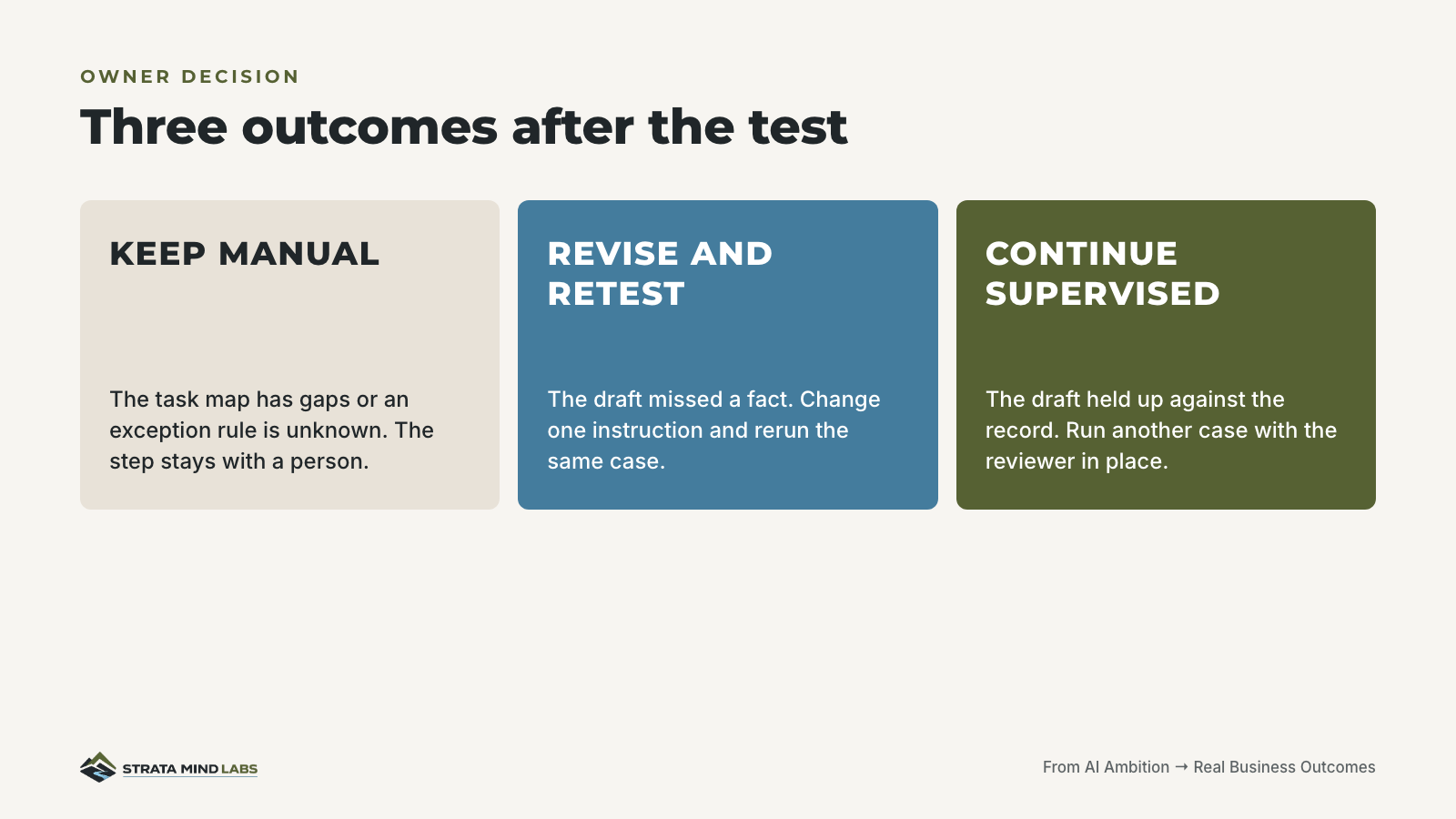
Using the reviewed results below, produce a decision table with keep manual, revise and retest or continue supervised drafting. Show evidence for each choice, unresolved gaps, the named reviewer, data boundary and stop condition. Do not claim time savings or deployment readiness without measured evidence.
What this should tell you: The recommendation should trace back to the two tests, state the gaps and leave final approval with the owner. A repeatable decision beats a polished answer that hides uncertainty. You choose whether to run another supervised draft, revise the card or stop. Record that decision and schedule a review of future misses before any wider use.
Reading the full result
Business value shows up only if a reviewer can produce and check a draft with less effort than doing the work by hand. No saving is assumed here. The first session sets a baseline and exposes what you don't yet know.
A later decision about production access needs measured review effort, an approved data boundary and an owner for exceptions. Until then the helper drafts and a person decides.
What to do this week
A fair limit on all this
A three-job sample isn't a frequency. It can't tell you how often an assistant would invent a fact in your shop, and nothing I read supplies that number.
Gauge describes its own product, and a vendor's description stays a vendor's description until you test it against your own work. NIST and the UK guidance give general principles for testing and oversight. Neither one validates a method for estimates.
The four-step sequence, the card, the 60-minute estimate and the five prompts are Strata Mind Labs proposed practice. No standard requires them and nobody has measured them. The shop in this piece is an illustration, not a client. And no return is assumed. What you get from the first session is a baseline and a list of what the card still doesn't say.
CIO Question of the Day
Which step in your estimate process could you describe well enough today that someone else could catch a wrong draft?
Sources
- National Institute of Standards and Technology. (2024, July 26). Artificial Intelligence Risk Management Framework: Generative Artificial Intelligence Profile (NIST AI 600-1). https://www.nist.gov/publications/artificial-intelligence-risk-management-framework-generative-artificial-intelligence
- National Institute of Standards and Technology. (2023). AI RMF core (AI Risk Management Framework 1.0). NIST AI Resource Center. https://airc.nist.gov/airmf-resources/airmf/5-sec-core/
- UK Department for Science, Innovation and Technology. (2026, September 8). AI risk management toolkit: guidance. GOV.UK. https://www.gov.uk/government/publications/ai-risk-management-toolkit/ai-risk-management-toolkit-guidance
- Gauge. (n.d.). Gauge CLI [Source code repository README]. GitHub. Retrieved November 6, 2026, from https://github.com/gauge-sh/gauge-cli
Define good work first. A person still sets the price.
New briefings land as soon as the signal is worth your time.