
Test the Fallback Before the Limit Changes
A practical continuity check for one AI-dependent workflow
Executive decision: Anthropic's preliminary October 26 filing discloses that it has changed usage limits, rate limits and model capabilities. Find the one workflow that would feel a change first and test a safe fallback. Authorize a proposed 90-minute first session and require a one-page gap sheet before you approve a production drill.
Your AI supplier has told investors its limits can move. Find out what that does to one workflow before it does it for you.
The signal this week
Anthropic filed a preliminary Form S-1 with the SEC on October 26. In its risk discussion, the company says it has changed, and may change in the future, its usage limits, rate limits and model and product capabilities. It also says it has consistently operated in a compute-constrained environment where customer demand exceeds available compute, and it describes a March 2026 outage and degraded service tied partly to usage demand and compute constraints.
Read that for what it is. A supplier disclosed risk to investors. The filing doesn't say any particular customer's limit will change, and it doesn't say a disruption is coming. It's also a preliminary prospectus, which states that its information is not complete and may be changed.
You can check this yourself. Open the filing on SEC EDGAR (the link is in the sources) and search the risk factors for "usage limits."
What the sources show and don't
Two public frameworks support the idea of planning for this. NIST's AI Risk Management Framework 1.0 (2023) lists a practice, GOVERN 6.2, that says contingency processes should be in place to handle failures or incidents in third-party data or AI systems deemed to be high-risk. CISA's guide for small and mid-sized businesses on supply chain risk says to build a contingency plan for disruptions, including criteria for declaring one, alternative suppliers or backup plans and recovery strategies.
Neither one validates the 90-minute exercise in this briefing. Neither promises a financial return. They support the need to plan and nothing more.
One more source is useful as a contrast. Cloudflare's October 26 changelog for its Computer product says code can resume after a deploy or crash and pause on an external action until an application supplies an approval decision. It also warns that if a call's result wasn't recorded before an interruption, recovery may repeat the call. That's a vendor describing its own product mechanism, not a client result. But the lesson carries over. A fallback still needs action boundaries and a human who reviews.
Four gates, one workflow
The continuity test has four gates. First, name the business process and its owner. Second, record the supplier dependency and the contract's actual notice language. Third, route synthetic requests through a half-limit tabletop and a manual fallback. Fourth, give one person authority to stop or switch, with a written exception route.
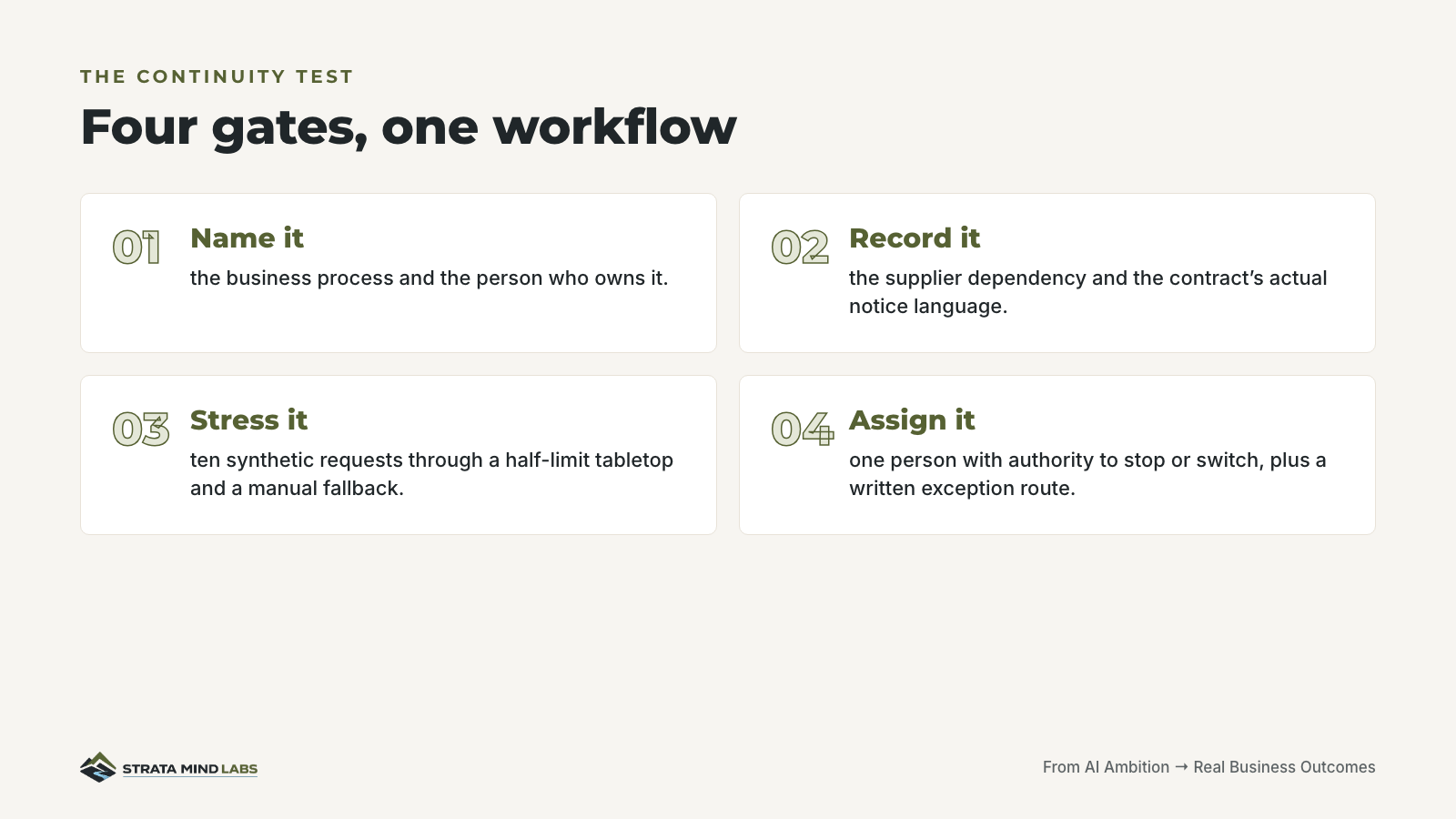
This is an original operator recommendation from Strata Mind Labs. It's not an externally validated framework.
The strongest counterargument is cost. Many small business processes can wait out a short slowdown, and maintaining a second model may cost more than the exposure. If the workflow is low impact, document a manual hold and stop there. Don't buy redundancy without a business case.
One afternoon, ninety minutes
The setup here is a labeled reconstruction from the SEC filing and public contingency guidance. It's not a client deployment and it reports no measured outcome. The 90 minutes is a planning estimate.
Bring one current contract or order form, a description of the workflow, its current rate or usage limits, ten synthetic requests and the named owner. A spreadsheet is enough. Don't put real customer data into an unapproved tool.
Build one row with these columns: workflow, input class, supplier and model, current limit, contract notice, half-limit queue, manual fallback, switch owner, prohibited action, exception route and next test date. Mark anything you can't find UNKNOWN. A blank notice cell is a question for procurement, not a protection.
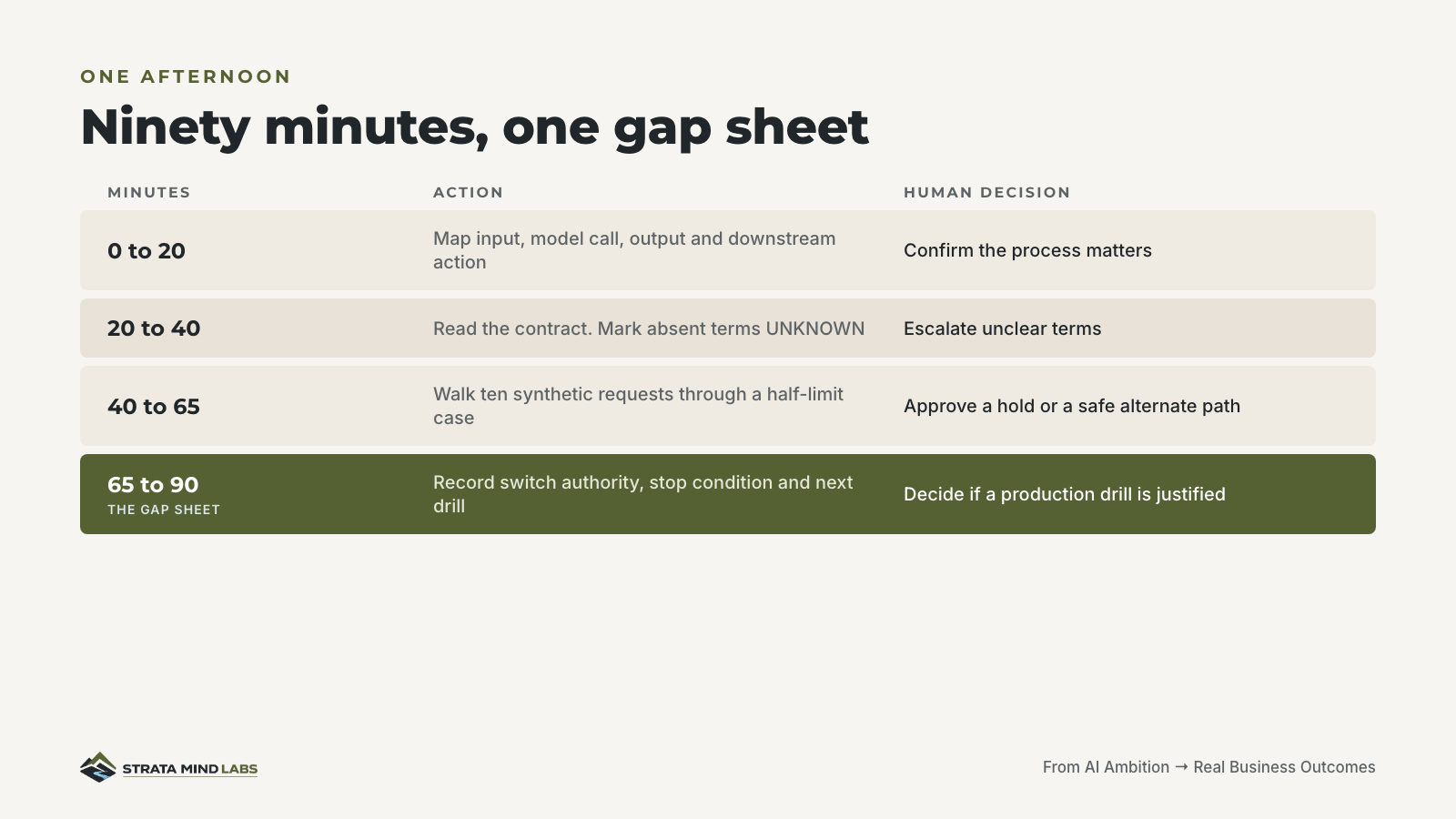
Stop if the fallback would expose restricted data, send an unreviewed message, change a customer record or exceed the owner's authority. Route the exception to the process owner and the security or privacy lead before any live test.
The half-limit case is a planning assumption. The filing says limits have changed in the past. It doesn't say yours will drop by half.
Who decides what
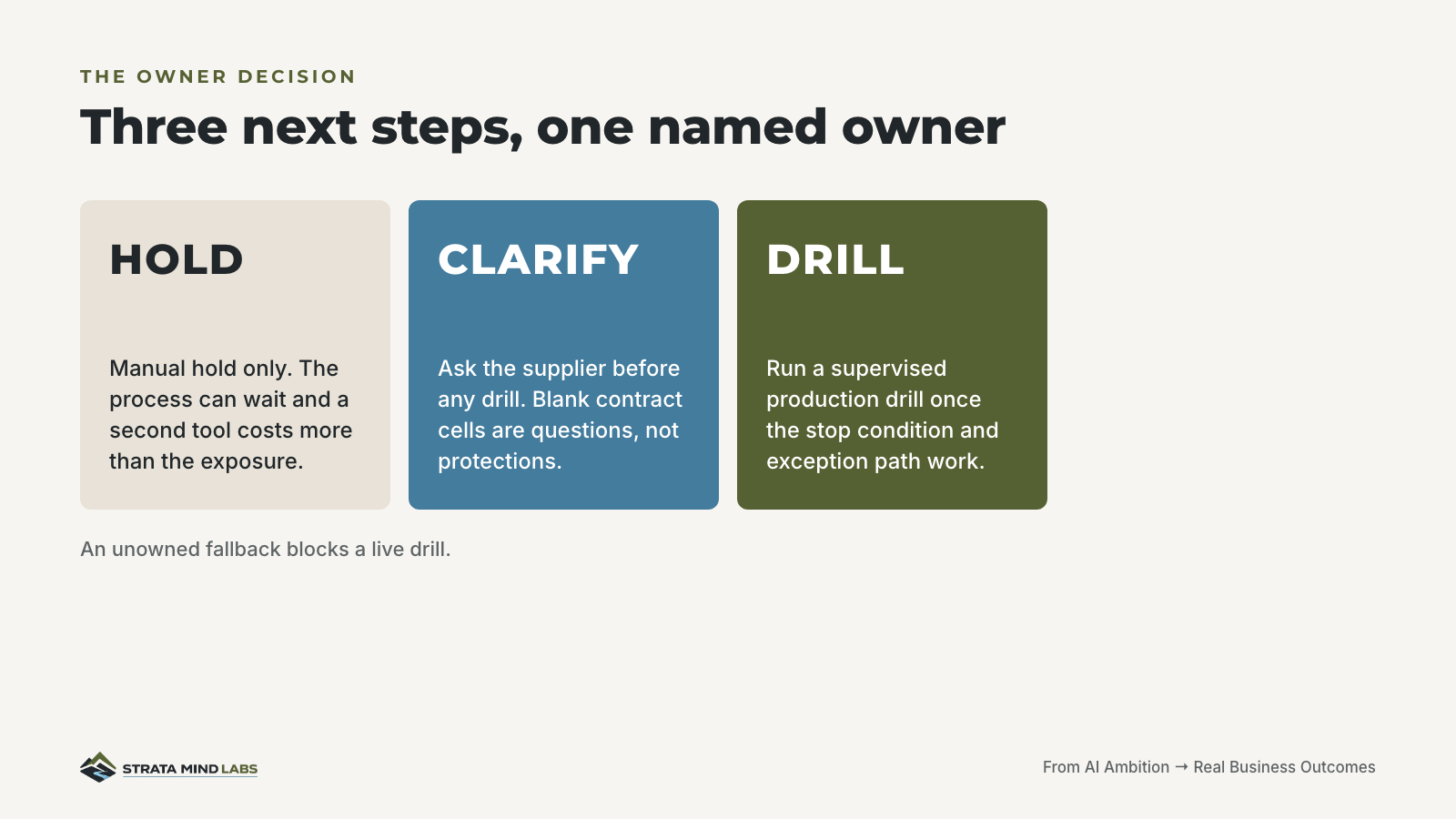
The first useful output is a gap sheet, not a new platform. It shows the queue, the fallback, the authority and the contract unknowns on one page. Then a person chooses.
The CIO or business owner sponsors the row, asks procurement to verify the contract and authorizes a supervised drill only when the stop condition and exception path are workable. Record the decision date and the person who can reverse it.
Five prompts to run this week
Run these in order on one workflow. Use redacted descriptions, synthetic requests and your own contract excerpts only. A person checks every result against the source document.
Map the dependency
Copy this prompt
Using only the workflow description I provide, list each input, model call, output, downstream action and human approval. Mark missing steps UNKNOWN. Do not infer customer data or system access. Workflow: [paste a redacted description].
What this should tell you: where a supplier change would touch the business process. Watch for a missing owner, an unclear data class, a downstream action nobody explained and approvals that don't exist. Decision: continue only if the workflow owner confirms the map.
Read the contract
Copy this prompt
Compare this confirmed workflow map with these contract and order-form excerpts: [paste redacted excerpts]. Extract exact terms for usage limits, rate limits, capability changes, notice, remedies and data handling. Quote short clause fragments with page or section references. Mark absent terms UNKNOWN. Do not provide legal advice.
What this should tell you: whether the contract protects the dependency or leaves it exposed. Check every clause reference against the original. A made-up notice period or a missing page reference is a failure. Decision: procurement decides which unknowns need a supplier question and counsel reviews anything disputed.
Stress the workflow
Copy this prompt
With the verified workflow and contract row, simulate a planning scenario in which the available rate limit is half its current value. Use only these ten synthetic requests: [paste]. For each, mark PROCESS, QUEUE, MANUAL HOLD or STOP. Show the rule used. Do not claim this is a measured supplier outcome.
What this should tell you: where limited capacity turns into a customer or staff delay. Watch that all ten requests get exactly one disposition and that no real customer data or unapproved action appears. Decision: the process owner decides whether the manual hold is tolerable inside the stated service window.
Set action authority
Copy this prompt
Turn the ten-request disposition table into an action authority card. State who may pause, switch to the manual fallback, contact customers and resume. List prohibited actions and the security or privacy exception path. If an owner is missing, write OWNER REQUIRED. Do not assign authority by inference.
What this should tell you: who can actually pull the switch. A fallback without switch authority can create a second operational failure. Watch for any role the assistant invented and any action with no human approval point. Decision: the business owner approves or rejects the card after security and privacy review where relevant.
Make the decision record
Copy this prompt
Create a one-page gap sheet from the verified dependency map, contract terms, synthetic stress table and approved action authority card. Separate FACT, INFERENCE and OPEN QUESTION. Recommend one of three next steps: manual hold only, supervised production drill or supplier clarification before any drill. State the reason and stop condition. Do not claim saved time or avoided loss.
What this should tell you: whether the exercise turned a general supplier risk into a bounded decision. Verify that every fact traces to an input, every inference is labeled and the next step has an owner and a date. Treat any savings claim as a failure. Decision: the executive sponsor picks the next step only after the workflow owner verifies the record.
A finished sequence gives you clarity on the decision and a faster switch later. That speed still has to be measured in a real drill. Unknown contract terms and synthetic traffic limit what the exercise proves, and the workflow owner keeps the authority.
What to do this week
A fair limit on all this
One filing isn't a frequency. It shows a supplier saying limits have changed before and may change again. It doesn't tell you how often, how much or whether your plan is affected. The Anthropic statements are the company's own, in a preliminary document that can still change.
The four gates, the half-limit case and the 90-minute window are Strata Mind Labs proposed practice, not a measured standard. NIST and CISA support planning in general and don't endorse this exercise. Cloudflare's description is a vendor's account of its own product. No return from this exercise is assumed. The goal is a decision you can defend.
CIO Question of the Day
If your main AI supplier cut your rate limit in half tomorrow, who is allowed to switch the workflow to a fallback, and what would they switch to?
Sources
- Anthropic, PBC. (2026, October 26). Preliminary Form S-1 registration statement. U.S. Securities and Exchange Commission. https://www.sec.gov/Archives/edgar/data/2130357/000162828026067168/anthropicpbc-sx1.htm
- National Institute of Standards and Technology. (2023). Artificial intelligence risk management framework (AI RMF 1.0): Core, GOVERN 6.2. https://airc.nist.gov/airmf-resources/airmf/5-sec-core/
- Cybersecurity and Infrastructure Security Agency. (2023, October). Empowering SMBs: A resource guide for developing a resilient supply chain risk management plan. https://www.cisa.gov/sites/default/files/2023-10/Empowering%20SMBs%20-%20A%20Resource%20Guide%20For%20Developing%20A%20Resilient%20SCRM%20Plan_508.pdf
- Cloudflare. (2026, October 26). Cloudflare Computer now helps agents recover from interruptions and wait for approval. Cloudflare Docs changelog. https://developers.cloudflare.com/changelog/post/2026-10-26-computer-durable-javascript/
Test the fallback before the limit moves. Then name who can switch to it.
New briefings land as soon as the signal is worth your time.