
Start Where You Can Prove the Money
The best first AI project may be the work nobody brags about.

Executive decision: Pick one recurring workflow where the business can establish a baseline today and know within 90 days whether AI improved the result. Favor measurable work over impressive demos.
An owner has ten possible AI ideas. One sounds exciting, a customer-facing agent. Another sounds boring, cutting the time employees spend preparing quotes, reconciling invoices, routing requests, or chasing overdue work. The exciting idea may eventually matter more. The boring one is easier to measure, which makes it the better place to learn how to baseline, test, govern, and decide whether to expand.
The practical question isn't "Where can we use AI?" It's "Where can we prove that AI made the business better?"
What the evidence says
AI adoption among small businesses is already substantial, and many owners report productivity and revenue gains. Separate healthcare evidence shows that administrative AI workflows produce returns that are easier to attribute than higher-judgment work.
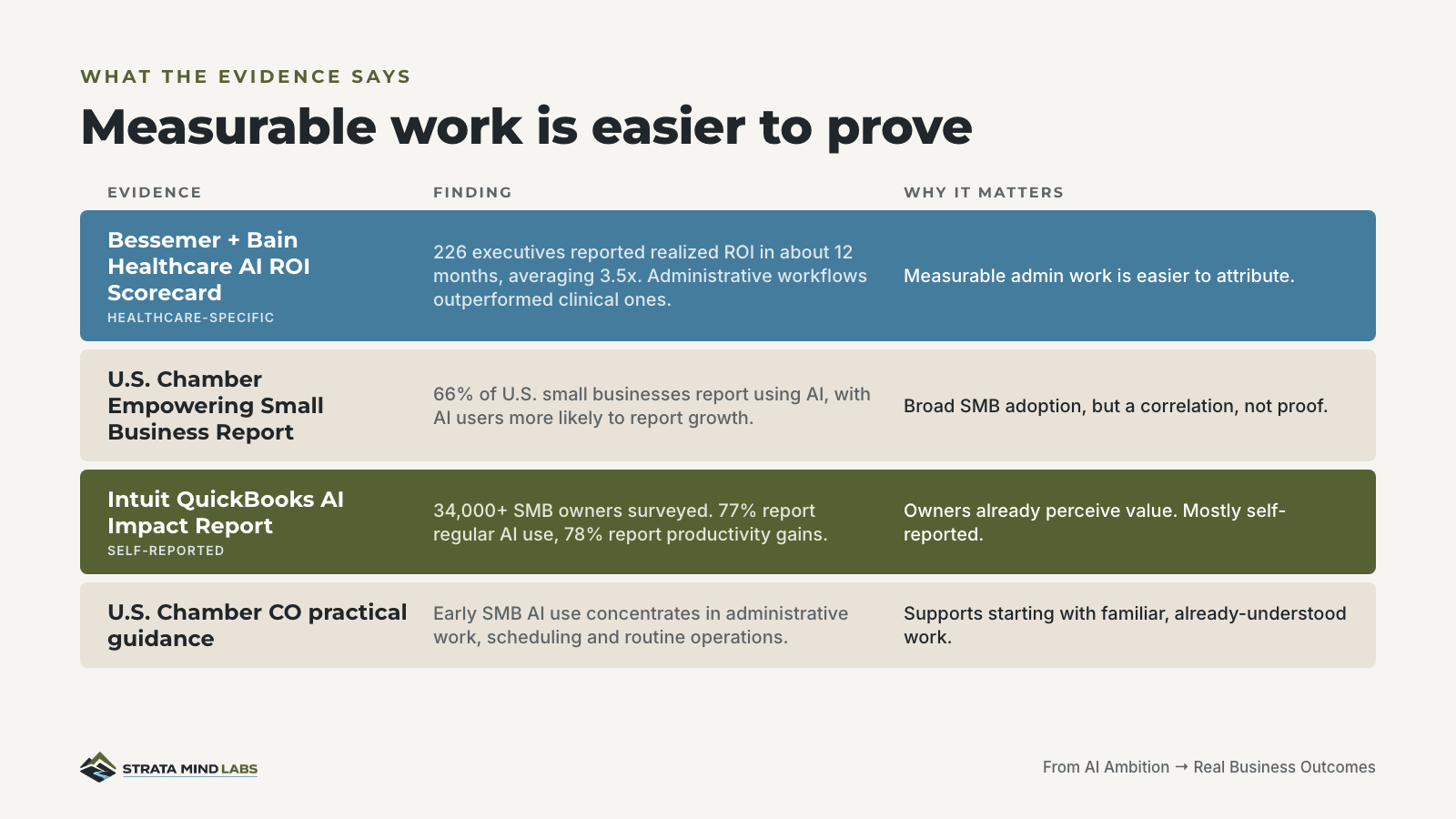
None of this says every business will see healthcare-grade returns, and self-reported survey gains aren't proof of causation. What it does say is that the workflows businesses can actually measure are the ones producing numbers anyone can point to.
Start with a workflow you can measure
A good first workflow happens often enough to matter, consumes visible time, money or attention, already has a result the business recognizes as good, and can be compared cleanly before and after the pilot. That's a more useful filter than picking a project because the demo looks impressive.
The usual candidates are quote preparation, scheduling, order entry, document intake, invoice follow-up, reconciliation, recurring reporting, customer-request routing, or first-pass drafting on repetitive internal work. The right one depends on the business.
Choose the work where the result can be proved.
Use find, baseline, test, prove
The selection rule turns into a sequence once you've picked a candidate.
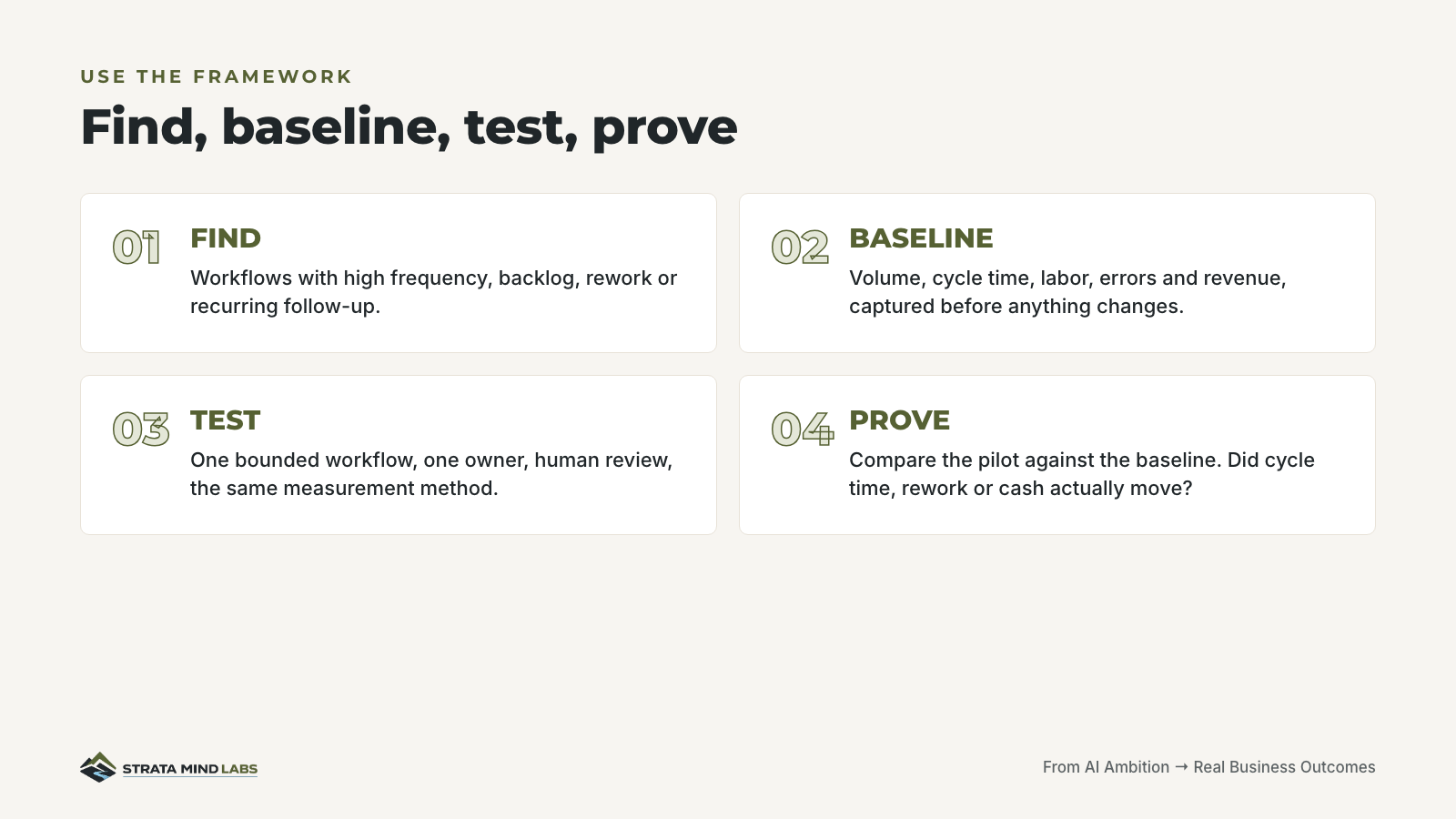
Skip the baseline and the business has no way to prove the result later, only an opinion about whether it felt better. Change more than one part of the process at once and nobody can say what actually caused the improvement.
What proof actually looks like
A small service company prepares 40 customer quotes a week. Before AI, prep ran 18 minutes a quote, 12 hours of labor a week, with 6 quotes needing rework and same-day customer response.
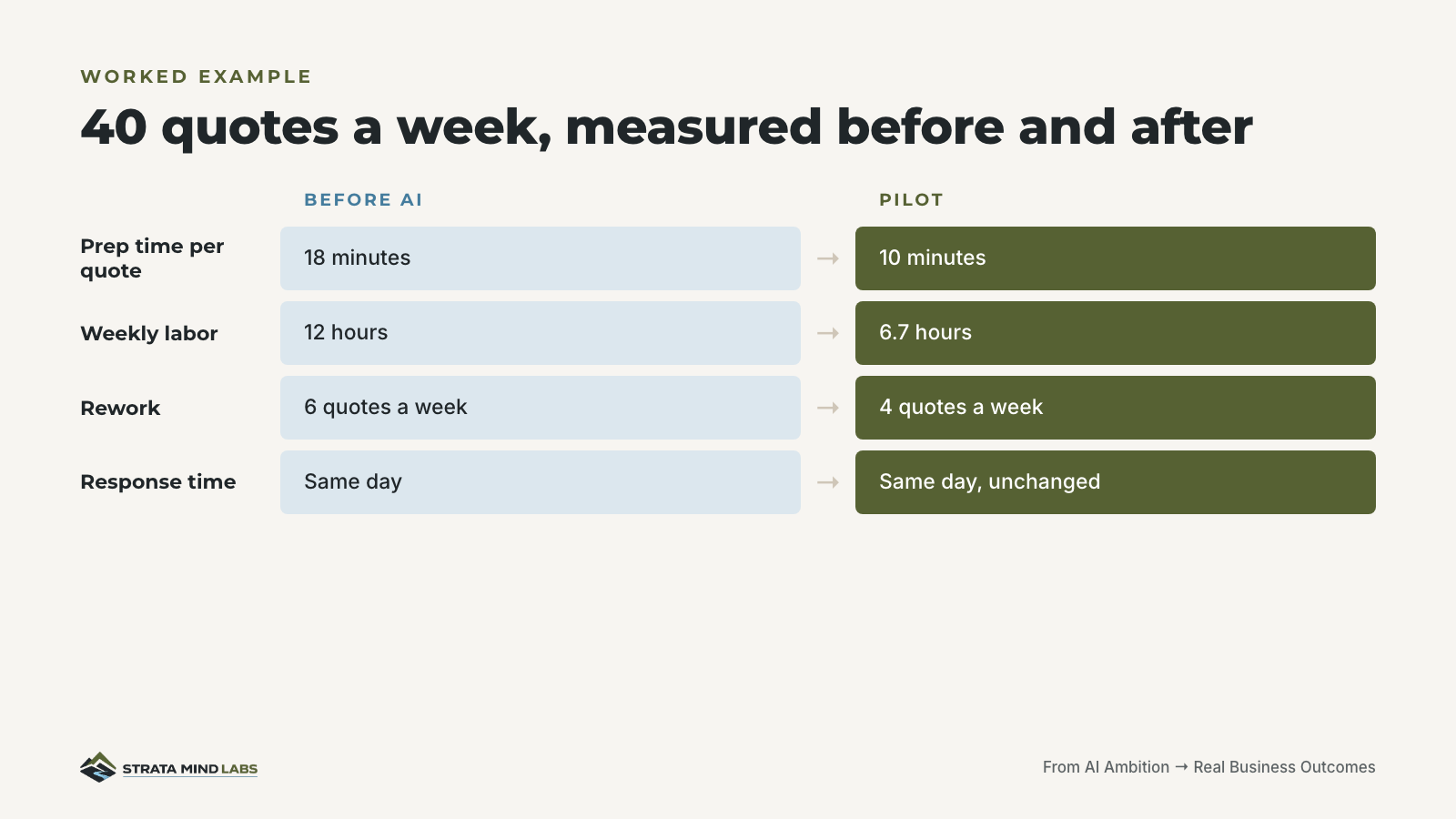
That doesn't prove the business should automate quoting completely. It proves something more specific: the workflow returned about 5 hours of weekly capacity without degrading the observed rework rate. The next decision is just as specific, expand to more quote types, improve the data feeding the draft, or stop if the result doesn't hold up at a larger sample.
Five prompts to run this week
You don't need a consultant to run the first pass. These prompts work in any capable model. Run them in order, on one real workflow, and hold the line on one rule, the model classifies and calculates from numbers you give it, it doesn't invent them.
Find measurable workflows
Copy this prompt
I will describe recurring work in my business. Identify 5-10 workflows that are candidates for an AI pilot. Prioritize work with visible volume, labor, delay, rework, or revenue impact. Do not recommend tools yet. For each workflow, explain why it is measurable.
Build the baseline
Copy this prompt
For the workflow I select, create a baseline measurement plan. Include volume, cycle time, labor time, backlog, errors/rework, customer wait, revenue delayed or lost, and any existing quality metric. Flag every metric I cannot currently measure.
Design the bounded test
Copy this prompt
Design a 30-90 day AI pilot for this workflow. Define the owner, pilot population, AI-assisted step, human review point, data required, success metric, failure condition, and what must remain unchanged so the before/after comparison stays meaningful.
Calculate the result
Copy this prompt
Using only the baseline and pilot data I provide, compare before and after. Calculate absolute and percentage change for the measured metrics. Do not invent missing numbers. Separate measured results from assumptions.
Make the decision
Copy this prompt
Based on the measured pilot result, recommend one of three actions: expand, adjust, or stop. Explain the evidence for the recommendation, the largest unresolved risk, and the next measurement required before more investment.
What to do this week
A fair limit on all this
The healthcare ROI figures here are healthcare-specific and shouldn't be read onto an unrelated SMB workflow. Survey correlations and owner self-reports are real signals, not proof that AI caused the growth respondents describe. The point of this briefing is narrower: measurable work is easier to prove than impressive work, and proving one workflow is a better use of 90 days than debating ten.
CIO Question of the Day
Which workflow could prove its value in 90 days?
Sources
- Bessemer Venture Partners + Bain & Company. 2026 Healthcare AI ROI Scorecard. https://www.bvp.com/atlas/the-2026-healthcare-ai-roi-scorecard
- U.S. Chamber of Commerce. 2026 Empowering Small Business Report. https://www.uschamber.com/technology/2026-empowering-small-business-report
- Intuit QuickBooks. 2026 AI Impact Report. https://quickbooks.intuit.com/r/small-business-data/ai-impact-report/
- U.S. Chamber CO. Small Businesses Are Using AI: What Is Actually Working. https://www.uschamber.com/co/run/technology/small-businesses-are-using-ai-heres-whats-actually-working
Prove value before you scale it.
New briefings land as soon as the signal is worth your time.