
Price the Finished Work
AI spend is a meter. Match it to accepted work before expanding the budget.
Executive decision: Choose one metered AI workflow and match one week of its charges to accepted completions in the system of record. The first decision is whether the unit, the period and the spend can be reconciled. If they can't, hold any expansion of that workflow and fix the handoff.
A usage report tells you what you spent. It doesn't tell you what the business got back. That second number lives somewhere else, and someone has to put the two side by side.
The signal this week
Anthropic announced smart reports and pooled group budgets for Claude Enterprise on October 28. The vendor says its reports group sampled transcripts into workstreams and show spend, deliverables and friction. A team can pick a date range and products, inspect spend and review recurring friction. Pooled budgets let administrators set a shared monthly amount and get threshold alerts. The vendor says the reports are available to Claude Enterprise customers, subject to configuration limits.
Those are useful operating clues. They manage use. They don't certify that a ticket was closed, an invoice question was resolved or a customer order was accepted. The process owner owns that definition.
What the sources show and don't
TechCrunch independently reported the launch and described pressure on AI suppliers to explain what customers are spending on. The article doesn't test completed business units. The product announcement is evidence for features and access, not a measured return.
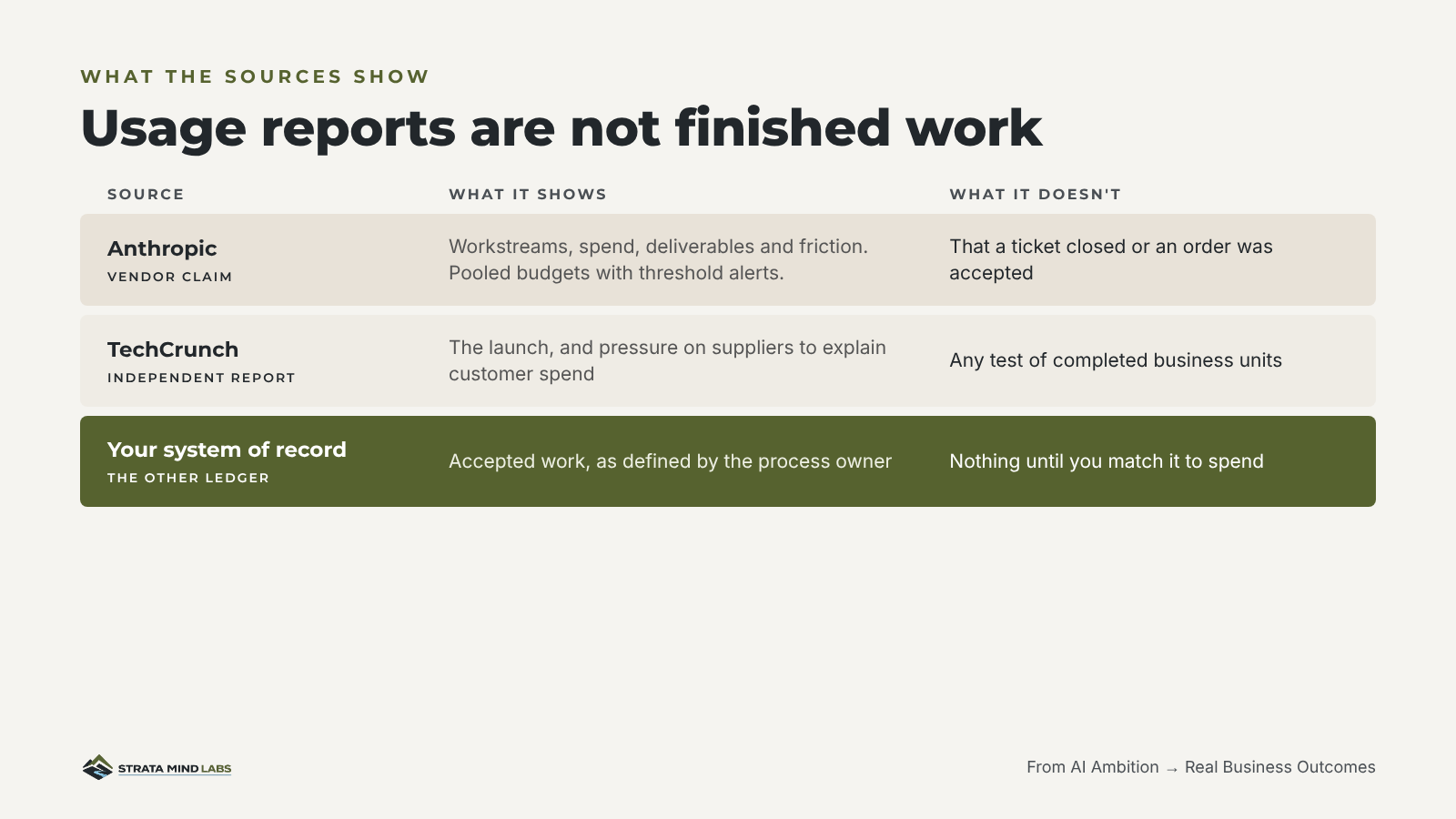
Keep the claims in their lanes. The fact is that the vendor describes workstream, spend and friction reporting. The calculation is matched-period spend divided by accepted completions, which gives a cost per accepted unit. The inference is that usage and accepted outcomes can drift apart. You don't need a prediction to run this check.
Two ledgers, one week
A vendor usage report is the left side of a reconciliation. The right side is the business system that records accepted work. This two-ledger check is an original Strata Mind Labs recommendation. It hasn't been externally validated as a standard.
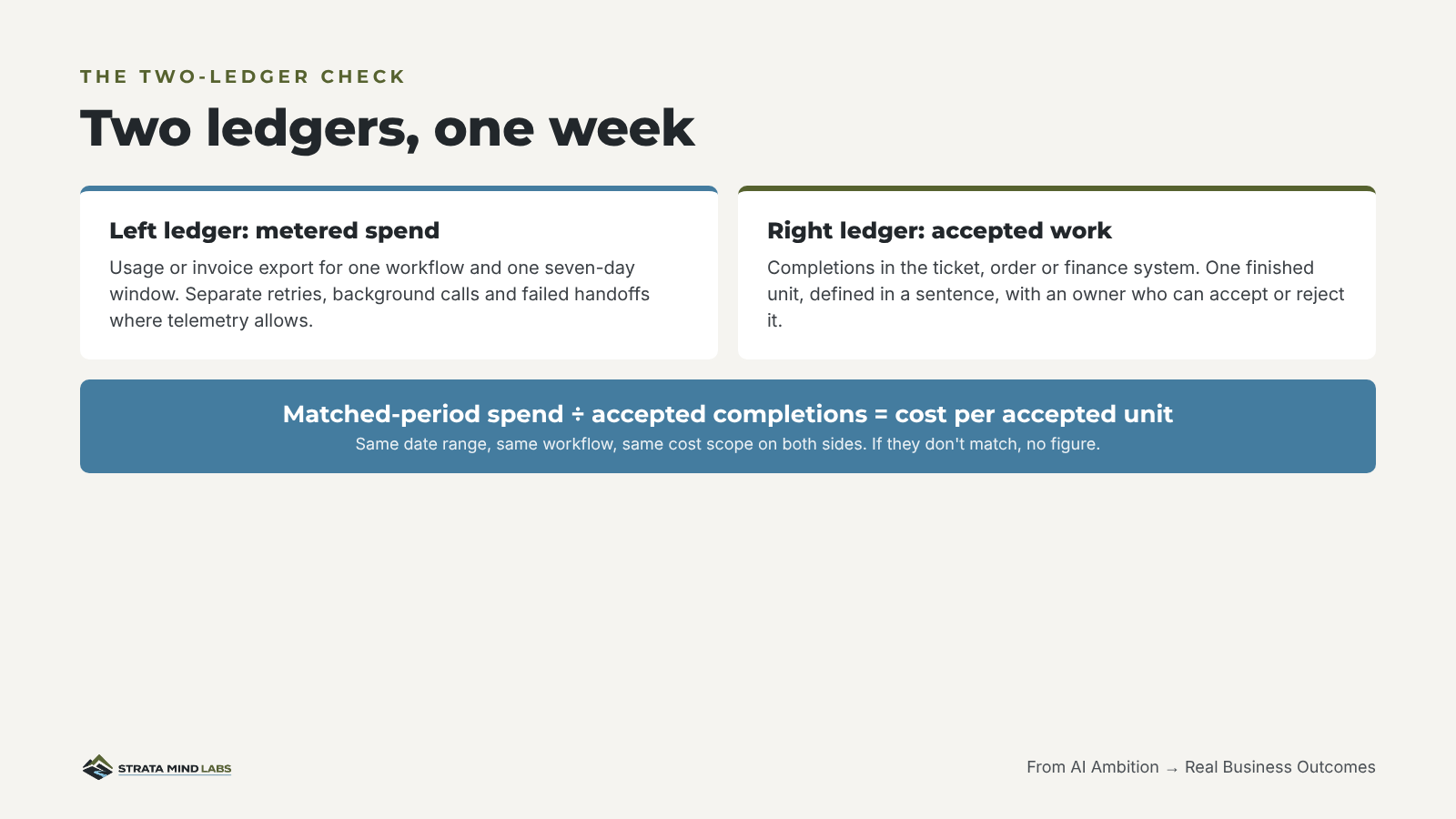
Define one finished unit in a sentence. Record the owner who can accept or reject it. Match the same date range, workflow and cost scope on both sides. Separate retries, background calls and failed handoffs where telemetry allows. A low price per call means little if the task needs a redo.
The strongest counterargument is that a small team may have no clean completion count. Start with a manually reviewed sample of accepted tickets or orders. If the sample can't tell accepted work from drafts, stop the calculation and repair the acceptance rule.
The first session
This is a proposed 60-minute first session. Sixty minutes is a planning estimate, not an observed deployment result. No new software is required if the exports already exist.
Bring a weekly usage or invoice export, one workflow identifier, a list of accepted outputs from the ticket, order or finance system and a process owner who can confirm the unit. Put metered spend and accepted output in the same seven-day window. Build rows with task ID, accepted date, charge amount, status and exception owner.
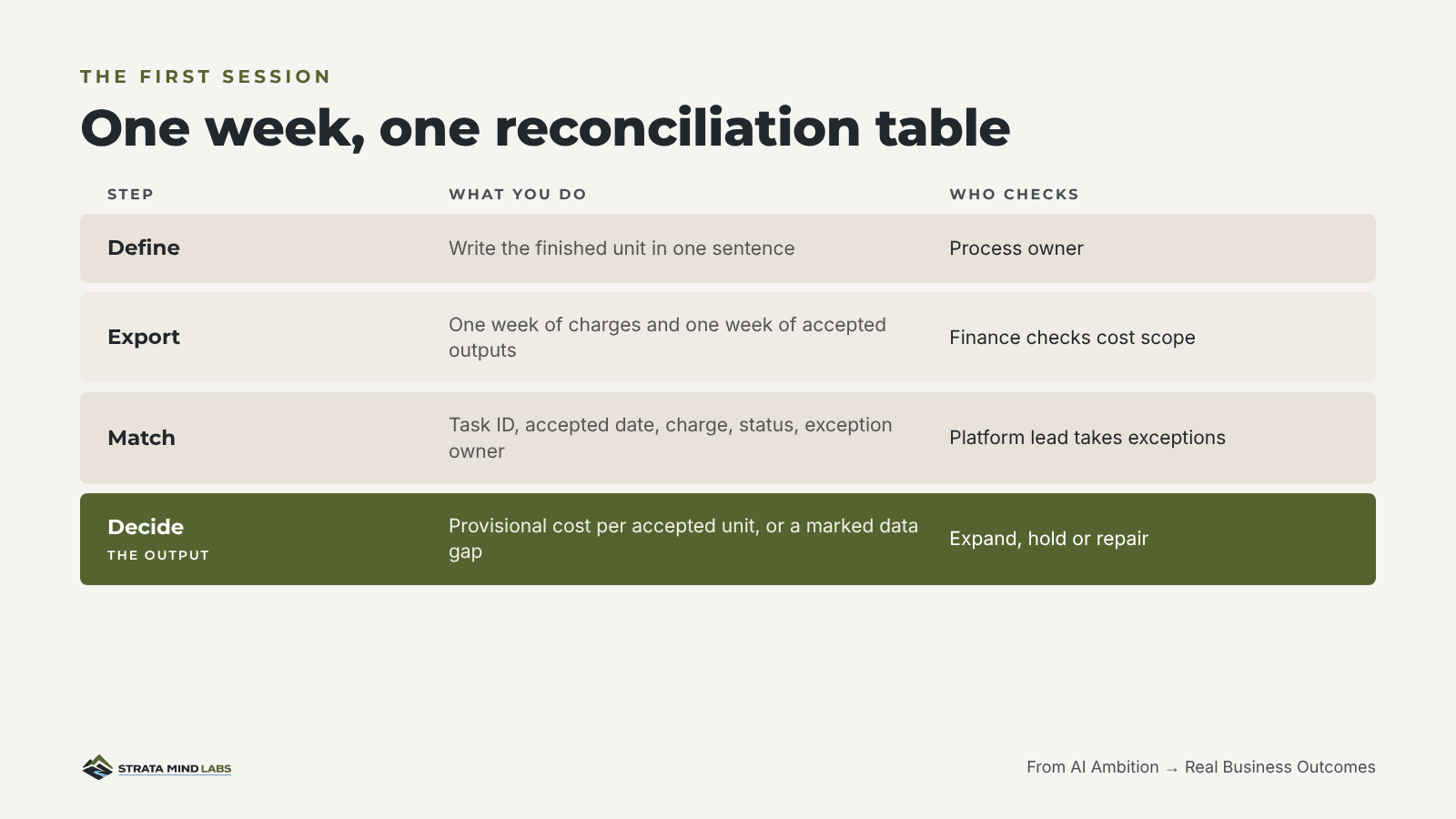
Review any charge with no mapped outcome and any accepted outcome with no clear cost attribution. A finance partner checks the cost scope. The process owner checks the completion count. The platform lead handles telemetry exceptions. The expected output is a reconciliation table with a provisional cost per accepted unit or a clearly marked data gap. It is not a promised savings figure.
Don't quote a unit cost if the date ranges differ, charges can't be assigned to the workflow or accepted status is undefined. Route unmatched rows to the platform lead and the process owner. They decide whether to fix identifiers, change the workflow or pause the spend increase.
Five prompts to run this week
Run these in order on one workflow. Use redacted rows only. A person checks every result against the source export.
Define the accepted unit
Copy this prompt
Using only the redacted workflow description and acceptance policy below, draft a one-sentence definition of a finished unit. List ambiguous cases and the human role that resolves each. Do not infer policy that is absent. Workflow: [paste]. Acceptance policy: [paste].
What this should tell you: the proposed unit, the ambiguity list and any missing policy. A unit defined only as an AI response is a warning sign. The denominator has to represent business acceptance before any unit cost is credible. Decision: the process owner approves the definition only when a real system can mark it complete.
Match the two exports
Copy this prompt
Compare these redacted usage rows and accepted-work rows for the same stated week. Return a table with task ID, usage date, accepted date, spend, accepted status and an unmatched flag. Do not merge records on a guessed identifier. Usage: [paste]. Accepted work: [paste].
What this should tell you: unmatched rows, date drift and duplicate IDs. Missing keys or different windows are warnings. An unmatched row is an attribution problem, not automatically waste. Decision: finance and operations authorize a calculation only when the scopes match.
Calculate a provisional unit cost
Copy this prompt
From the matched table below, sum metered spend for this workflow and count accepted completed units. Show the formula, period and included charge types. Calculate spend divided by accepted units only if the count is positive and attribution is documented. Label all assumptions. Table: [paste].
What this should tell you: the numerator, the denominator and the exclusions. A zero denominator or an unknown charge category means no result. The figure is a local cost measure, not a return on investment claim. Decision: finance accepts the provisional figure only after reconciling it to the invoice or billing export.
Investigate repeat work
Copy this prompt
Review these redacted tool-call rows for one task. Group identical calls by task ID, tool and normalized arguments. Flag repeats above three within one task as review candidates. Explain any known legitimate retries and do not label them waste without an owner review. Rows: [paste].
What this should tell you: flagged groups, missing task IDs and retry reasons. Repetition can raise total task cost even when each call is cheap. Decision: the platform lead decides whether to add a cap, repair tool instructions or keep a justified retry path.
Prepare the owner decision
Copy this prompt
Using the approved unit definition, reconciled table, provisional unit cost and reviewed exceptions below, draft a one-page decision record. Separate facts, calculations, inferences and unresolved questions. Offer expand, hold or repair with a named owner and a review date. Do not invent savings. Inputs: [paste].
What this should tell you: the chosen action, the evidence links and the open gaps. A recommendation without a named accepting owner is incomplete. Decision: the CIO or business owner chooses expand only when acceptance, attribution and review capacity are adequate.
The full sequence gives you an accepted-unit definition, a matched population, a provisional unit cost and an exception review. Business value stays unmeasured until an owner compares that cost with the value of the completed work. Unmatched spend, missing IDs and disputed acceptance remain uncertainty, not savings.
What to do this week
A fair limit on all this
The product announcement is evidence for features and access. It isn't a measured return, and TechCrunch's report doesn't test completed business units either. The two-ledger check and the 60-minute session are Strata Mind Labs proposed practice, not a validated standard. No savings figure is assumed. A budget increase without a matched denominator is an AI Investment Trap.
CIO Question of the Day
For the AI workflow you spend the most on, could you show me last week's cost per accepted unit, and who signed off on what counts as accepted?
Sources
- Anthropic. (2026, October 28). Smart reports, surveys, and pooled group budgets for Claude Enterprise. https://claude.com/resources/articles/smart-reports-surveys-pooled-budgets
- Fernholz, T. (2026, October 28). Anthropic just launched tools to show companies what their AI spending is buying. TechCrunch. https://techcrunch.com/2026/10/28/anthropic-just-launched-tools-to-show-companies-what-their-ai-spending-is-buying/
A low price per call means little if the task needs a redo.
New briefings land as soon as the signal is worth your time.