
Patch or Pull: Who Decides?
A named owner for the day a critical fix lands

Executive decision: Name the business owner who can authorize an emergency patch or remove an exposed service from the internet. Test the rule against the oldest web-facing instance this week.
If nobody can say yes to downtime at 9 p.m., the patch is already late.
The signal this week
On October 21 the PHP project released 8.5.12, 8.4.27, 8.3.36 and 8.2.35. Its advisory says the releases fix two critical vulnerabilities that can allow unauthenticated remote code execution. They are tracked as CVE-2026-109618 and CVE-2026-109619, and PHP says all users are strongly encouraged to update immediately.
The advisory covers every PHP installation serving web requests, including PHP-FPM, Apache with mod_php, php-cgi, FrankenPHP and LiteSpeed. PHP considers the risk highest for mod_php. There, it says, an exploit was demonstrated in which an unauthenticated request triggers the attack before any application code runs.
PHP also lists settings for teams that can't update right away. Its own wording is that only an update is a complete solution, and that these measures reduce exposure to specific attack paths but do not make an installation safe. So a workaround isn't a closure.
One more line matters for small shops. PHP 8.1 and older no longer get updates from the project. Some Linux distributions and long-term support vendors provide backported fixes, and PHP tells readers to contact their vendor for details.
The PHP Foundation's post on the release credits reports from the security firm Calif, from OpenAI and from Wiz. It also says AI-assisted research means the PHP security team now receives far more reports than before. That post doesn't say which tools found these two flaws, so we won't claim it.
What the sources show and don't
The PHP advisory is the authority on affected versions and fixes. A GitHub advisory for CVE-2026-109618 lists it as critical with a CVSS v4 base score of 9.2 and says it can lead to remote code execution as the web worker account. The Foundation post gives release context and the timeline.
None of this shows that your business was exposed or compromised. Whether you are affected depends on your versions, your hosting and your vendor's patch level. A scan that comes back UNKNOWN doesn't close the question, and a version label alone can miss a distributor backport.
To check this yourself, read the PHP advisory dated October 21, 2026 on php.net, then compare it with your own version records or your vendor's written patch status.
The decision most teams skip
The 80/10 Operator Test starts with one exposed service. Can your team identify the runtime, patch it, check it and restore it within a known window? If the answer is no, you have a decision-right problem as much as a patch problem.
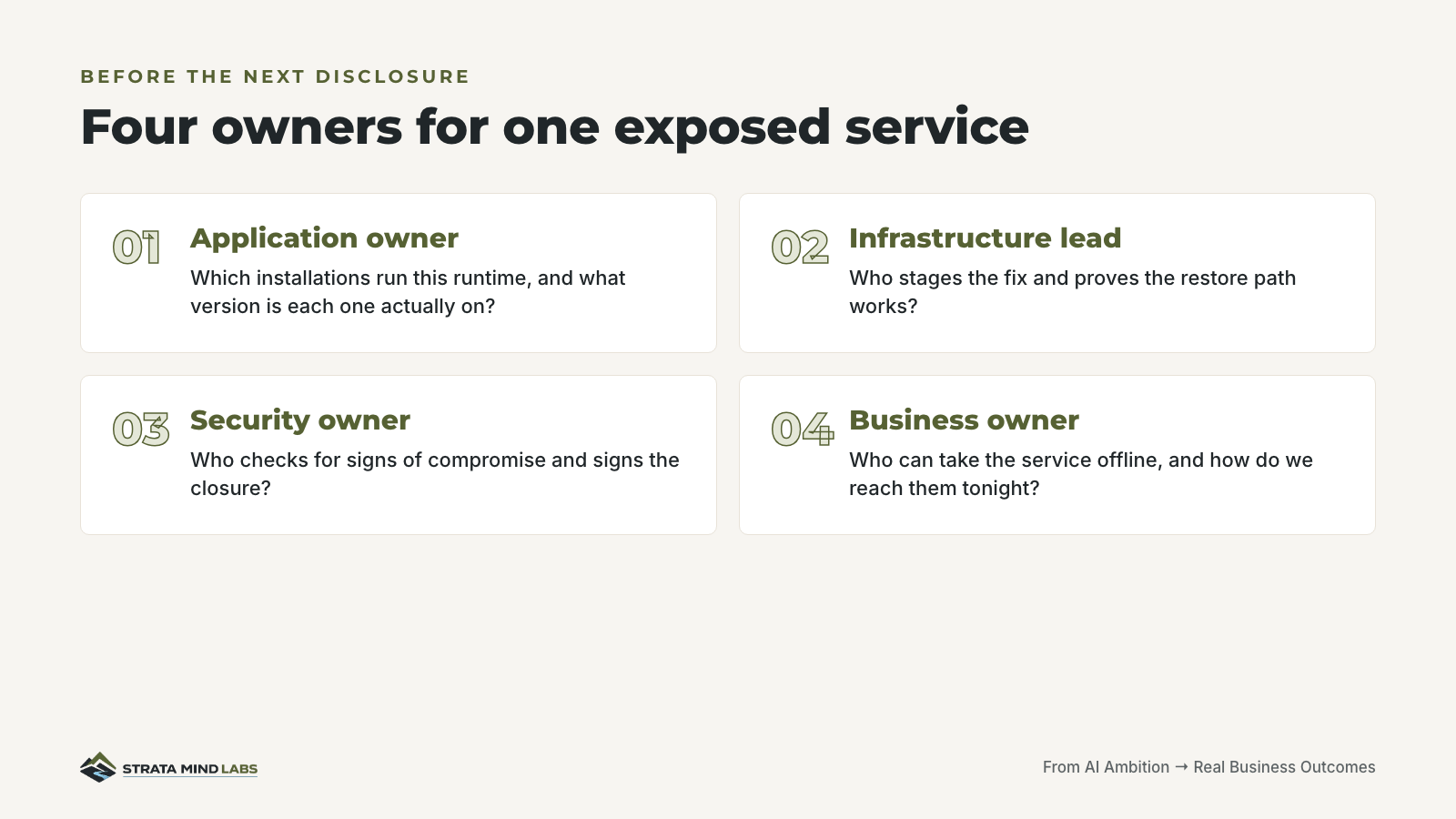
Four people own the result. The application owner finds the installations. The infrastructure lead stages the fix and proves the restore. The security owner looks for signs of compromise and signs the closure. The business owner decides whether a customer-facing service stays online when a safe update isn't available.
Put the evidence on one card. It is a proposed tool, and a named human signs it.
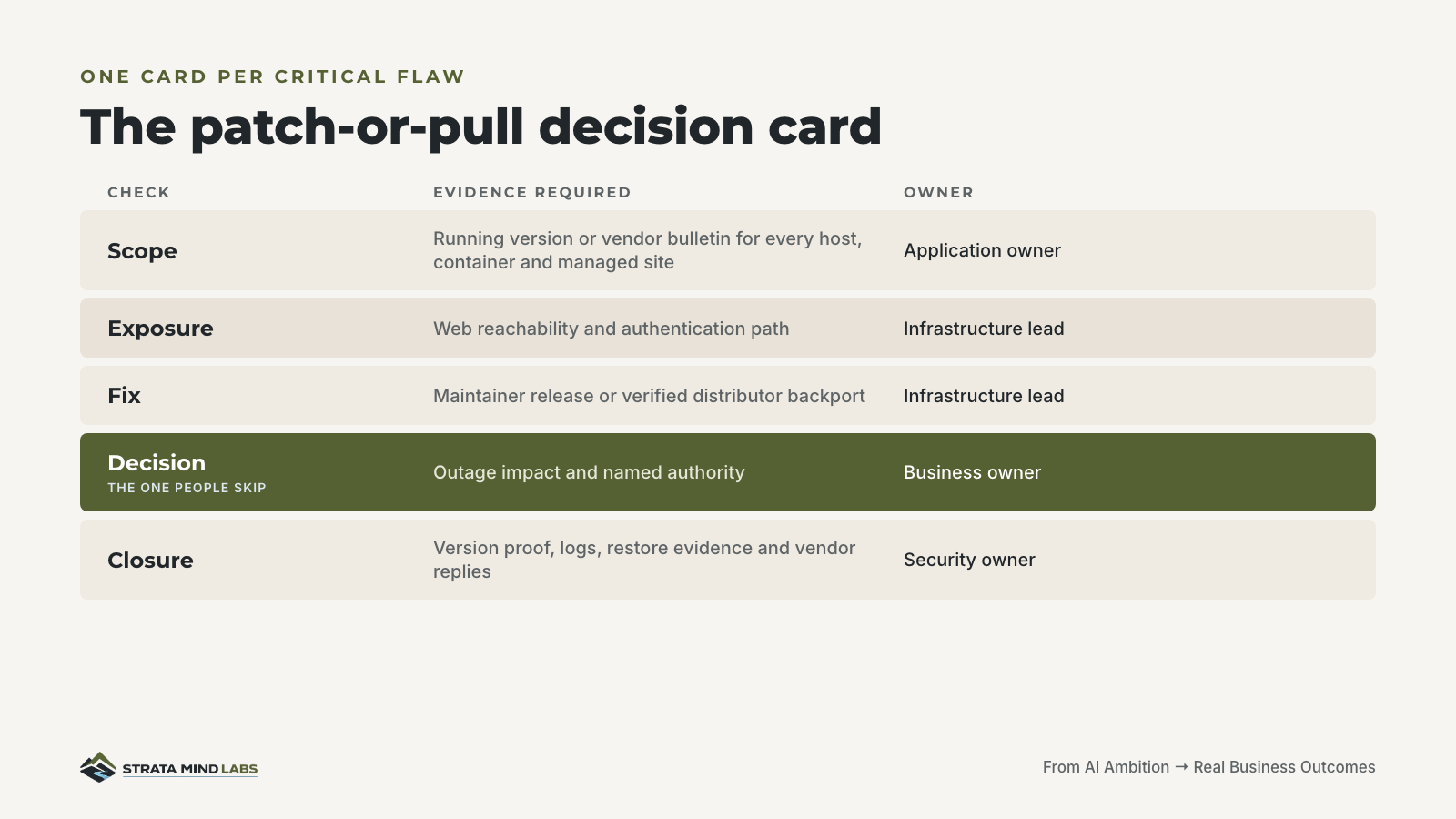
Where you don't control the runtime, a vendor manager gets the provider's written patch status. A managed host or a vendor-run site is still your exposure.
What the business owner chooses
The owner has three real options. Update now, take a short planned interruption or pull the service from public access until a safe update exists. Each one needs a time, a restore condition and a person who can be reached.
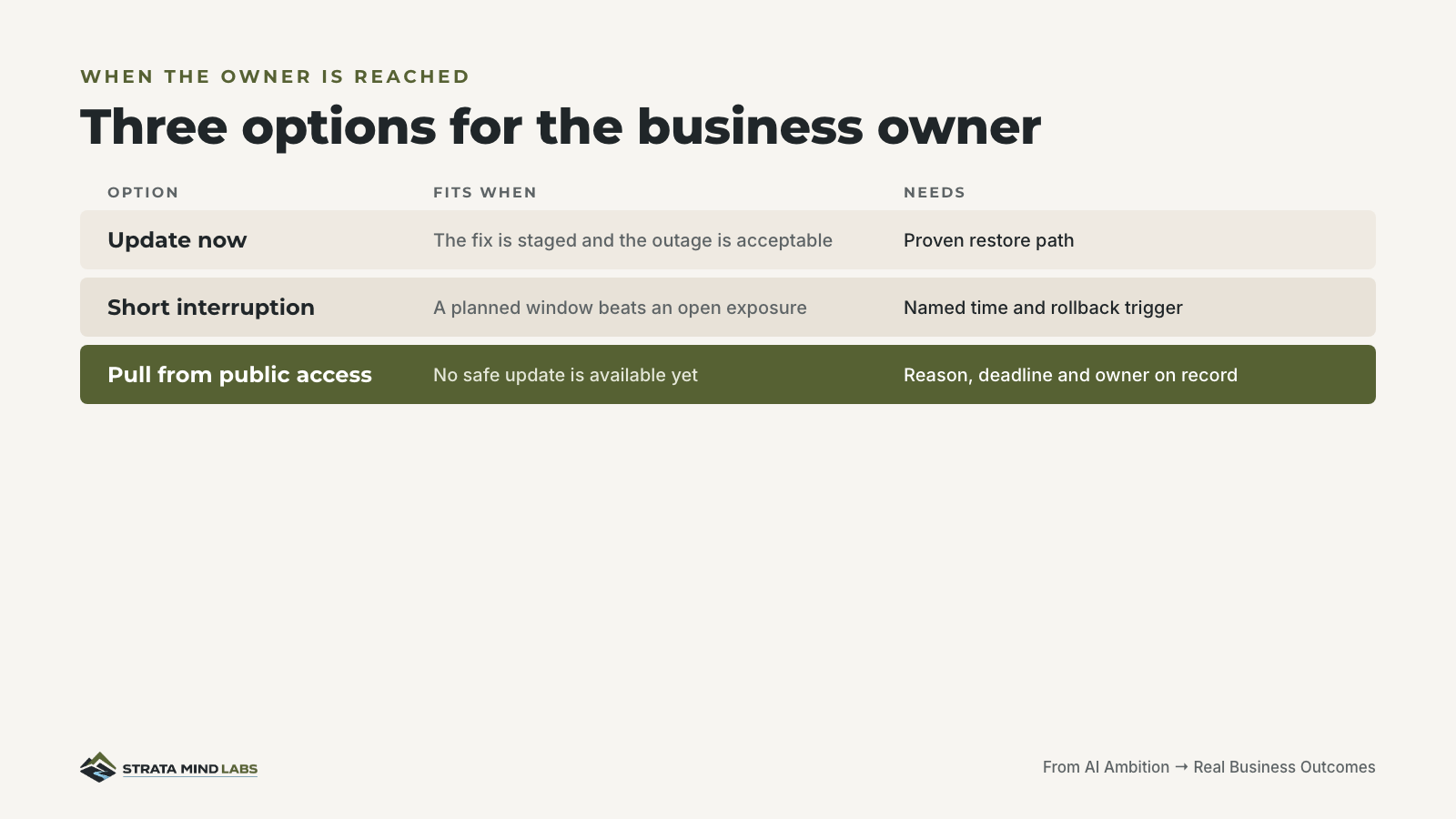
The proposed rule: if an affected public service can't be patched promptly and safely, the reachable business owner decides whether it stays available. Record the reason, the deadline and the owner. That's SML practice, not a universal response-time standard.
Five prompts to run this week
Use these in order. Feed them your own inventory and vendor records, and have a person verify every result. They organize evidence. They don't inspect your servers.
Map runtime exposure
Copy this prompt
Using only the inventory, deployment records and vendor attestations supplied below, list every web-serving PHP installation. Include host, container, base image, managed service and vendor-operated site. For each, show the evidence source, running version, internet reachability and owner. Mark unknowns explicitly. Do not infer an installed version from a website header alone.
What this should tell you: how many deployments are really exposed, not how many sites sit in a dashboard. Watch for missing vendor layers and unverified versions. Decision: the application owner picks which instances need direct inspection first.
Compare with the maintainer advisory
Copy this prompt
Compare the supplied deployment rows with the PHP project advisory dated October 21, 2026. Identify whether each installation appears to run 8.5.12, 8.4.27, 8.3.36 or 8.2.35, or a vendor-confirmed backport. Mark potential exposure, confirmed fixed state and unknown separately. Quote the exact advisory or vendor record used for each classification. Do not claim a workaround is complete.
What this should tell you: which rows are fixed, which are exposed and which are guesses. Watch for backport assumptions nobody can source. Decision: the infrastructure lead chooses what needs an emergency update or written confirmation from the provider.
Build the patch and restore plan
Copy this prompt
For each affected or unresolved installation, draft a human-reviewed update plan using the supplied deployment notes. Include the maintainer or distributor package, backup, test, expected outage, rollback trigger, named operator and verification command. Mark every missing input. Do not execute commands or make changes.
What this should tell you: whether you can get back if the update goes wrong. Watch for missing package provenance, no named operator and no restore evidence. A fast update with no restore path can create a second incident. Decision: the technical owner says whether the plan is ready for controlled execution.
Frame the business decision
Copy this prompt
Using the confirmed exposure, patch plan and service impact provided, draft a one-page decision for the named business owner. Compare immediate update, short interruption and temporary removal from public access. State what is known, what remains unknown, the deadline for reassessment and the person authorized to decide. Treat PHP's interim measures as partial only. Do not choose on the owner's behalf.
What this should tell you: whether each option has a real owner, a time and a restore condition. Watch for any option that leans on an unverified mitigation. Decision: the business owner authorizes patch timing or removal from public access.
Verify closure and learn
Copy this prompt
Given the approved action and fresh evidence, produce a closure checklist. Verify the installed fixed version or vendor backport on every instance, note any log review needed from the earliest relevant disclosure date, record outage and restore times and list unresolved vendor replies. Show evidence links and a separate open-risk list. Do not mark a host fixed without direct or written proof.
What this should tell you: whether you can honestly call it closed. One UNKNOWN host or one silent vendor blocks a complete closure claim. Decision: security and the application owner decide whether the incident can close, and the elapsed time from disclosure to verified fix becomes your own baseline.
What to do this week
A fair limit on all this
One release is not a frequency. The PHP advisory and the Foundation post establish the vulnerabilities, the fixed versions and the guidance. They don't show that your business was exposed, and they don't show how often events like this will repeat.
The Foundation describes AI tools in PHP's security work and reports from several firms, but it doesn't say which tools found these two flaws. Treat any claim that AI found them as unconfirmed. The owner roles, the decision card and the five prompts are SML proposed practice. We've measured no local result and we assume no savings or return.
Your first drill gives you a baseline. It isn't a benchmark borrowed from another company.
CIO Question of the Day
If a critical flaw hit your oldest web-facing service tonight, who could take it offline and how fast could you reach them?
Sources
- The PHP Foundation. (2026, October 21). Today's PHP security release, and how we're strengthening PHP security. https://thephp.foundation/blog/2026/10/21/todays-php-security-release-and-how-were-strengthening-php-security/
- PHP Group. (2026, October 21). Security advisory: Critical remote code execution vulnerabilities, update now. PHP.net news archive 2026. https://www.php.net/archive/2026.php#2026-10-21-5
- PHP. (n.d.). GHSA-w8hw-w9fx-j79w: RCE via OOM corruption (CVE-2026-109618). GitHub Security Advisories, php/php-src. Retrieved October 22, 2026, from https://github.com/php/php-src/security/advisories/GHSA-w8hw-w9fx-j79w
Name who can pull the plug. Do it before the advisory lands.
New briefings land as soon as the signal is worth your time.