
Know the Model Inside the Product
Vendor model provenance belongs in the renewal file
Executive decision: Ask vendors to name the models inside AI-enabled products that touch company data. Start with the highest-access products and record the answer at intake or renewal. Procurement owns the request. Security checks observable network activity, legal writes the terms and the business owner accepts the decision.
If a product touches your data, you should know which model runs it.
The signal this week
The Department of Homeland Security published a notice in the Federal Register on October 20 about an order it issued under the Federal Acquisition Supply Chain Security Act. The order excludes information technology products and services developed by DeepSeek and its affiliates from federal civilian agency procurement. It also orders removal of DeepSeek and affiliate products, and of third-party products and services developed using DeepSeek implementations, from civilian agency systems.
That last clause is the one to notice. A product can carry a model its buyer never picked. The notice text we read doesn't list which third-party products are covered and doesn't publish the evidence behind the order.
The order covers federal civilian agencies. It isn't a rule for private companies. It does show how fast a hidden dependency can turn into a removal project once someone upstream decides it matters.
What the sources show and don't
The notice is the primary evidence for the scope of the order and for nothing beyond it. We haven't seen the full evidentiary record, so we can't say how many products are affected.
Joint guidance from NIST, NSA and CISA, published in October 2026, sets out ten voluntary key practices for incident readiness and response. They include technical controls, monitoring for unexpected activity and evidence retention. Its stated audience is organizations training or evaluating highly capable agents. Applying it to a small business buying software is our extension of the idea, not a requirement in that document.
NIST's supply chain guidance, SP 800-161, is the older and more fitting reference. It helps organizations identify, assess and reduce cybersecurity risk across supply chains, including acquired products and services. It's general practice guidance. It doesn't tell you what to ask any specific AI vendor.
One record for each AI product
Keep a model provenance record for each AI-enabled product. Capture the model provider and version family, hosting, data handling, change notice, switch-off options and logs. Give it an owner and a review trigger.
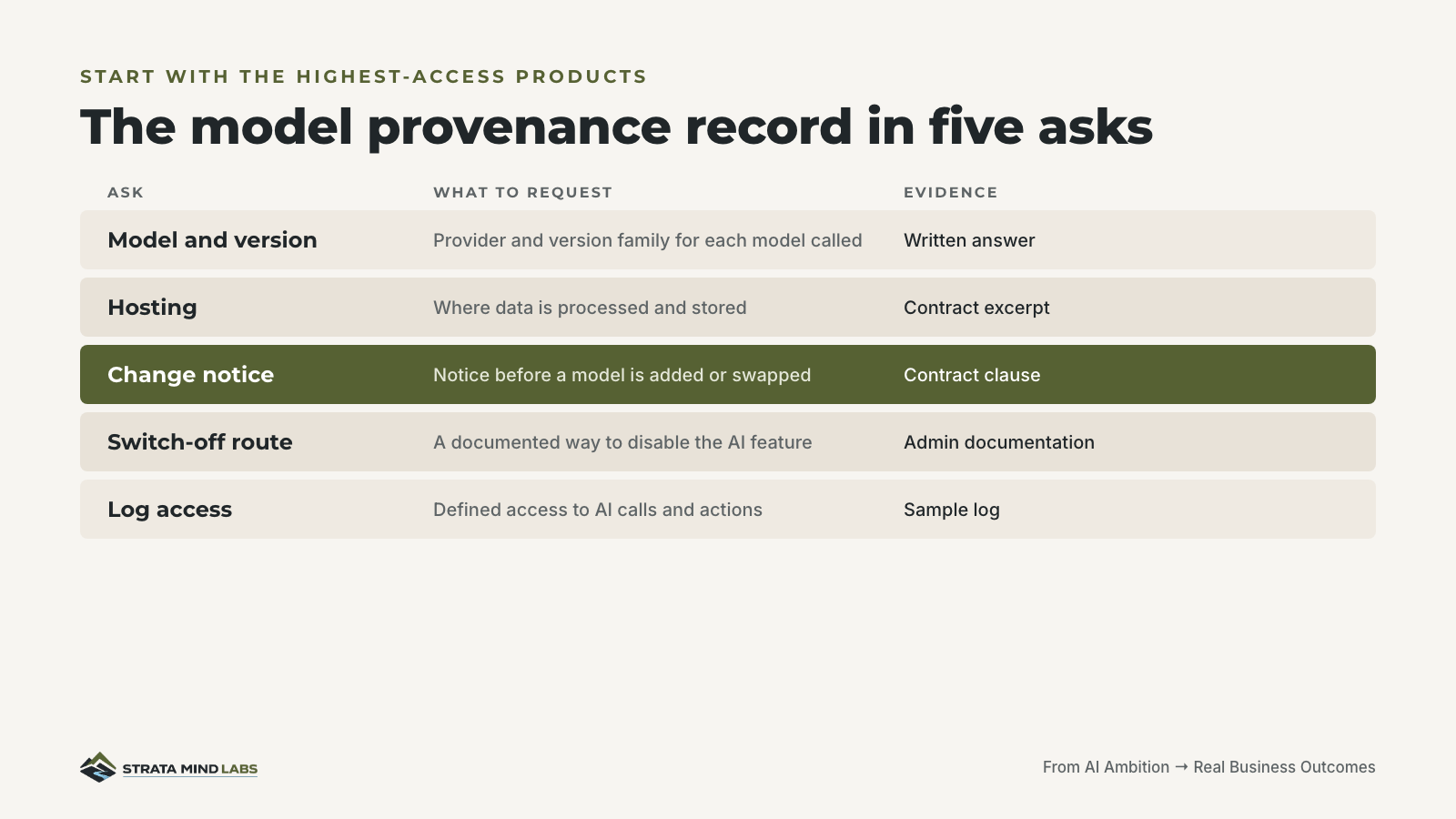
A weighted scorecard can help you rank which products to review first. The weights are SML's proposal. They aren't measured failure probabilities, and a high score is a reason to look, not a verdict.
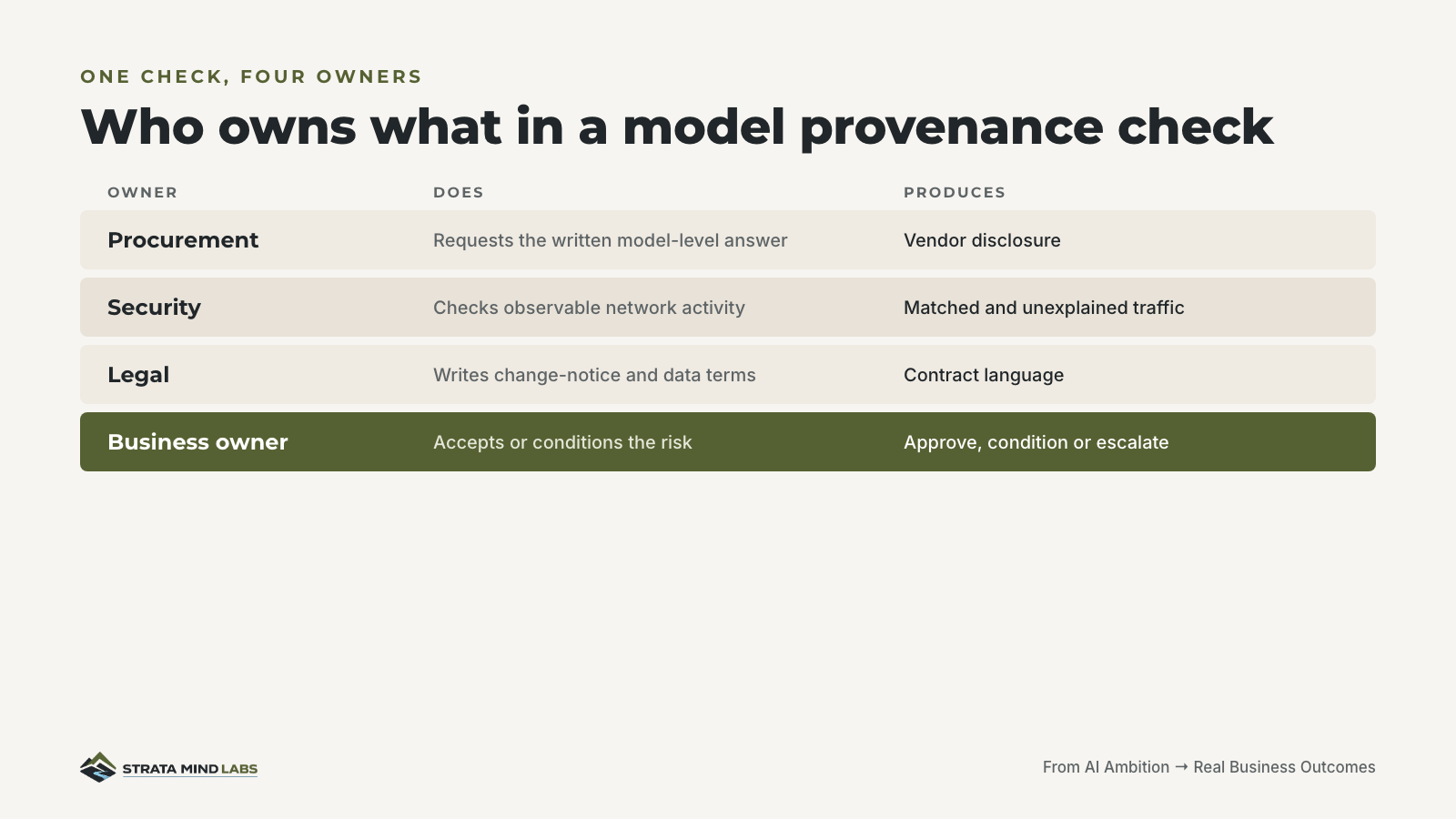
One check, four owners
Pick the products with the widest access to company data. Procurement requests a written model-level answer. Security compares the vendor's disclosed endpoints with the traffic it's permitted to observe and records what stays invisible. Legal reviews the change notice and data terms. A human owner records approve, condition or escalate.
Track review time and unresolved unknowns before you claim any value. A missing model-level answer on a high-access product gets escalated before renewal, whatever the score says.
Five prompts to run this week
Use these in sequence. Work from your approved software inventory and redacted observations only. A person verifies every result and approves anything before it goes outside the company.
Inventory the exposed products
Copy this prompt
Using only the attached approved software inventory, list AI-enabled products, business owner, data classes, vendor and renewal date. Mark unknowns. Do not infer a model from marketing copy.
What this should tell you: how wide the review is. Watch for missing owners, access scope and renewal dates. Unknown fields are work items, not passes. Decision: choose the first review group by data access and renewal timing.
Draft the vendor disclosure request
Copy this prompt
For each selected vendor, draft a neutral written request for model provider and version family, hosting, processing and storage locations, model change notice, retention, training use and logs. Do not send it.
What this should tell you: whether each question is specific to the product. A specific question is easier to compare with contract terms than a broad assurance. Watch for any assertion the draft makes without support. Decision: procurement decides which questions go to which vendor, and a person approves the request before it goes out.
Compare answers with evidence
Copy this prompt
Compare approved vendor replies and relevant contract excerpts with the requested fields. Cite exact evidence locations. Label each field confirmed, vague, contradicted or missing. Do not treat silence as assurance.
What this should tell you: where the vendor's answer and its paper disagree. Watch for contradictions, missing versions and hosting claims nobody verified. A written answer can still leave a model-change risk. Decision: security and legal choose which gaps need technical or contract review.
Check the visible boundary
Copy this prompt
Using redacted network observations supplied by security, compare observed destinations with the vendor disclosure. Separate matched, unexplained and unobservable traffic. Do not identify a model from an endpoint alone.
What this should tell you: whether traffic supports the disclosure. Watch for unexplained destinations and monitoring blind spots. Traffic evidence tests parts of the answer but can't prove the whole model chain. Decision: security decides whether to investigate or constrain access.
Prepare the owner decision
Copy this prompt
From the reviewed inventory, vendor answers, contract excerpts and security findings, draft approve, condition or escalate options. State evidence, unresolved gaps, data exposure, renewal timing and the named human approver. Do not decide or contact the vendor.
What this should tell you: whether each option rests on evidence and names an owner. A score organizes the discussion and doesn't replace judgment. Decision: the business owner, security and legal sign the final record, then you log the decision, the review date and the change trigger.
What to do this week
The business value is a clearer renewal decision and fewer unknown dependencies. Recheck after any notified model change, and escalate a missing answer on a high-access product before you renew.
A fair limit on all this
The DHS order covers federal civilian agencies and doesn't establish a private-sector obligation. The notice we read doesn't name the affected third-party products. The joint NIST, NSA and CISA guidance targets organizations training and evaluating highly capable agents, and we've applied its principle to procurement.
A vendor can answer incompletely, traffic can be unobservable and an implementation can change later. The provenance record, the scorecard and the five prompts are SML operating practice. No outside source validates the weights or a predicted return, and none is claimed.
CIO Question of the Day
Which AI-enabled product in your business touches the most sensitive data, and could its vendor tell you today which model runs inside it?
Sources
- Department of Homeland Security. (2026, October 20). Notice of order regarding exclusion and removal of DeepSeek products from federal civilian executive branch information technology systems and procurements (Docket No. DHS-2026-0628, FR Doc. 2026-21447). Federal Register. https://public-inspection.federalregister.gov/2026-21447.pdf
- National Institute of Standards and Technology, National Security Agency, & Cybersecurity and Infrastructure Security Agency. (2026, October). Key practices for incident readiness and response in super intelligence training and evaluation (Ver. 1.0). https://www.nist.gov/document/keypracticesforincidentreadinessandresponseinsuperintelligence-trainingandevaluation
- National Institute of Standards and Technology. (2022, May, updated 2024, November 1). Cybersecurity supply chain risk management practices for systems and organizations (SP 800-161 Rev. 1 Update 1). https://csrc.nist.gov/pubs/sp/800/161/r1/upd1/final
If a product touches your data, you should know which model runs it. Ask at renewal, in writing.
New briefings land as soon as the signal is worth your time.