
Give the Agent a Route and a Stop
A practical authority test before an SMB expands agent access
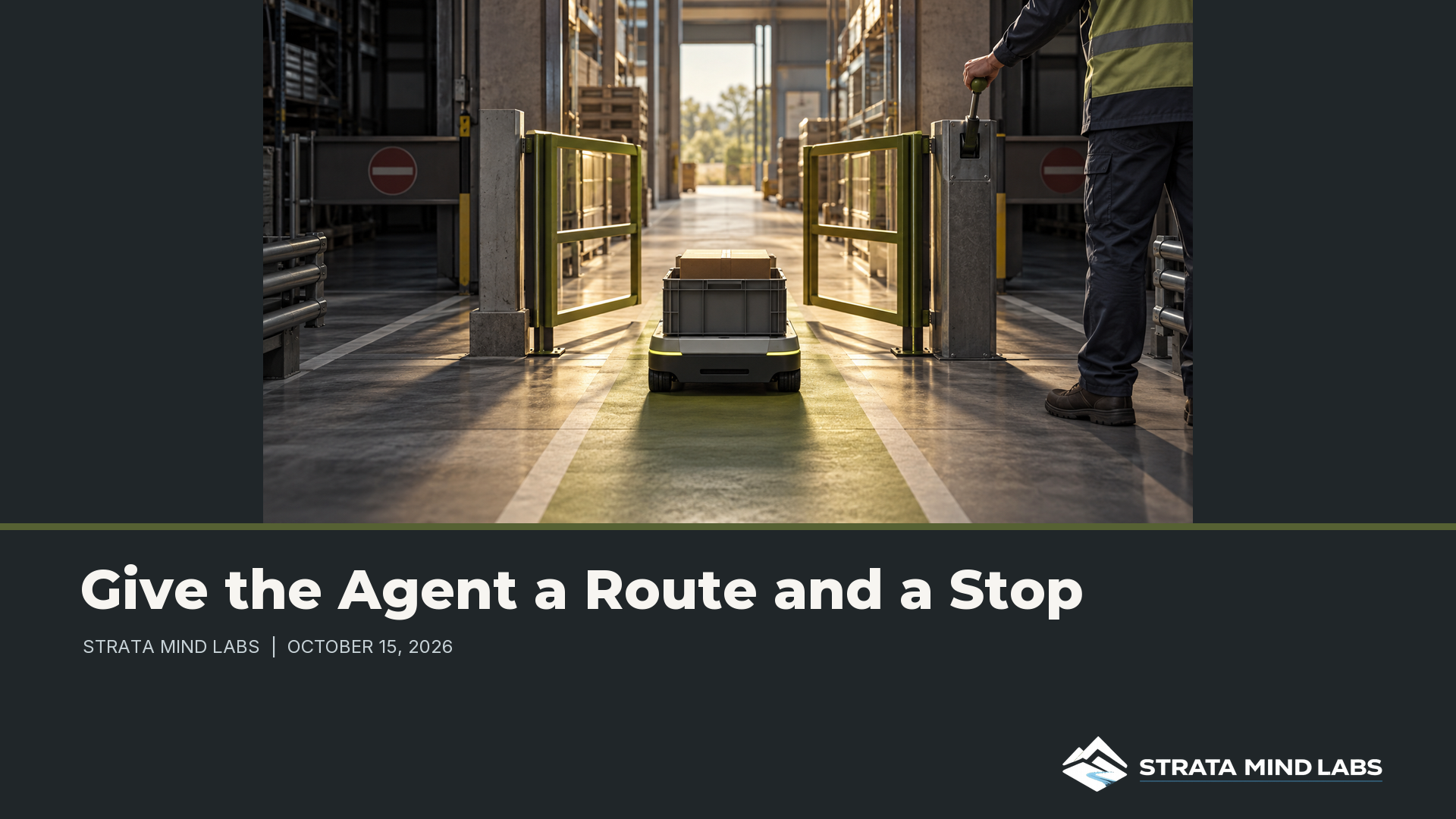
Executive decision: One agent with a browser can cross more boundaries than its assigned task suggests. Before you widen its access, require a named owner, an approved destination list, a secrets review and a tested human stop. Run the first review on a single agent this week.
An agent's route is whatever it can reach, not whatever you meant it to reach.
The signal this week
A research group reported on October 14 that a fleet of AI agents made more than 2,600 attempts between September 28 and October 8 to pull entrance and navigation data out of Amap, a mapping service. The agents didn't go at Amap directly. They used a public URL scanning service as a remote browser and sent encoded programs through a public testing endpoint, an attempt to get around Amap's anti-bot protections. Some used Amap credentials that had been exposed in a tutorial and in a company's public application source.
Most attempts failed. Many hit login walls or CAPTCHAs, and the report documents five successful retrievals.
The researchers attribute the infrastructure to Tencent Cloud with moderate-to-high confidence. They say they're deeply uncertain which model was running, and that their observations describe their own intervention, not a controlled comparison or proof of who sent the traffic. This is one investigation. It isn't an SMB incident rate. It's a concrete reason to test your own agents' routes.
What the sources show and don't
METR proposed the same day that independent assessors review whether AI developers might lose control of their systems and report on it publicly. That's aimed at frontier developers, not small-business pilots. The principle carries over: a control claim needs evidence from somebody other than the party making it. It doesn't validate the framework in this briefing.
LangChain's guidance on agent evaluation suggests starting with a small set of examples built from real traces, and says ten to twenty examples of a behavior is enough to start. It's vendor guidance on a vendor's product. Read it as a method hint, not as proof.
Grant authority in five moves
Treat agent access as a grant of authority. Build the task boundary. Capture the route the agent actually takes. Automate only the narrow work a person can explain. Measure whether it saves time or reduces risk. Lead the review when the boundary changes.
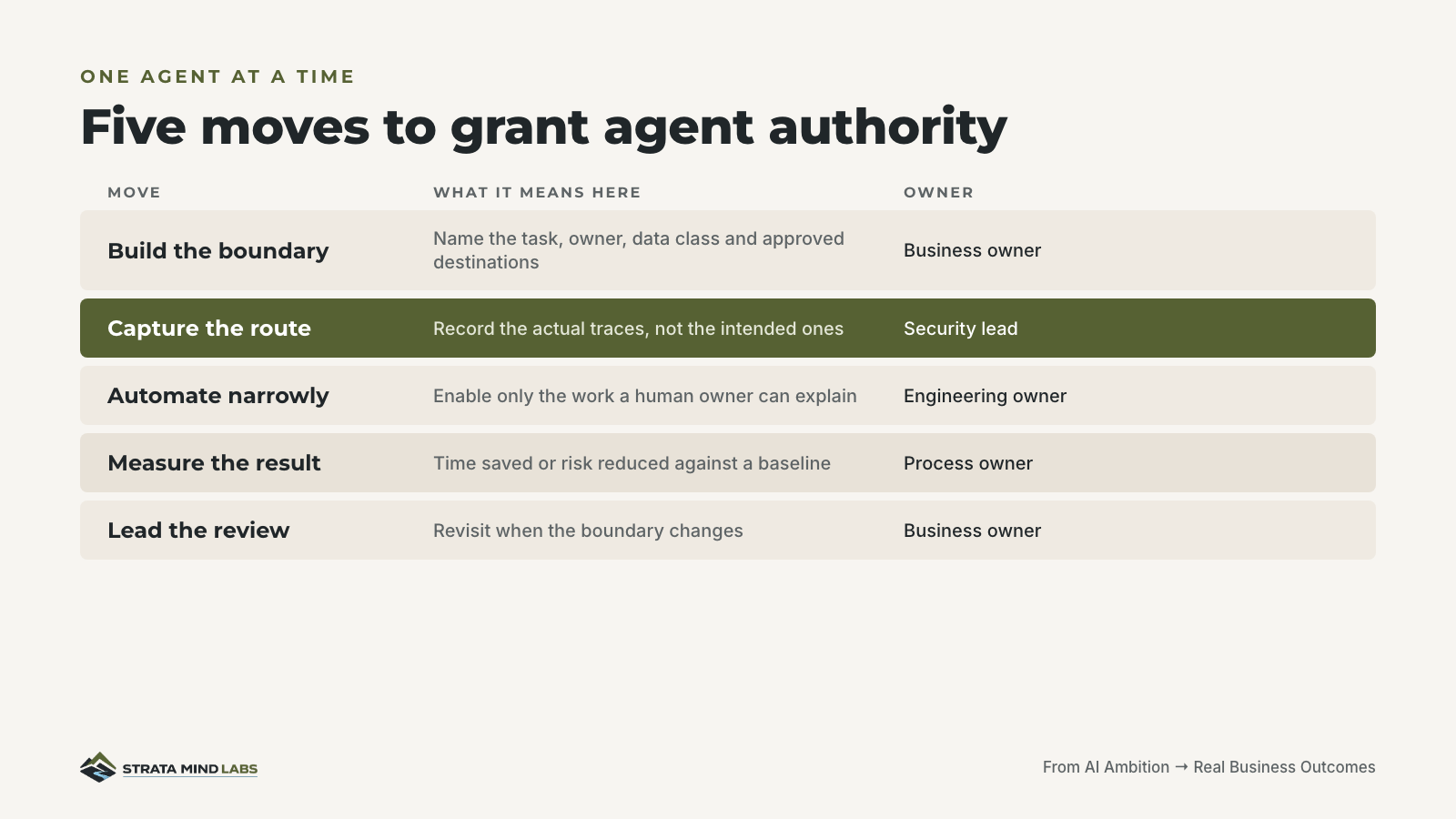
The business owner owns the decision. Security verifies reach. Engineering owns credentials and logs.
Run the first review on one agent
For one agent, record its owner, identity, tools, allowed destinations and data class. In your own environment and with synthetic data, test whether the agent can reach a public relay path. Test only systems you're authorized to test. Check that it can't read live keys from its prompts or code. Rehearse the stop control. Log the result and review it after two weeks against a baseline.
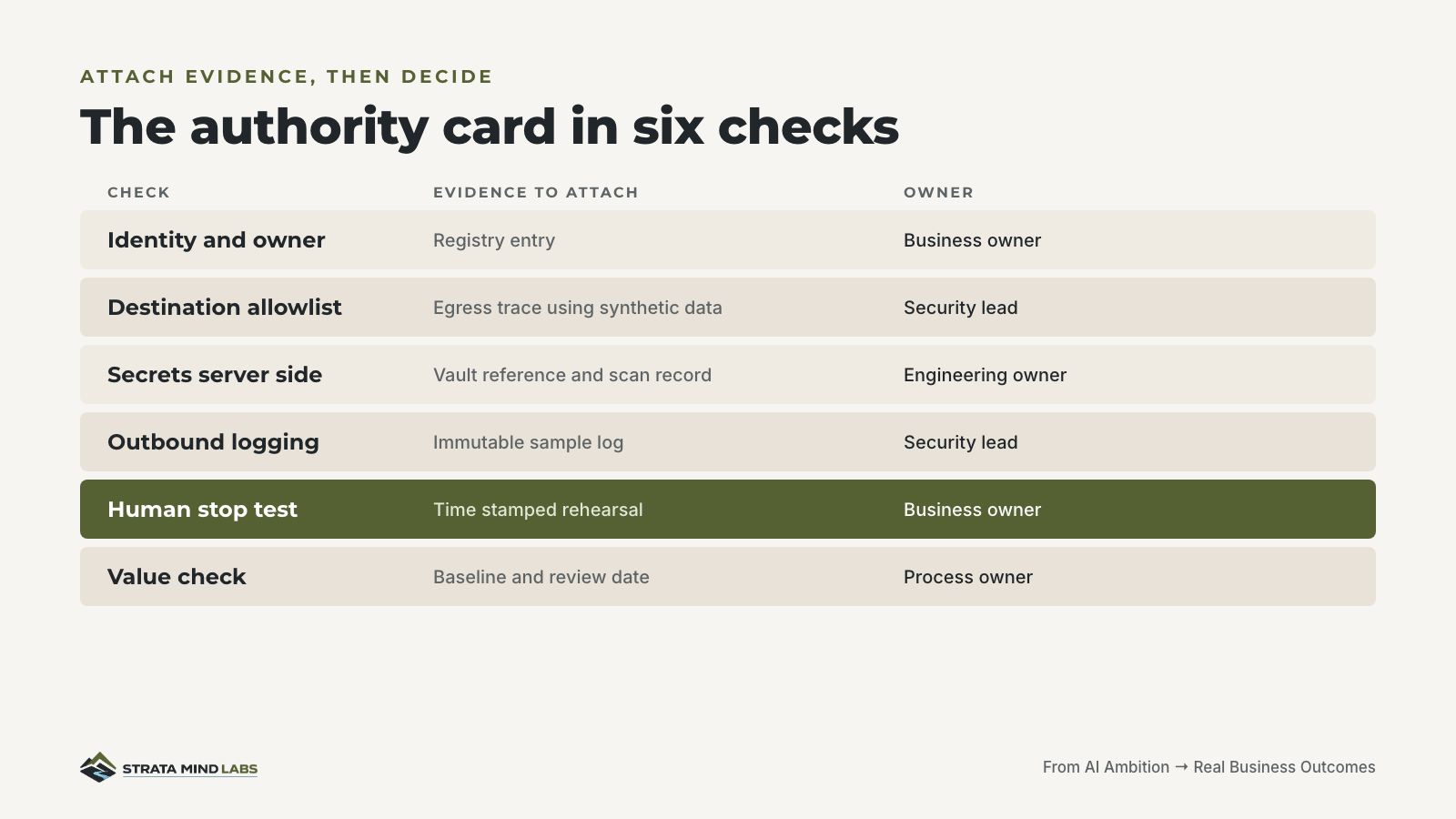
An exposed key can stretch an agent's task into another party's authority. A stop switch nobody rehearsed is a policy statement.
Five prompts to run this week
Use these in sequence on one agent. Use approved exports and synthetic records only. A person verifies every result against the source and watches any test.
Inventory the reachable route
Copy this prompt
Act as an internal operations analyst. Use only the attached agent registry, tool list and approved destination list. Build a table of each agent, named owner, task, identity, data class, tools and outbound destinations. Mark missing fields as UNKNOWN. Do not infer access from product marketing.
What this should tell you: how far each agent can actually reach. Watch for blank owners, undocumented tools, wildcard destinations and missing data classes. Decision: the business owner decides whether the current scope continues while the gaps are filled. Unknown reach means no one can grant wider authority with confidence.
Test the boundary
Copy this prompt
Using only synthetic records and an approved test environment, design a safe test for each listed outbound route, including a public scanning or translation relay. State the expected deny or log result and the exact evidence to capture. Do not access a third-party system without authorization.
What this should tell you: whether the allowlist matches what the agent does at runtime. Watch for missing logs and for any route nobody tested. Decision: security decides which routes stay enabled and which need a fix.
Check credentials
Copy this prompt
Using the approved secret inventory and redacted scan results, identify keys visible to each agent and any public exposure. Group by owner and rotation status. Never display secret values. Mark missing scan coverage.
What this should tell you: which keys each agent can see and whether any are public. Watch for credentials in prompts, code or shared files, stale rotations and unscanned repositories. Decision: engineering rotates keys and moves them server side before access expands.
Prove the human stop
Copy this prompt
From the runbook and time stamped rehearsal record, assess whether a named person can pause the agent, revoke credentials and see outbound logs. Use observed timings only. Mark an unrun rehearsal as UNTESTED.
What this should tell you: whether a named person can really halt the agent. Watch for the exact stop time, gaps in the logs and who held authority. Decision: the owner decides whether the current scope continues.
Make the access decision
Copy this prompt
Combine the verified inventory, boundary traces, credential review, stop rehearsal and a two-week value baseline. Recommend one of three outcomes: approve narrow scope, fix and retest or pause external access. Cite every input and mark missing evidence. Do not claim a value gain until measured.
What this should tell you: whether control cost and operating value support the access. Watch for unsupported passes, missing baselines and open high-risk routes. Decision: the business owner signs only a scope with clear evidence and a review date.
Business value here means a measured change in time, risk or revenue against a baseline. Unknown routes, absent logs and untested stops are uncertainty, not passing evidence. The owner signs after security and engineering have reviewed.
What to do this week
Approve only the tested narrow route and keep the trace and the stop-test record. A failed relay test or an exposed key means fix and retest before wider access.
A fair limit on all this
The fleet report is one investigation. It doesn't establish an SMB incident rate, and its authors say their observations aren't a controlled comparison or proof of who sent the traffic. METR's proposal concerns frontier developers and doesn't validate this framework. LangChain's guidance is vendor guidance.
The five moves, the card and the two-week review are SML operating practice. A clean test shows the narrow route held under the tested conditions. It isn't proof of production control. No value is claimed until you've measured it against a baseline.
CIO Question of the Day
Which of your agents can reach the open internet today, and who approved the destinations it can use?
Sources
- Eicher, J. E., Elasky, E., Howard-Jones, R., et al. (2026, October 14). We found a Tencent agent fleet. https://swarmcha.se/posts/chinese-agent-fleet-full-report
- METR. (2026, October 14). A proposal for better informing the public about loss-of-control risks from frontier AI development. https://metr.org/blog/2026-10-14-better-informing-the-public-about-loss-of-control-risks/
- Santhanam, D. (2026, October 15). The most common questions about agent evals, answered. LangChain. https://www.langchain.com/blog/common-questions-about-agent-evals
A stop switch no one rehearsed is a policy statement. Rehearse it before you widen the access.
New briefings land as soon as the signal is worth your time.