
Count the Check Before You Count the Saving
AI review cost belongs in the business case
Executive decision: Run a one-week baseline on one AI-assisted workflow. Count draft time, review minutes, corrections and the cost of errors that get through. The business owner approves the workflow only after Finance compares the cost per correctly completed task with the old process.
Fast output can still create slow work.
The signal this week
McKinsey's 2025 state of AI survey found that 27% of respondents at organizations using generative AI said employees review all generated content before it's used. A similar share said 20% or less is checked. The survey describes variation in practice. It doesn't show which review rate is right or what review costs.
That gap has a name. Verification Tax is the time and cost of establishing that an AI-assisted task is correct enough to use. For a small business, the decision is narrow: does a specific workflow still create capacity once the checking is counted?
What the sources show and don't
NIST's AI Risk Management Framework calls for defined human oversight roles. Its Playbook suggests measuring and documenting human oversight (including statistics on overrides) and recording go and no-go decisions made by accountable parties. That's guidance, not a forecast of savings.
Brynjolfsson, Li and Raymond studied 5,172 customer-support agents using a generative AI assistant. Productivity rose about 15% on average. It rose roughly 34% for novices and changed little for the most experienced agents. That's a useful counterweight to the claim that checking always cancels the benefit. It can't price another company's review queue.
Treat the task as the unit of value
Treat the task, not the generated draft, as the unit of value. Define a correct completion first. Record total elapsed and labor time from intake to accepted outcome. Route review according to what an unnoticed error could do. Keep human authority over irreversible actions and customer-facing commitments.
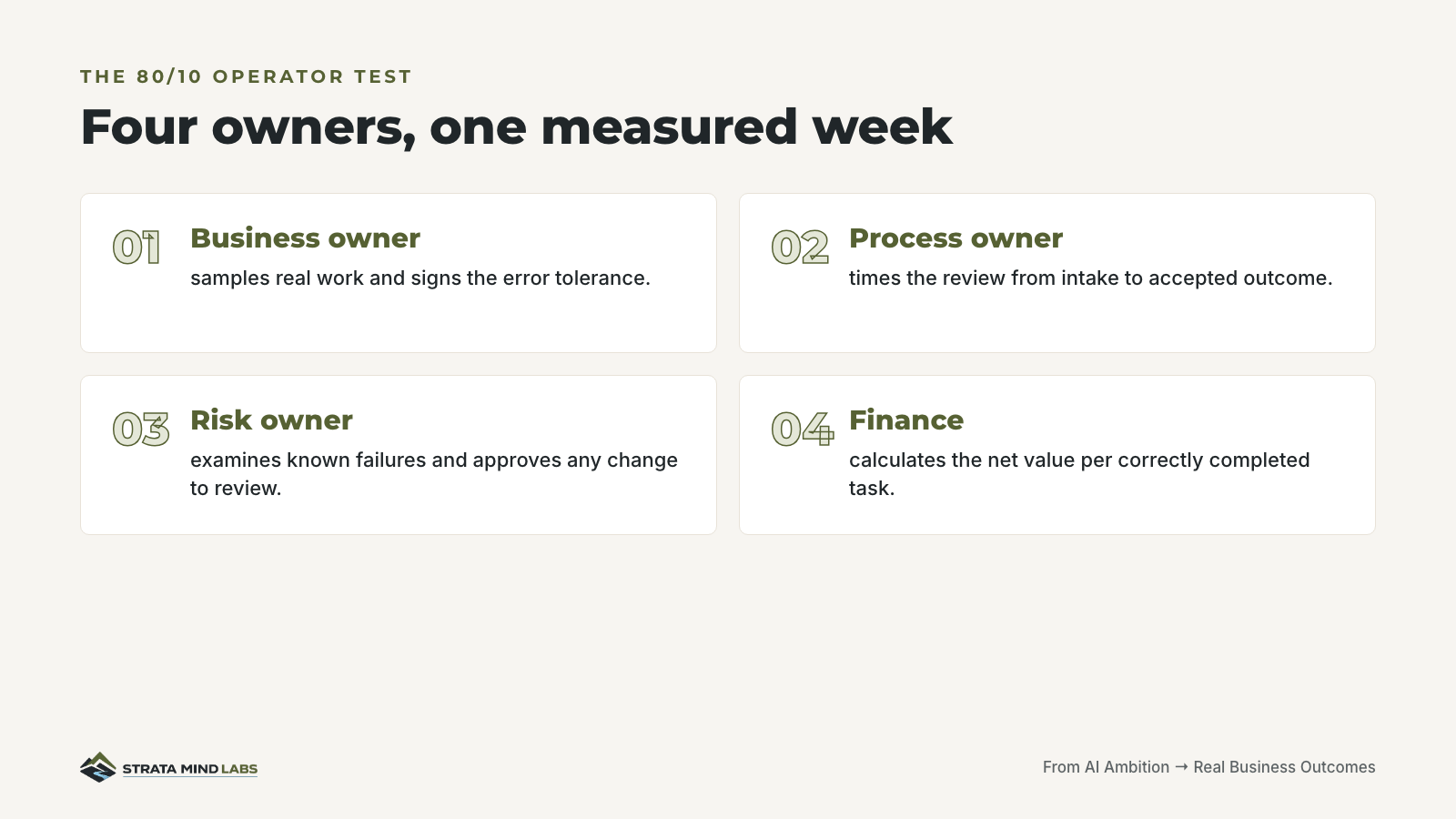
The proposed 80/10 Operator Test puts four owners on one measured week. The name is a practical label for this proposed test, not an external research finding.
Run the one-week baseline
Choose one repeatable workflow with enough weekly volume to observe. Classify outputs as low, material or severe consequence. Set the current process as the comparison. Record volume, AI tool cost, draft minutes, review rate, review minutes, correction minutes, escaped errors and total labor cost. Use the same definition of a correct completion for both paths.
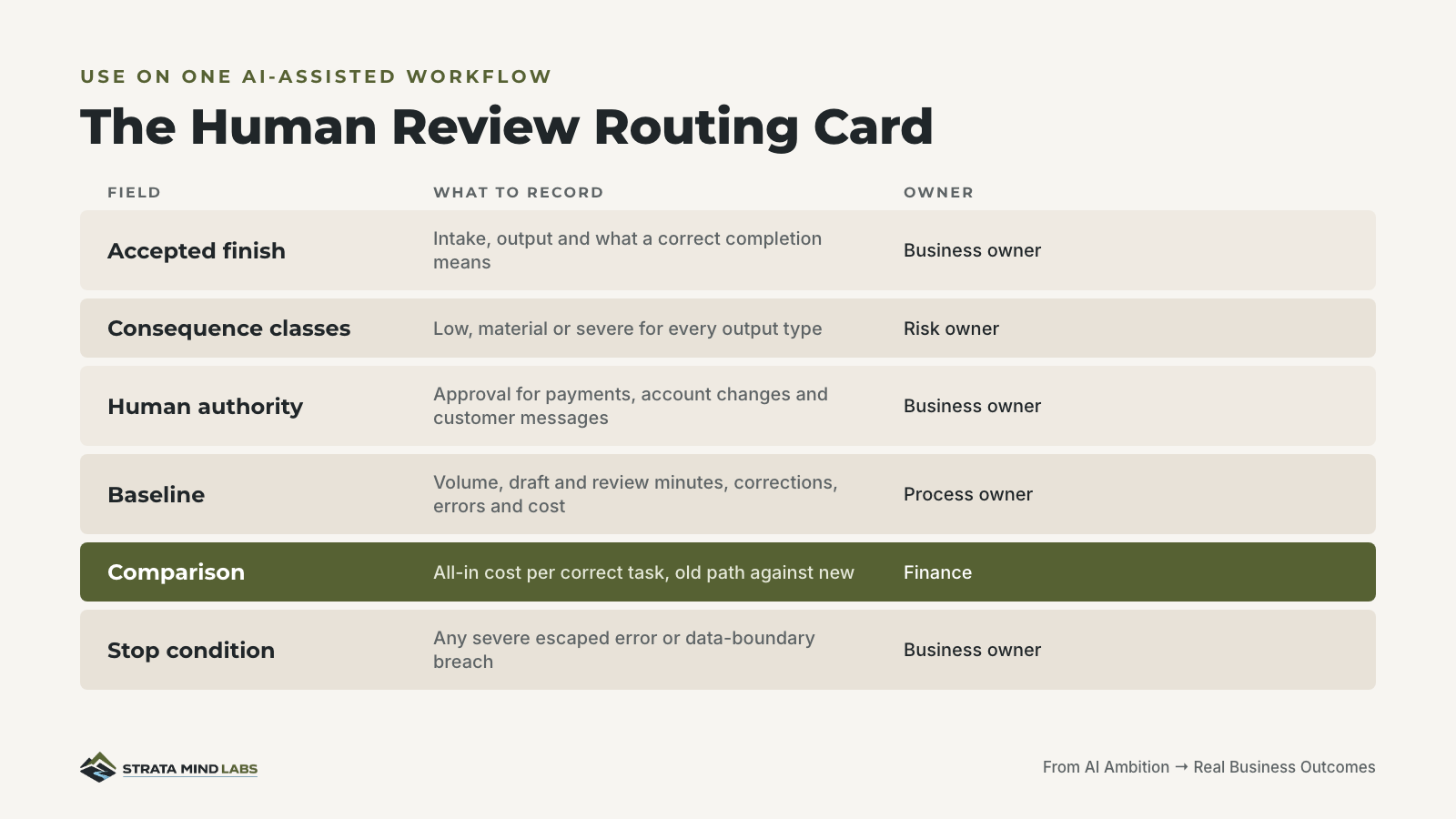
Don't lower review based on the model's own confidence alone. Test the proposed routing rule on past cases, including known failures. A risk owner signs any change. Stop the test if a severe error passes its control or if the data boundary is violated.
Five prompts to run this week
Use these in sequence on one workflow, with synthetic or approved records only. A person checks every result against the source.
Define the workflow
Copy this prompt
Using only the supplied workflow description and synthetic or approved records, identify the task boundary, inputs, output types, current human steps and the named business owner. List missing facts. Do not estimate savings.
What this should tell you: whether each output has a clear start, an accepted finish and an owner. A vague task boundary makes every later cost calculation look better than it is. Watch for missing volume or source records. Decision: pick a single workflow only when its owner and completion rule are documented.
Classify consequence
Copy this prompt
For each output type from Prompt 1, classify the consequence of an unnoticed error as low, material or severe. Identify irreversible actions, customer commitments, data boundaries and current approval rules. Mark uncertain classifications for a human risk owner.
What this should tell you: how much an unnoticed error could cost for each output type. Review effort should follow consequence, not output volume alone. Watch for missing outputs, unsupported labels and any action with no human authority. Decision: require human approval for irreversible or severe actions and send uncertain cases to the risk owner.
Build the baseline
Copy this prompt
From approved case logs only, create a baseline table with weekly volume, generation time, review rate, review minutes, correction minutes, tool cost, labor rate and correctly completed tasks. Show missing values and calculation formulas. Do not fill gaps with estimates.
What this should tell you: the cost per correct task, which is the useful comparison, not the seconds it takes to create a draft. Watch for raw counts, units, missing cases and whether correction time is included. Reject rows with invented values. Decision: Finance calculates a baseline only when the measured inputs and the comparison period are sufficient.
Test review routing
Copy this prompt
Propose review and sampling rules for the consequence classes using the baseline and known failure cases. Run the proposed rules against those historical cases. Report catches, misses and cases that lack evidence. Do not put a new rule live.
What this should tell you: whether a lower review rate still catches consequential errors. Watch for missed material or severe failures, thin samples and any case where the model's confidence was the only routing reason. Decision: the risk owner accepts, revises or rejects the rule after the historical test.
Frame the owner decision
Copy this prompt
Using the approved baseline and routing test, calculate cost per correctly completed task for the old process and the proposed AI process. Show formulas, sensitivity to review minutes and unresolved uncertainty. Draft a one-page owner decision with a stop condition and next measurement date.
What this should tell you: net value depends on accepted work and the Verification Tax, not draft speed. Watch for the numerator, the correct-completion denominator, the sensitivity range and any saving no log supports. Decision: the business owner proceeds, revises or stops only after Finance and the risk owner review the evidence.
The sequence produces a decision record, not an automated approval. Business value is cost and capacity per correctly completed task. Uncertain inputs stay visible. Finance owns the calculation, the risk owner owns control changes and the business owner decides whether to continue the one workflow.
What to do this week
Continue only if the measured result saves time or reduces risk within the agreed error tolerance.
A fair limit on all this
The McKinsey survey shows variation in review practice. It doesn't show which rate is right or what review costs. NIST is guidance, not a forecast of savings. The customer-support study found gains that vary a lot by worker and doesn't price your review queue.
The routing card and the 80/10 Operator Test are SML proposed operating practice, not an industry standard. No saving is claimed until a measured week supports it.
CIO Question of the Day
For your busiest AI-assisted workflow, what's the cost per correctly completed task once checking is counted, and who measured it?
Sources
- McKinsey & Company. (2025, March 12). The state of AI: How organizations are rewiring to capture value. https://www.mckinsey.com/capabilities/quantumblack/our-insights/the-state-of-ai-how-organizations-are-rewiring-to-capture-value
- National Institute of Standards and Technology. (2023). AI RMF Core. AI Risk Management Framework. https://airc.nist.gov/airmf-resources/airmf/5-sec-core/
- National Institute of Standards and Technology. (2023). AI RMF Playbook: Measure. https://airc.nist.gov/airmf-resources/playbook/measure/
- Brynjolfsson, E., Li, D., & Raymond, L. R. (2025). Generative AI at work. The Quarterly Journal of Economics, 140(2), 889-942. https://academic.oup.com/qje/article/140/2/889/7990658
Cost per correct task is the comparison that counts. Not the seconds it took to draft.
New briefings land as soon as the signal is worth your time.