
Cheaper AI Still Has to Earn Its Keep
A small-business test for the AI price-cut headlines.
Executive decision: Ask the office manager to collect 20 recent examples of one routine task. Record current handling time, then run a controlled comparison with human review. Keep customer actions under the existing approval rule.
The price-cut story is getting attention. For a business owner, the useful question is whether a cheaper model lowers the cost of work the team can actually use.
A plumbing office might use AI to sort incoming service requests or draft appointment confirmations. A draft that takes four minutes to repair is a different product from a draft the dispatcher can accept in one minute. A lower model bill is useful only if the accepted outcome costs less.
The signal this week
Anthropic launched Claude Haiku 5.5 on October 7 and reports an average running-cost reduction of around 75% versus Haiku 4.5. That's a vendor calculation, not an SMB savings result. The published API rate is $0.10 per million input tokens and $0.50 per million output tokens for prompts up to 100,000 tokens, rising to $0.50 and $2.50 above that. These are developer usage prices, not a promise that a software subscription falls by the same amount.
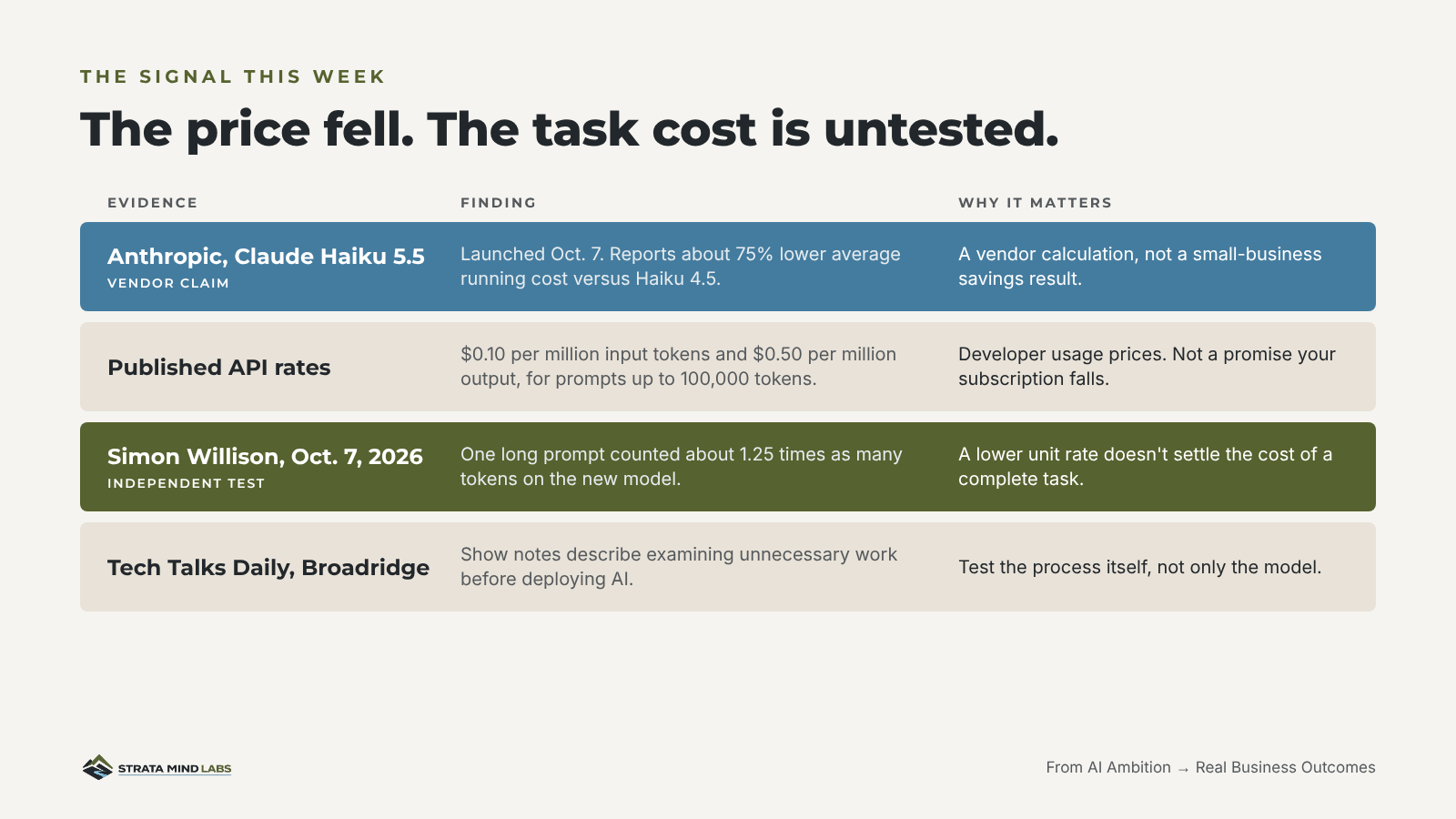
Simon Willison independently tested token counting on one long prompt and reported roughly 1.25 times as many tokens with the new model. His test doesn't measure small-business workflow economics, but it shows why a lower unit rate doesn't settle the cost of a complete task. Separately, the Tech Talks Daily show notes describe Broadridge examining unnecessary work before deploying AI. That's a different setting, and it supports testing the process itself before trusting any savings claim.
Choose the task before the model
A business can spend less on each AI call and still spend more overall if it creates extra checking, repeats work or produces outputs nobody uses.
That's why the Verification Tax belongs in the calculation. It's the staff time spent checking and repairing AI output before it can be accepted. It's an SML operating measure, not a published benchmark, and it's usually the number nobody writes down.
Run the Accepted Task Test
Four steps, in order, on one narrow task.
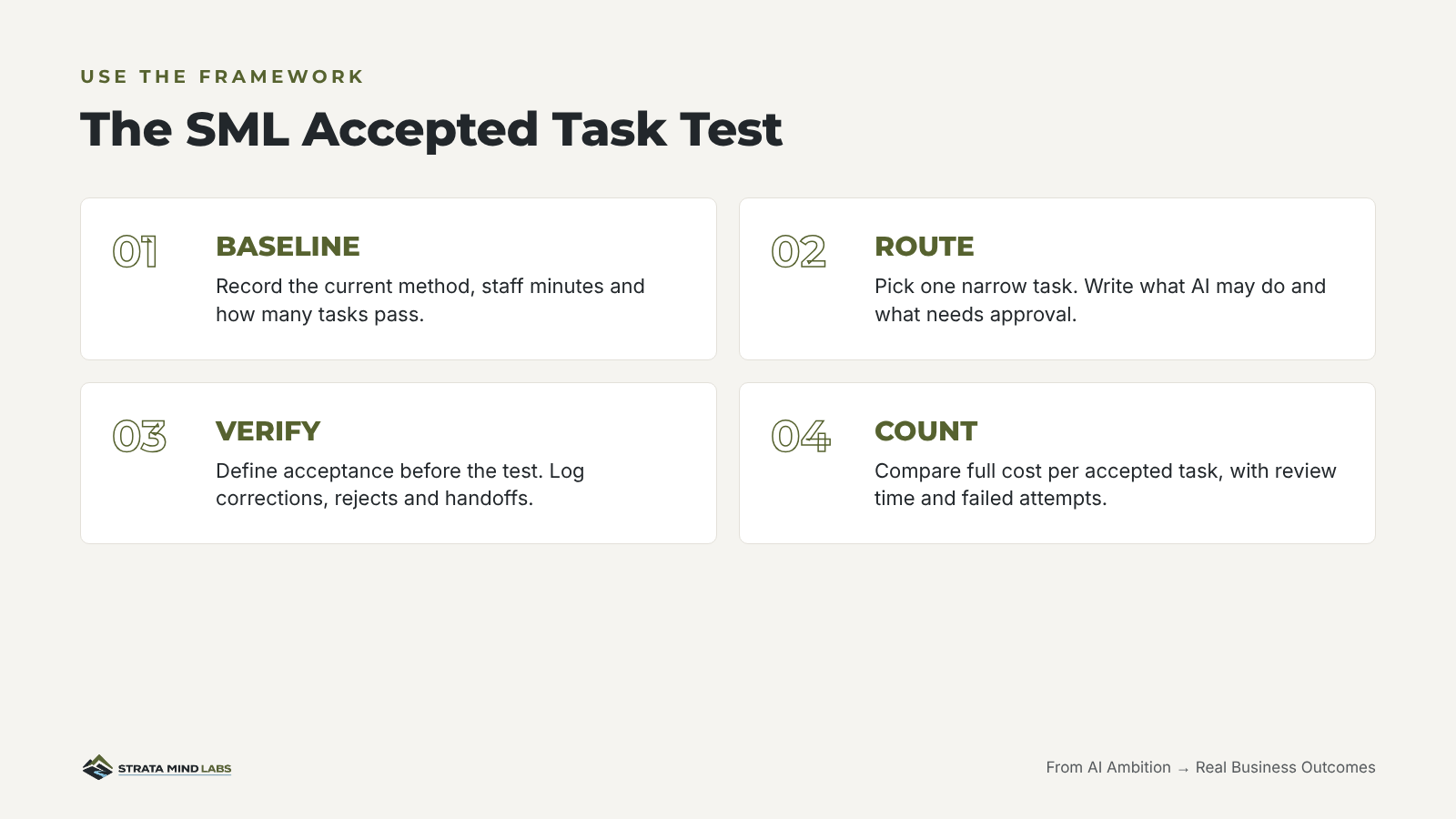
BASELINE. Record the current method, the staff minutes and the number of tasks that pass.
ROUTE. Choose one narrow task with known inputs. Write down what the AI may do and what requires approval.
VERIFY. Define acceptance before the test starts. Record corrections, rejects and human handoffs.
COUNT. Compare full cost per accepted task. Include review time and failed attempts.
What makes a good first task
Sorting customer enquiries into existing categories is a reasonable first comparison. So is drafting a confirmation from an approved appointment record. Use the same examples for both methods and keep sending under human control.
A disputed refund or a safety recommendation needs judgment beyond a routine drafting test. Cheap output doesn't remove that consequence. Keep the normal human approval path while testing any supporting work.
The measure
Full cost per accepted task = total test cost divided by tasks that pass.
Total test cost includes model or tool charges, allocated staff handling time and setup cost for the evaluation period. Count review once. Include rejected attempts in cost, but exclude them from accepted output.
A worked example
This is illustrative arithmetic only. The inputs are invented, not a client result or a model-price estimate. An office processes 100 confirmations in a test period. Today each takes four staff minutes. At an assumed $30 per staff hour, the handling cost is $200, and all 100 meet the acceptance rule.
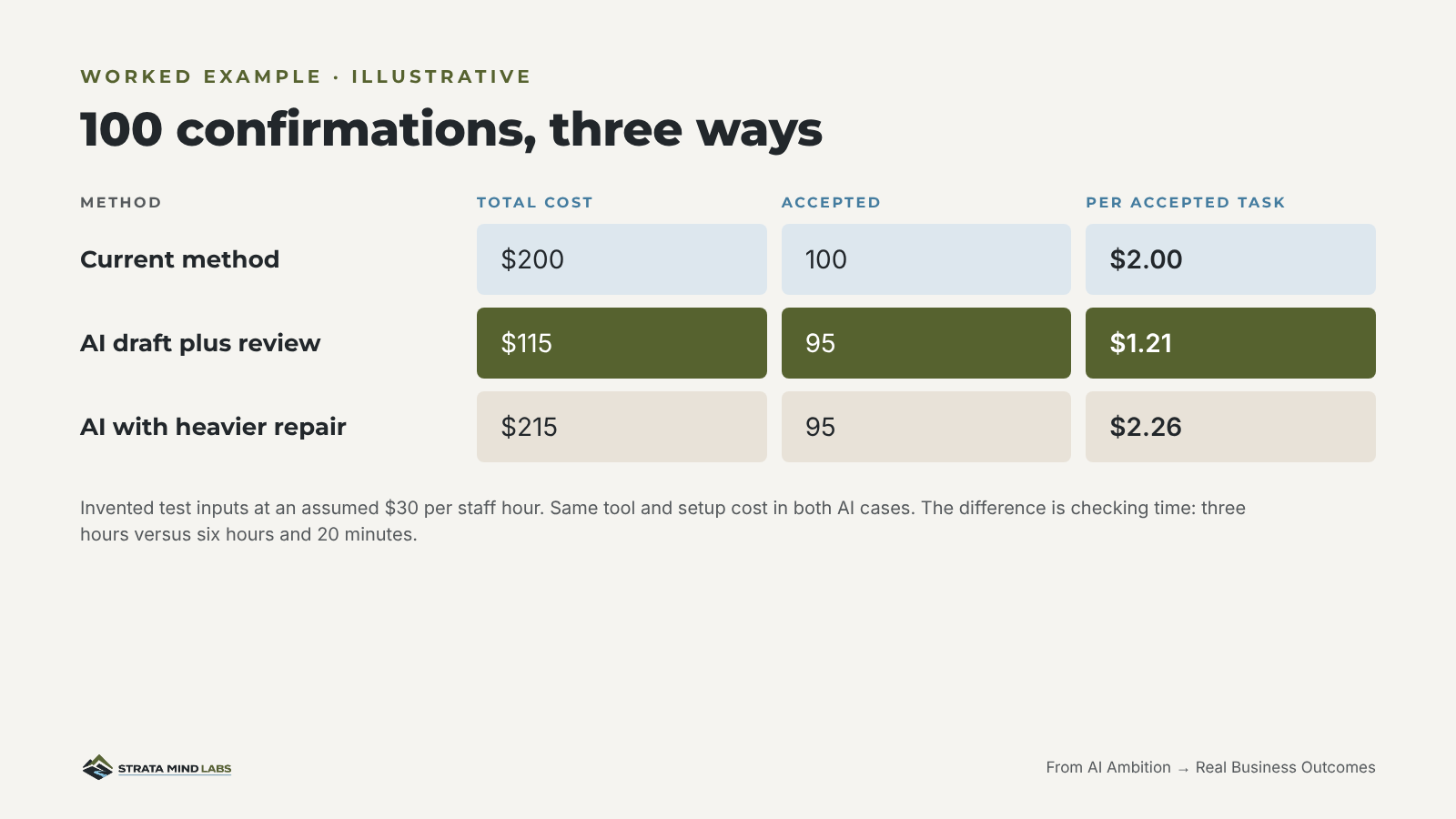
The first AI case assumes $10 in tool charges, three hours of staff work at $30 per hour and $15 of allocated setup cost. That's $115 for 95 accepted tasks, or $1.21 each. The second uses the same tool and setup cost but needs six hours and 20 minutes of staff work. That's $215 for the same 95, or $2.26 each. The five rejected drafts consume effort in both cases.
The first case has a lower unit cost but still leaves five tasks unfinished. Plan and price their completion separately before deciding the whole workflow costs less. The second case is more expensive even before those five get done. Same model, same price. The checking made the difference.
Five prompts to run this week
Use these in sequence with information your business permits in the chosen tool. Each prompt advances one decision.
Baseline the task
Copy this prompt
I will describe one recurring office task and provide 20 recent examples. Map the current steps and identify what counts as a correct completed result. Use only supplied information. Ask for missing timing, volume or cost data. Do not recommend a model yet.
Remove unnecessary work
Copy this prompt
Using this task map, identify duplicate work and steps that produce no needed outcome. Separate necessary steps from candidates for removal. Do not remove required checks. Mark each proposed change for owner approval and show how to measure the effect.
Write the routing rule
Copy this prompt
For the selected task, define the permitted inputs and expected output. Specify what AI may draft or classify, what a person must approve and what triggers a handoff. Do not authorize sending messages, changing appointments or moving money. Flag any unclear boundary.
Count the Verification Tax
Copy this prompt
I will supply the test log. Calculate staff minutes spent reviewing and repairing outputs. Separate accepted tasks, rejected attempts and incomplete work. Include tool charges and allocated setup cost. Show full cost per accepted task for the current and tested methods. Do not invent missing values.
Make the test decision
Copy this prompt
Review this baseline, test log and acceptance rule. Recommend continue, redesign or keep the current method. Explain the evidence and uncertainty. Include unresolved tasks and their completion costs. Propose one next action with an owner and stop condition. Do not generalize beyond the tested task.
How to read the result
Continue a controlled trial when the accepted-task cost is lower, quality meets the rule and unfinished work has a defined completion path. Expand only within the tested boundary.
Redesign and retest when staff checking or exceptions erase the apparent saving. Simplify the task, improve the inputs or tighten the permitted output before testing again.
Keep the current method when the tested method misses required facts, breaks approval rules or costs more after review.
Lower cost with slower completion is a tradeoff to price explicitly. Faster drafts with more rejected work aren't a clean productivity gain.
What to do this week
A fair limit on all this
The 75% figure is Anthropic's own calculation, and the pricing evidence concerns API usage. It doesn't establish a reduction in subscription fees. Willison's token count is one reported test, not a business-wide cost estimate. The operating model, test design and worked arithmetic are SML recommendations, not claims from Anthropic or observed client outcomes. A 20-example comparison is a screening test, not proof that performance will hold at scale. The model-price headline is a reason to retest one task. The decision belongs in the work log.
CIO Question of the Day
Which routine task would still be worth automating after you count the time spent checking it?
Sources
- Anthropic. Claude Haiku 5.5. October 7, 2026. https://www.anthropic.com/claude-haiku-5-5
- Simon Willison. Introducing Claude Haiku 5.5. October 7, 2026. https://simonwillison.net/2026/Oct/7/claude-haiku-5-5/
- Tech Talks Daily. Moving AI from pilot to production with Broadridge. October 8, 2026. https://techtalksnetwork.com/podcast/tech-talks-daily/episode/moving-ai-from-pilot-to-production-with-broadridge
Pay for work that passes.
New briefings land as soon as the signal is worth your time.