
Can You Tell Who Acted?
Agent action attribution before the next SMB connection

Executive decision: Require a distinct identity and an attributable log trail before granting an agent access to applications that hold money or customer data. Put consequential actions behind a human approval point. The owner can then approve a bounded pilot, keep it read-only or hold it.
If the log can't tell your agent from your bookkeeper, you don't have an audit trail. You have a guess.
The signal this week
Axios reported on October 22, under the headline "Scoop: Unvetted AI agents are accessing U.S. bank accounts," that major US banks are dealing with third-party AI agents acting in customer accounts. Axios blocked our fetch, so we couldn't read the scoop itself. A secondary summary we could open says several large US banks are restricting third-party agents while they try to separate customer-authorized activity from unauthorized activity.
Our briefing source adds two details: the agents sign in with customer credentials, and the report rests on people familiar with the issue. We couldn't confirm either detail on a page we opened, so treat both as Axios's claims, relayed to us and unchecked.
The same summary points to JPMorgan Chase. It says the bank told investors on its October 13 earnings call that it would not allow outside AI agents to operate inside the bank, and it describes agents as tools to use where they help customers rather than an all-or-nothing category. That comes from the summary's reading of the transcript. We haven't read the transcript.
Neither the summary nor the briefing reports a count of incidents or a measured loss. That matters. The story shows an identity problem at banks. It doesn't show the same pattern in your applications.
The problem still travels. When software acts with a person's credentials, the system may record the person and hide the actor.
What the other sources show and don't
1Password announced 1Password for Agents on October 22. Its post says that when a supported agent reaches a login page, it asks for a credential from the user's vault, the user approves the request, and 1Password fills the credential into the destination site. The post says the agent doesn't have access to the credential. It also says safeguards vary by integration and that some integrations are still coming soon.
We found nothing in the post about audit trails inside the destination application. That's the gap this briefing cares about. And it's a vendor describing its own product.
Microsoft's Hayete Gallot made the architectural case on October 19 in "Securing the agentic insider." The post argues that agents need an identity, a container and a set of policy and permissions, and that monitoring has to be continuous. It gives no figures and no measured outcomes. It's vendor guidance about direction.
Together these sources support one move: inspect identity and logs. They don't tell you what your own applications record. To check this yourself, read the three posts listed under Sources, then run the test below on your own systems.
The card and the test
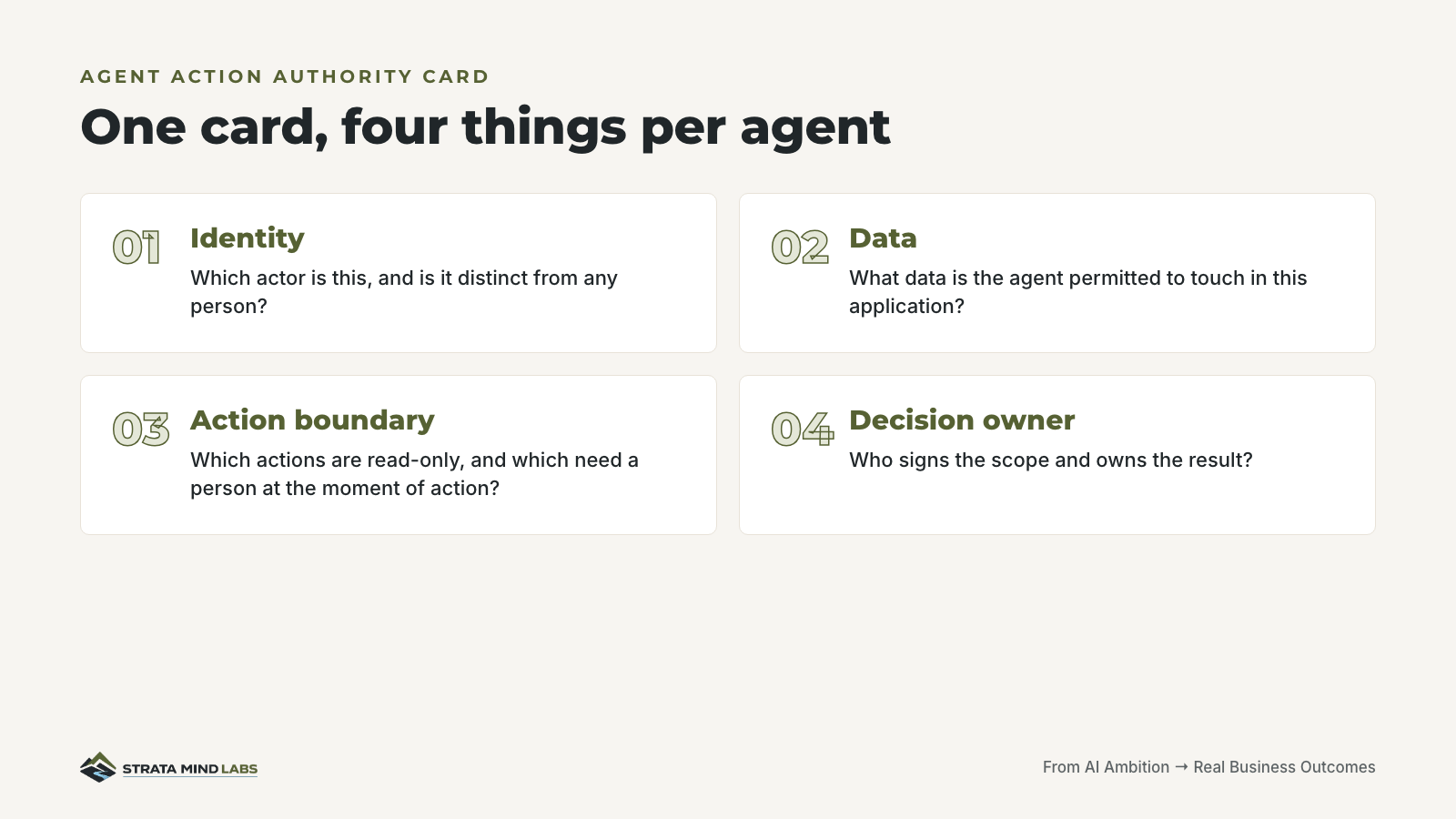
The Agent Action Authority Card is our proposed tool. For each agent and application it makes four things explicit: the actor's identity, the permitted data, the action boundary and the person who owns the decision. The thresholds on it are SML management recommendations. No outside source validates them.
The aim is modest. Reduce the Verification Tax before a connection becomes routine.
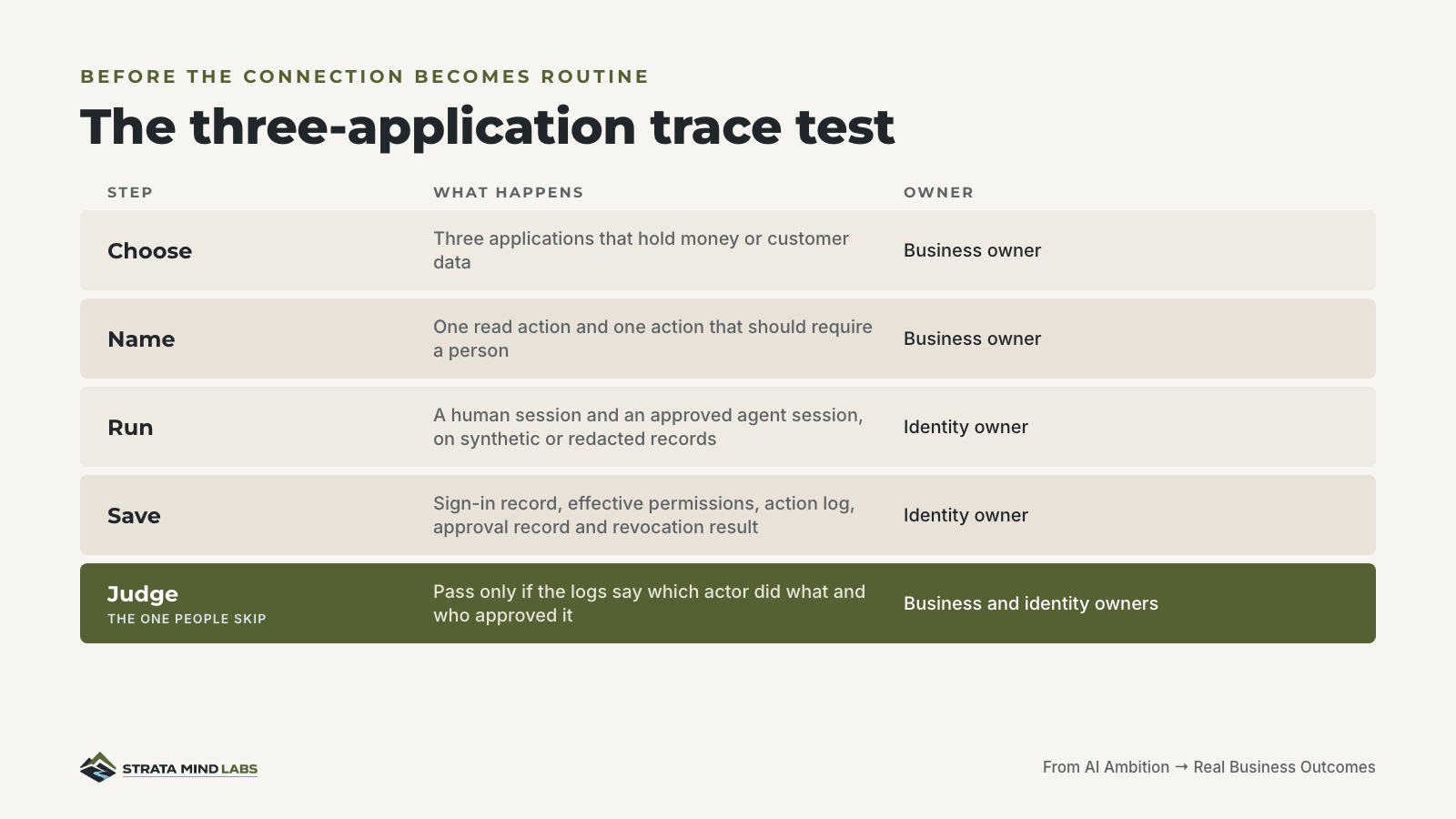
The test is small on purpose. Pick three applications that hold financial or customer data. For each, the business owner names one read action and one action that should require a person. The identity owner then runs or reconstructs two sessions on synthetic or redacted records, one human and one approved agent. Save the sign-in record, the effective permissions, the action log, the approval record and the result of revoking access.
A pass means the logs identify which actor performed each action and who approved any consequential step. If the destination can't do that, document the gap and keep the agent read-only while the owner decides on a remedy.
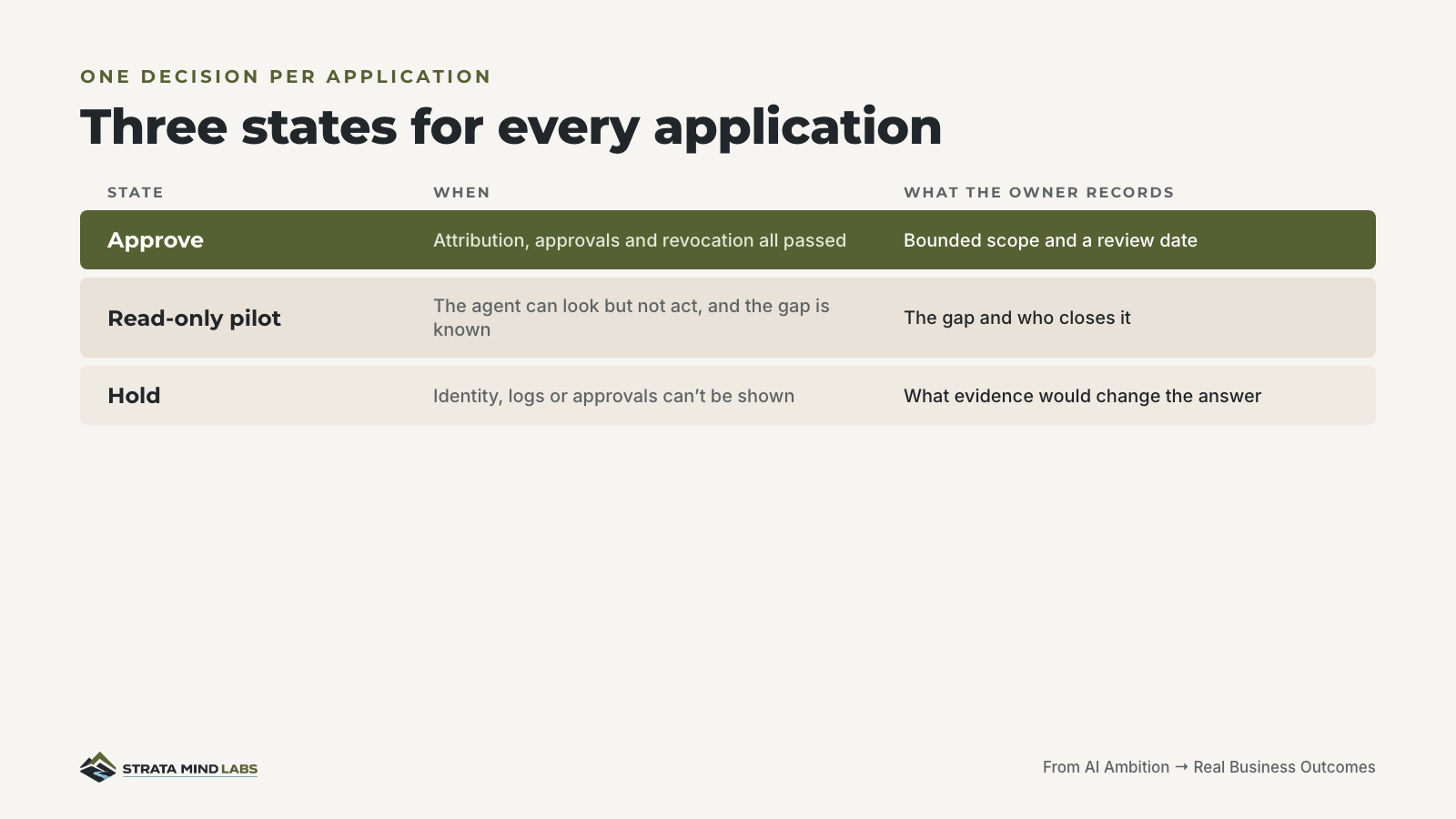
Every application ends in one of three states. The named business owner chooses. The identity owner verifies the traces and a finance owner reviews anything that moves money.
Five prompts to run this week
Run these in order against your own inventory and evidence. A person verifies every result. They organize evidence. They don't inspect your systems.
Inventory the actor
Copy this prompt
Using only the supplied inventory of approved integrations, list each agent that can access the selected application. For each, identify its owner, account or token type, purpose, data classes and evidence link. Mark every missing field UNKNOWN. Do not infer an identity from a product name.
What this should tell you: who is actually connected. Missing account IDs, owners and stale entries are warning signs, and an unowned or shared identity blocks a clean attribution test. Decision: which agents enter the trace test, and hold any entry without a named owner.
Map the effective rights
Copy this prompt
For the verified agents, compare the approved task with the effective application permissions. Separate read, write, export, payment, bank-detail change, delete and external-send actions. Cite the supplied permission evidence for each right. Mark unknown rights UNKNOWN. Propose no permission change.
What this should tell you: how far the agent's rights run past its stated job. Watch for rights broader than the approved task and for missing permission exports. A narrow purpose carries little force when effective rights are broad. Decision: which actions need a human approval point and which stay read-only.
Trace two sessions
Copy this prompt
Compare one supplied human session and one approved agent session in the same application. Follow sign-in, token use, data access and action logs. Use synthetic or redacted records only. Quote log field names and record IDs. Mark any point where the actors become indistinguishable. Do not invent missing events.
What this should tell you: whether this application can support an ownership decision at all. Watch for sessions that share an actor ID or break the event chain. Decision: pass attribution only when the owner can distinguish every tested action.
Check human authority
Copy this prompt
For every tested write, export, payment, bank-detail change, delete or external-send action, identify the configured human approver, approval timing and audit record. Use only the supplied workflow evidence. Mark unsupported controls UNKNOWN and separate configuration from a completed test.
What this should tell you: whether authority operated at the moment of action. A pilot sign-off from months ago doesn't count, and missing approval logs are warning signs. An owner on paper isn't an owner in practice. Decision: a bounded pilot or a read-only state, based on verified approvals.
Write the owner decision
Copy this prompt
Draft a one-page decision for the named business owner. Include observed facts with evidence links, unresolved gaps, effective rights, attribution result, approval result, revocation result and a proposed state of APPROVE, READ-ONLY PILOT or HOLD. State what evidence would change the decision. Do not claim the pilot was approved.
What this should tell you: whether the owner can see what was observed and what is still uncertain. Remove any claim that has no trace or policy record behind it. Decision: the named owner selects the state and signs the action scope. Record an expiry date and a next review, and retest after any new tool or permission.
What to do this week
A fair limit on all this
One report is not a frequency. The bank story gives no count of incidents and no measured loss, and it doesn't show the pattern in your applications. The 1Password and Microsoft posts describe a product and an architecture. Neither supplies an SMB incident rate.
The Agent Action Authority Card, its thresholds and the five prompts are SML proposed practice. They haven't been independently validated. The sequence can save review time by collecting one evidence trail per agent and destination, but it doesn't measure business value or prove safety. We assume no savings and no return.
Unknown identities, missing logs and untested approvals stay open risks until someone closes them.
CIO Question of the Day
Pick one application that holds your money or customer data. If an agent changed a record there today, could you prove who did it?
Sources
- Let's Data Science. (n.d.). US banks tighten controls around external AI agents. Retrieved October 23, 2026, from https://letsdatascience.com/news/us-banks-harden-defenses-against-rogue-ai-agents-e60aa4a6
- Torrey, J. (2026, October 22). Introducing 1Password for Agents. 1Password. https://1password.com/blog/1password-for-ai-agents
- Gallot, H. (2026, October 19). Securing the agentic insider. Microsoft. https://blogs.microsoft.com/blog/2026/10/19/securing-the-agentic-insider/
If the log can’t say who acted, keep the agent read-only.
New briefings land as soon as the signal is worth your time.