
AI Spend Needs a Receipt
A vendor report shows activity. A receipt shows what the business accepted and what it cost.

Executive decision: Run a 45-minute planning-estimate review of one material AI-assisted workflow this afternoon. Put the allocated invoice amount beside human-accepted outcomes and review minutes. If the acceptance record is missing, mark the unit cost unverified and stop the budget decision until the lead repairs the evidence.
A dashboard can tell you what the meter ran. It can't tell you what the business accepted. Somebody has to put those two numbers on one sheet.
The signal this week
Anthropic announced smart reports for Claude Enterprise on October 28. Per Anthropic's page, you pick a team, a date range and the products to include. Claude then analyzes a sample of that team's transcripts and groups the work into workstreams. Each workstream shows its spend, the deliverables produced and common friction points. Anthropic says availability varies by configuration. It also says the reports aren't meant for evaluating individual performance or making employment decisions.
GitHub made a related move the same day. Its Universe post says Enterprise customers can use all Copilot features without a separate subscription and that "you pay for the AI credits you use." GitHub says this is available through GitHub Sales today with self-serve coming soon. The same post says "Completed work, not more code, is the output that matters."
Two vendors, one direction. AI is becoming a metered line item, and the meter is getting better. That helps. It doesn't answer the question your CFO will ask next, which is what the money bought.
What the sources show and don't
TechCrunch reported the Anthropic launch independently. The report says the tools draw on internal analytics and employee surveys and frames the tools as a response to customer concern about return on investment. Jellyfish's Nicholas Arcolano, quoted in the piece, calls growth in agentic coding spend "growth that most CFOs didn't plan for."
None of that shows a buyer saving money, improving quality or finishing more work. Anthropic describes its own product. GitHub describes its own billing offer. A sampled transcript or a survey answer is a lead worth following. It isn't an accepted business outcome.
So the sources establish the product features and the shift toward metered use. The receipt below is something else. It's an operator method from Strata Mind Labs, and neither vendor validates it.
One row, five owners
Before you read any dashboard, define one unit of finished work. For a support workflow it might be a closed ticket a lead accepted. For a document workflow it could be a delivered document with signoff. The definition needs an end state, a human acceptance event and an ID someone can check. You own that definition. The vendor's metrics stay a separate input.
This is the 80/10 Operator Test in working form. A small set of accepted records tells you whether the reported activity deserves a bigger review.
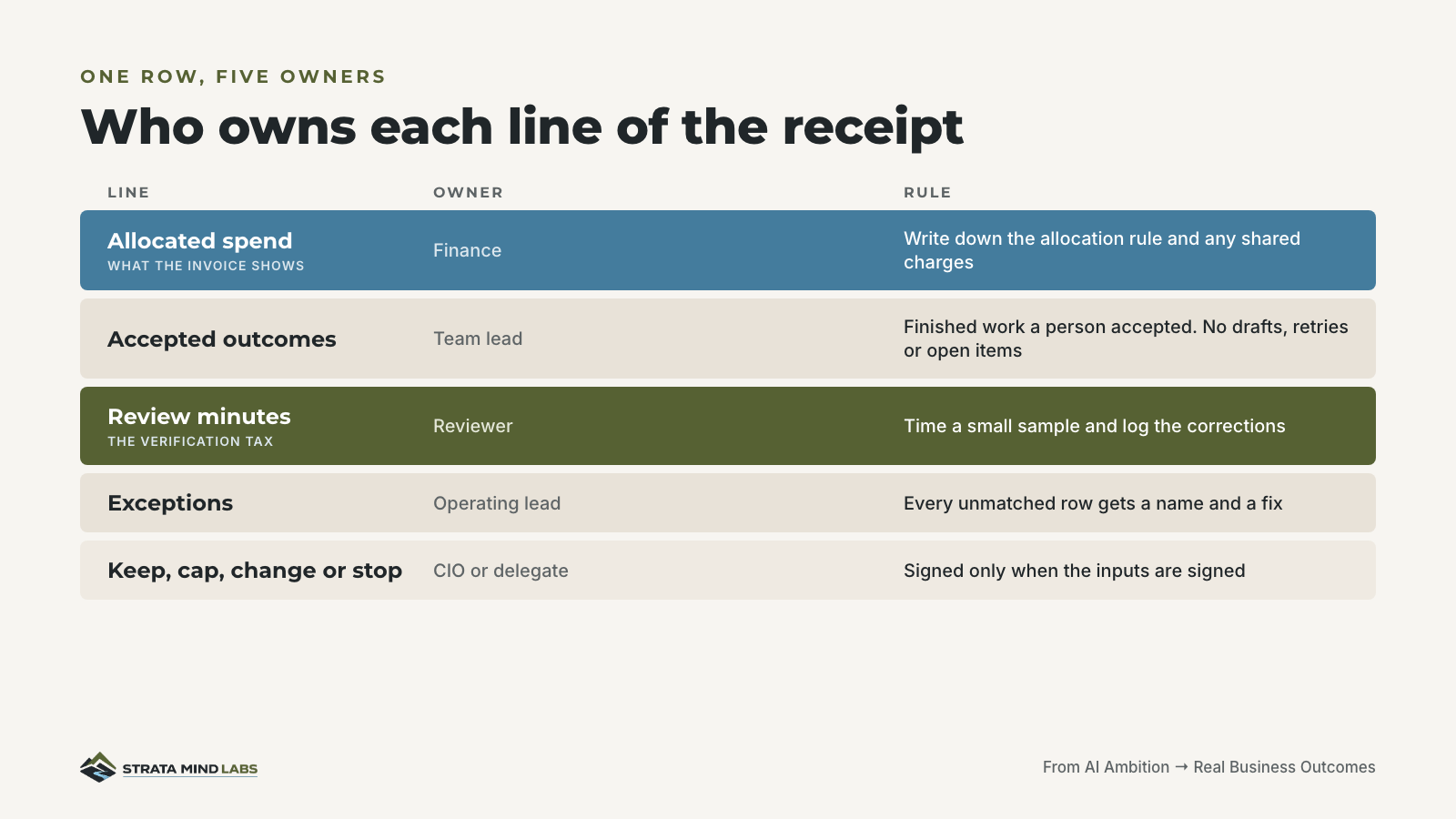
Finance supplies cost. The team lead supplies accepted item IDs from the system of record. A reviewer checks exceptions and a small sample. The CIO or a delegate owns the keep, cap, change or stop call. One sheet, no new software purchase.
This is a labeled reconstruction built from public product descriptions and an operator-designed method. It isn't a description of a client deployment.
The first session
You need one month of AI invoice or card export, one workflow name, a list of completed item IDs with acceptance dates and a person authorized to inspect them. A spreadsheet is enough. If you demonstrate this to anyone, use synthetic or redacted records.
Finance assigns the month and the allocated cost to the workflow and writes down the allocation rule, including any shared charges. The team lead then lists accepted item IDs from the system of record and leaves out drafts, retries and open items. Divide allocated spend by accepted outcomes, but only when the count is above zero. Time a small sample of human review and record the exceptions. Last, set the vendor's activity report next to the receipt using the same period and scope.
The first output is one row: spend, accepted count, cost per accepted outcome, review minutes, exception count, source links, uncertainty flags and an owner decision. The 45 minutes is a planning estimate, not something we observed.
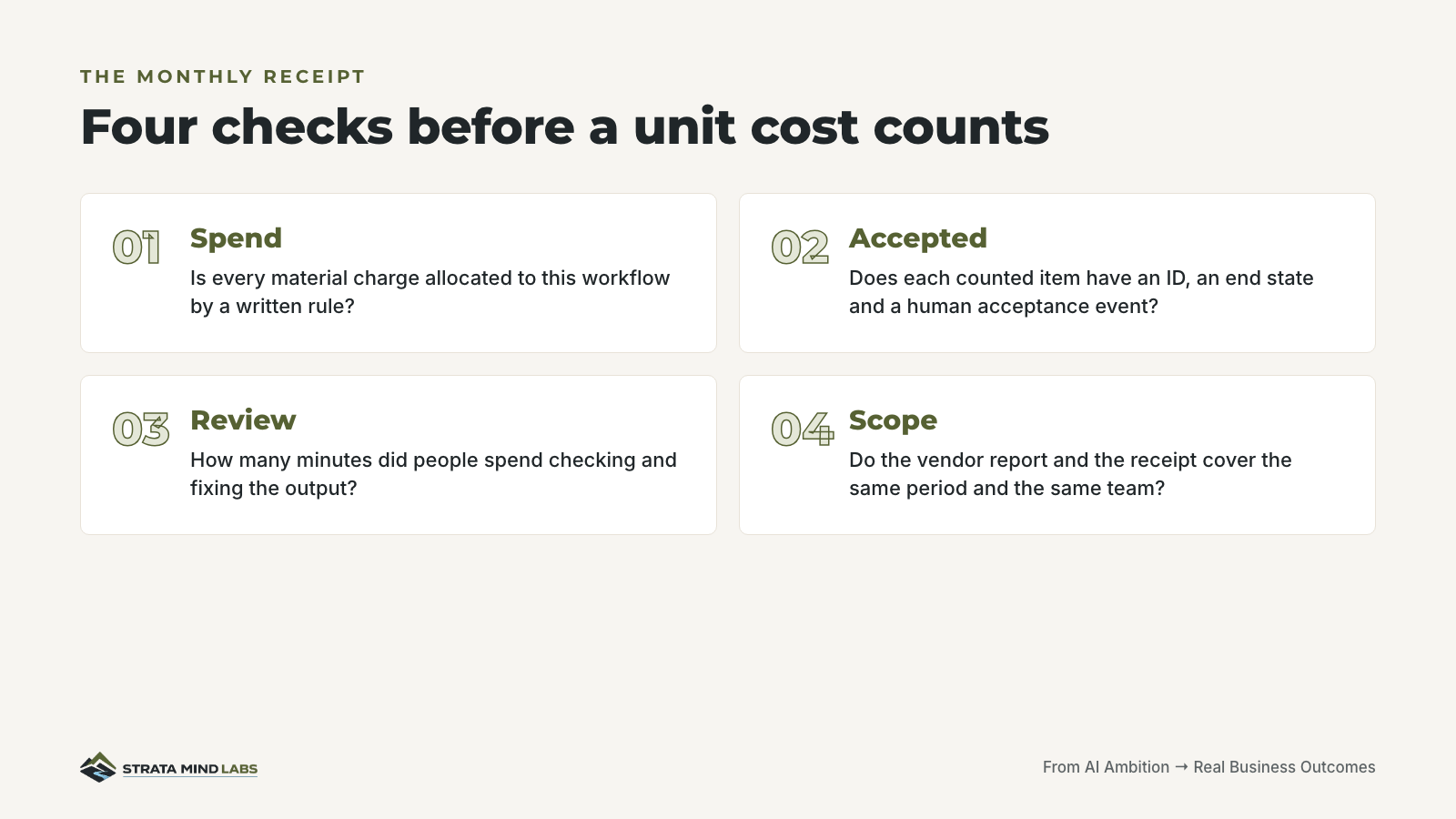
If the denominator is zero or the period can't be reconciled, write "unverified" in the cost cell, name an evidence owner and stop the budget decision. A clean number with no allocation rule behind it is worse than a blank.
Keep the assistant in its lane
The action authority card keeps the assistant in its lane. It may read the redacted tables you supply, draft the receipt and flag missing records. It may not approve outcomes, change budgets, touch raw customer data outside the boundary you set or present a vendor estimate as measured value. Check access and retention rules before you paste any record into an AI tool.
Finance verifies spend. The team lead verifies accepted IDs. The CIO or delegate signs the monthly decision. When records conflict or the accepted count is zero, calculation stops.
Five prompts to run this week
Run these in order on one workflow. Use redacted rows only. A person checks every result against the source records.
Define the accepted unit
Copy this prompt
Using only the workflow description and acceptance policy I provide, propose one countable finished outcome. Return the required end state, human acceptance event, record ID, exclusions and unanswered questions. Do not infer missing policy. Workflow: [paste redacted description]. Policy: [paste policy or write missing].
What this should tell you: whether the response names a verifiable ID and explicit exclusions. An invented approval rule is a warning. A usable denominator starts with a clear end state, not a token or prompt count. Decision: the team lead approves the unit only if it matches the actual system of record.
Reconcile the spend period
Copy this prompt
With this accepted-unit definition [paste], examine a redacted invoice table [paste] and an accepted-item export [paste]. Match period, team and workflow. List shared charges, missing dates, duplicates and items outside scope. Do not calculate a unit cost yet.
What this should tell you: which rows don't match and whether the model quietly assigned shared spend. A tidy total with no allocation rule is a warning. Period and scope errors can swamp the apparent unit cost. Decision: finance approves an allocation only when every material charge has a documented rule.
Calculate the receipt
Copy this prompt
From approved allocated spend [amount] and verified accepted-item IDs [list], calculate accepted count and cost per accepted outcome. Show the formula and exclude drafts, retries and open items. If the count is zero or an input is unverified, return unverified instead of a number.
What this should tell you: whether the numerator, denominator, formula and exclusions all trace back to source records. Watch for a computed value despite missing evidence. The calculation is a decision aid only when the inputs are auditable. Decision: the CIO accepts the unit cost only after finance and the lead sign their inputs.
Check review and exceptions
Copy this prompt
Using a redacted sample of accepted items [paste] and reviewer time records [paste], summarize review minutes, corrections and exceptions. Mark the sample size. Do not extrapolate savings or quality beyond the supplied records.
What this should tell you: how much human time sits behind the accepted work, and where corrections cluster. A claim of zero review time, or missing reviewer logs, needs a visible uncertainty flag. Cheap model usage can still carry a Verification Tax in people's hours. Decision: the operating lead decides whether the workflow needs a larger sample or an exception fix.
Frame the budget choice
Copy this prompt
Given the approved receipt [paste], vendor report [paste], review record [paste] and open issues [paste], draft a one-page keep, cap, change or stop decision. Separate facts, calculations, inferences and predictions. State the condition that would reverse the choice. Do not make the final decision for the owner.
What this should tell you: whether the draft keeps the unresolved gaps and names a reversal condition. Reject any invented return or client result. The receipt earns its place when it changes a real budget choice with the uncertainty still visible. Decision: the CIO and the finance owner decide after reviewing cost, quality and exception evidence.
How to read the result
A credible receipt gives you a cost per accepted outcome with traceable inputs and an explicit review burden. Compare the same period and scope as the vendor report. Chase missing charges, mismatched counts, quality corrections and review time.
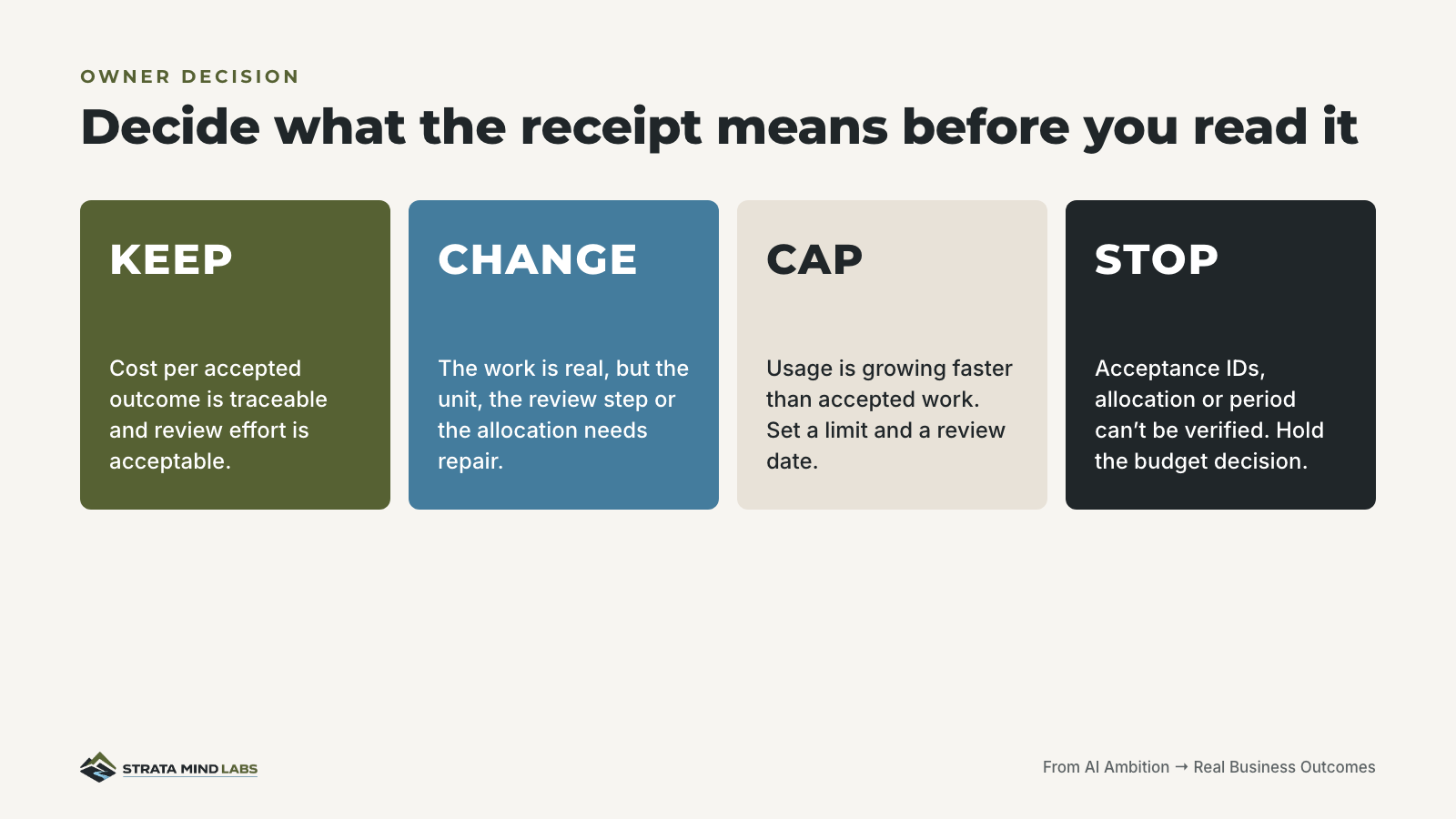
It can expose an AI Investment Trap, where usage grows and accepted work stays uncertain. It can't prove causation or savings from one month. Pick the keep, cap, change or stop call before you look at the row, or every owner will read the same number their own way.
Two defaults are starting points only. A 20 percent variance trigger and a ten-item review sample are SML proposed practice, not sourced benchmarks. Adjust both to the size and risk of the spend.
What to do this week
A fair limit on all this
One month on one workflow is one case. It isn't a frequency, and it doesn't prove savings. The vendor sources describe vendor products. They don't measure what any buyer got. The 20 percent trigger, the ten-item sample and the 45-minute session are SML proposed practice. No return is assumed anywhere in this method.
The strongest counterargument is cost. For a very small spend line a vendor report may be enough, and a second measurement process can eat more time than the decision is worth. Limit the receipt to a material workflow where the invoices and acceptance records are within reach. If the reconciliation starts costing more than the decision, simplify it or stop.
CIO Question of the Day
For the AI workflow you spend the most on, can you show last month's cost per accepted outcome, and who signed off on what counts as accepted?
Sources
- Anthropic. (2026, October 28). Smart reports, surveys, and pooled group budgets for Claude Enterprise. https://claude.com/resources/articles/smart-reports-surveys-pooled-budgets
- Fernholz, T. (2026, October 28). Anthropic just launched tools to show companies what their AI spending is buying. TechCrunch. https://techcrunch.com/2026/10/28/anthropic-just-launched-tools-to-show-companies-what-their-ai-spending-is-buying/
- Parikh, J. (2026, October 28). GitHub Universe 2026: Evolving every layer of the stack. GitHub Blog. https://github.blog/news-insights/company-news/github-universe-2026-evolving-every-layer-of-the-stack/
A dashboard counts activity. A receipt counts accepted work.
New briefings land as soon as the signal is worth your time.