
AI Gave You Another Job
Why AI productivity should be measured after the work is checked
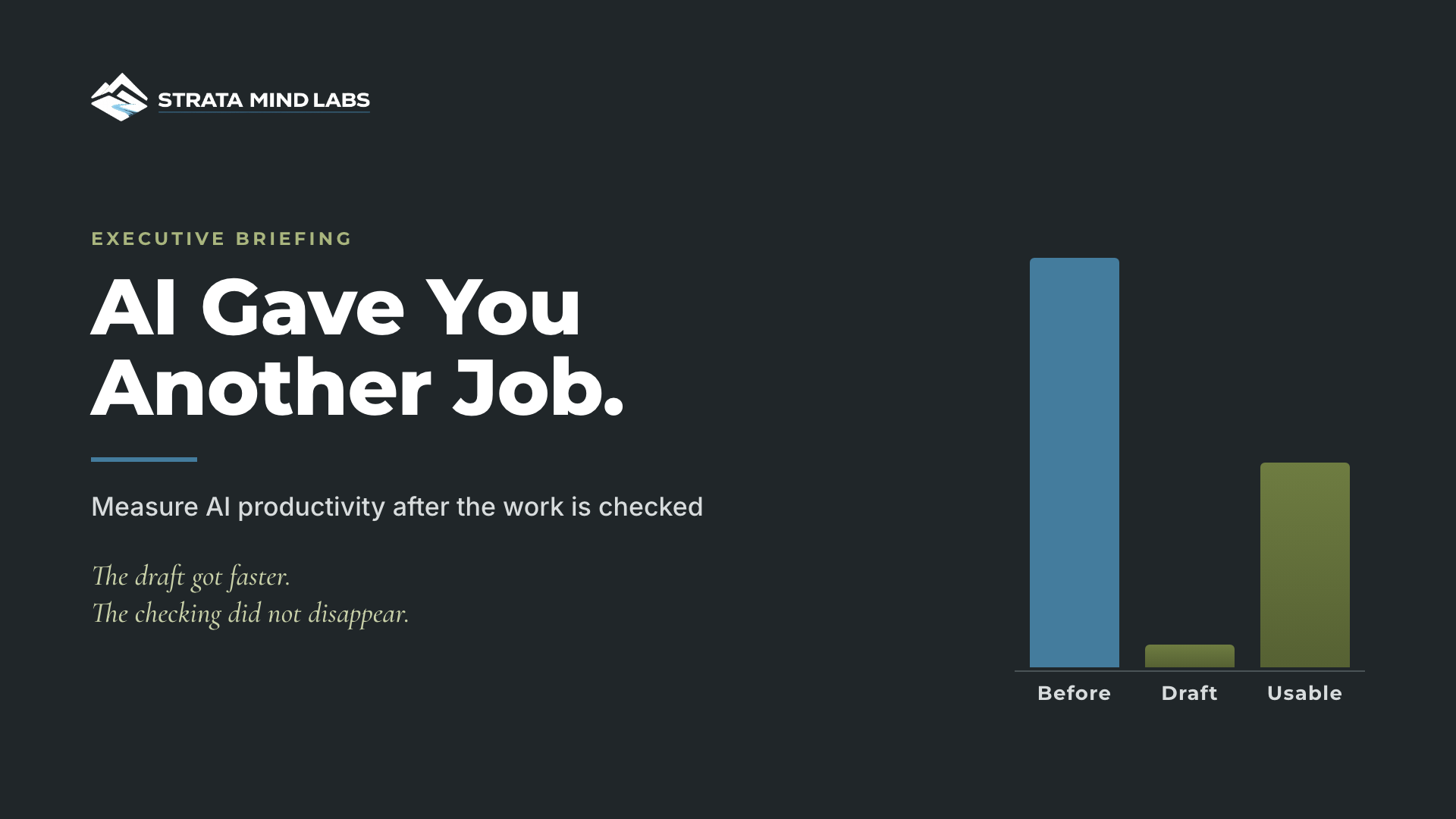
AI wrote the reply in a minute. Then someone spent six minutes making sure it was right.
That second number almost never makes it into the productivity slide. It should. The draft got faster. The checking did not disappear.
The signal this week
Harvard Business Review ran a piece by MIT's Christian Catalini arguing that as AI makes execution cheap, verification becomes the scarce and valuable part of the work. Firms still have to decide which outputs they can trust and stand behind.
The field evidence points the same way.
A Stanford study in the Journal of Accounting Research tracked 277 accountants and more than 200,000 transactions across 79 small and mid-sized businesses. AI use came with real productivity gains. It also moved effort away from data entry and toward communication and quality assurance.
A July study of 802 developers and 196,212 pull requests found per-person throughput roughly doubled under an enterprise AI mandate. Per-reviewer load roughly doubled with it.
The work didn't vanish. It moved downstream to whoever has to check it.
The stopwatch usually stops at the draft
Most AI productivity claims time the easiest part to see: how long did the draft take?
That's useful. It's also incomplete. A draft only helps the business once it's accurate, complete, current and appropriate enough to use. Before an AI-drafted customer reply goes out, someone still confirms the pricing, the contract terms, the schedule, the policy and what was said last time.
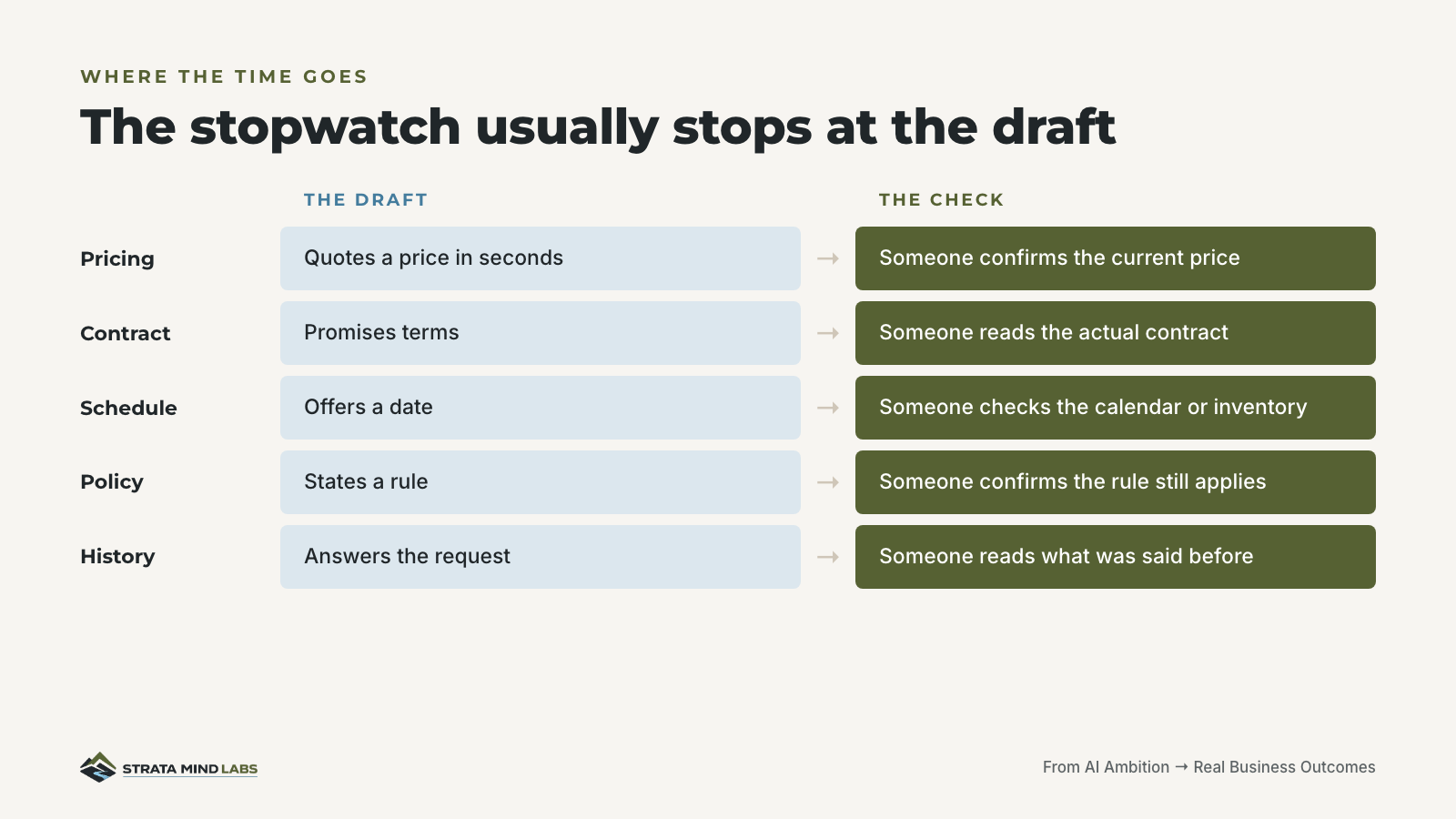
A fast draft that someone else has to finish isn't productivity. It's workslop with a timestamp.
Verification is not failure
Checking is responsible work. People already review calculations, proposals, junior work and system recommendations. Nobody calls that a failure.
The problem is visibility. AI makes the creation step so fast that the checking becomes invisible in the numbers. That makes verification an operating metric, and you can't manage the Verification Tax if you never measure it.
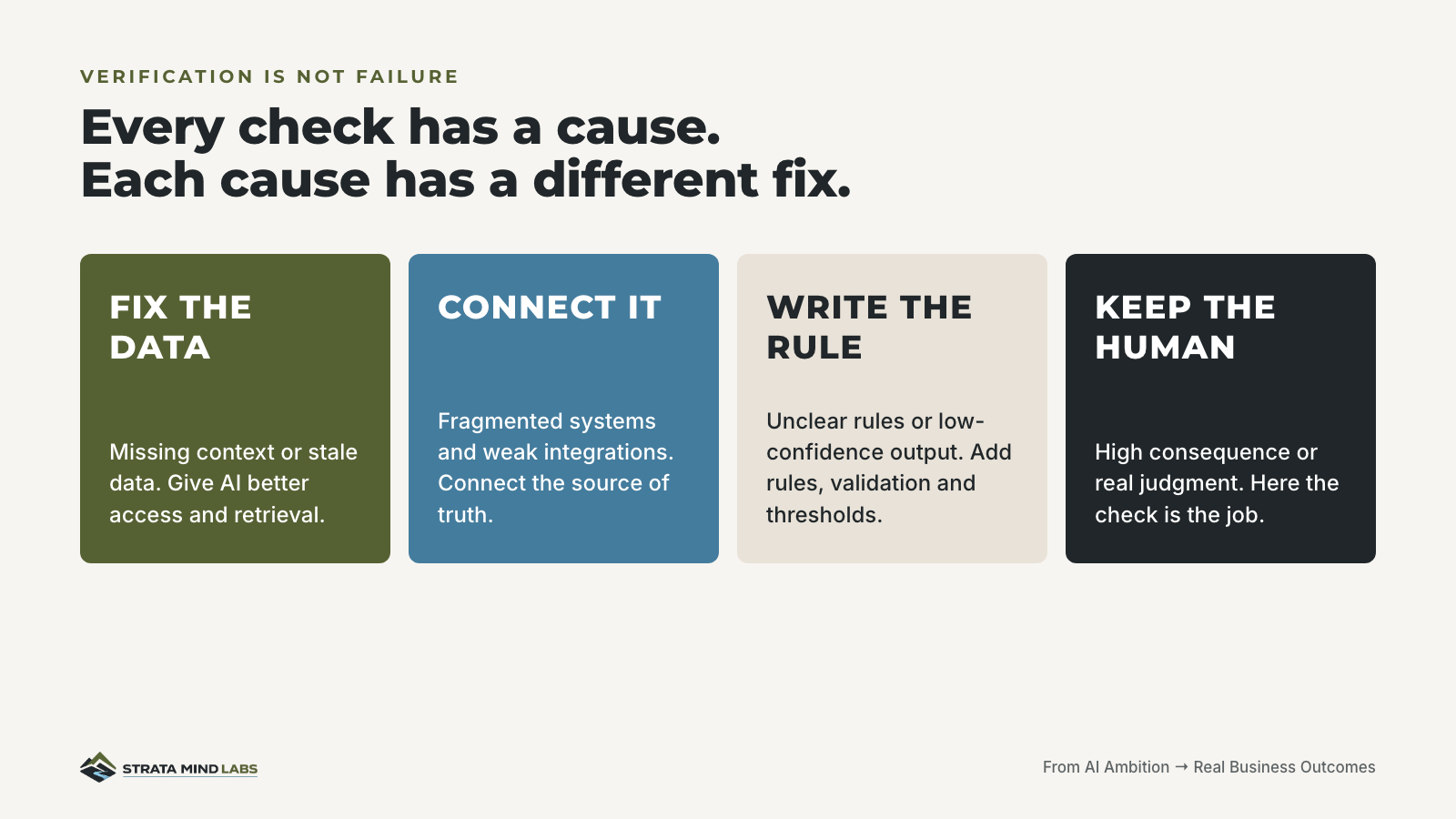
When people spend real time checking, the reason matters. Missing context, stale data, fragmented systems, unclear rules and high-consequence decisions all look the same on a timesheet. They need very different fixes.
Time all four steps
Measure the full path, not the first step. We use four stages: Create, Check, Fix and Use.
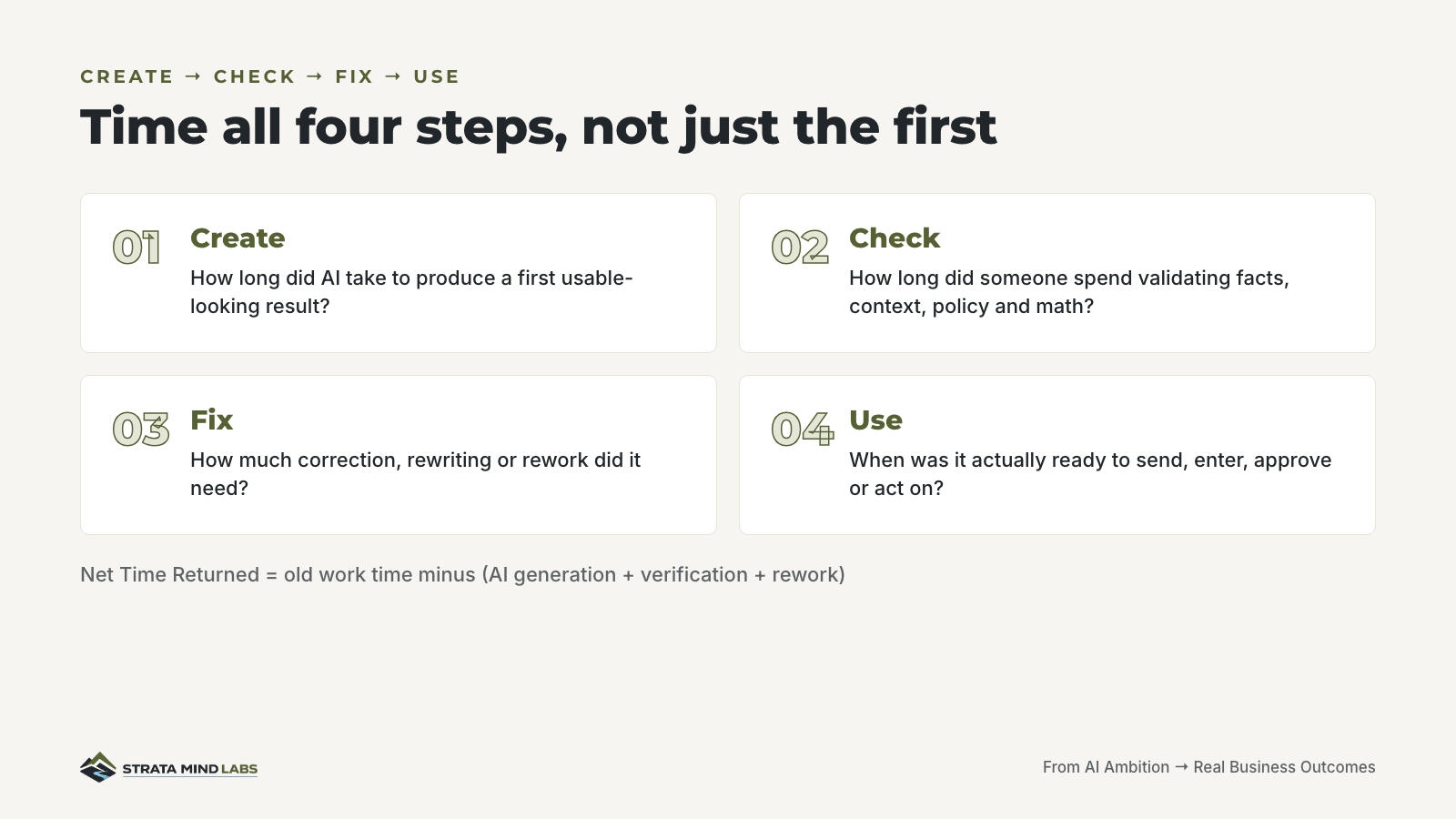
The number that matters is Net Time Returned: old work time minus AI generation, verification and rework. It's a Strata Mind Labs operating measure for workflow discovery, not a published scientific standard.
What it looks like on one email
Here's an illustrative example. A customer emails a small business with a pricing and scheduling question. Before AI, the reply took 18 minutes end to end.
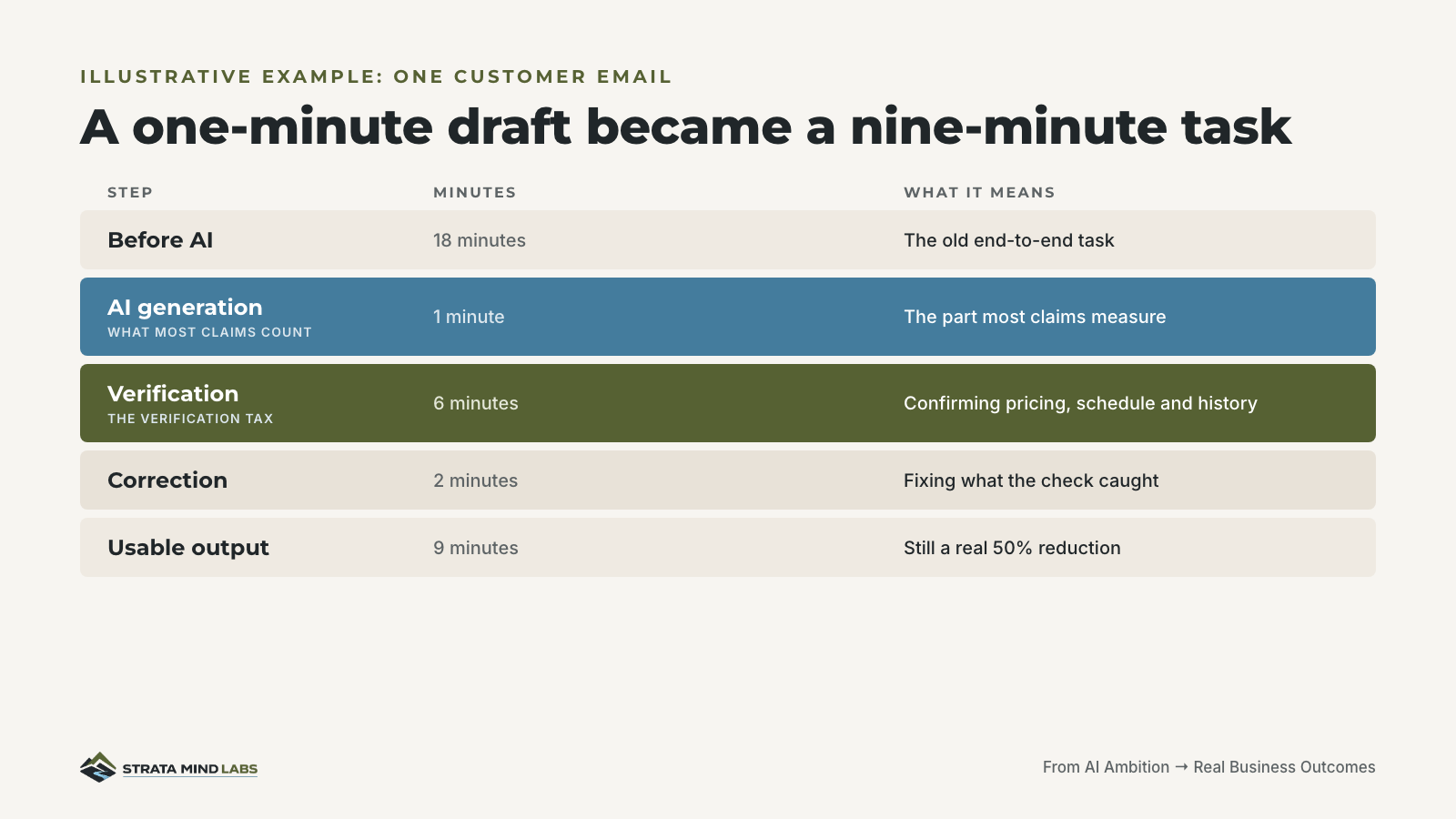
The task didn't become a one-minute task. It became a nine-minute task. That's still a 50% reduction, and worth having.
The bigger win is that you now know where the remaining work lives. If most of those six minutes go to confirming current pricing, the next investment might be a safe pricing integration, not a better model.
Run the Verification Tax Check
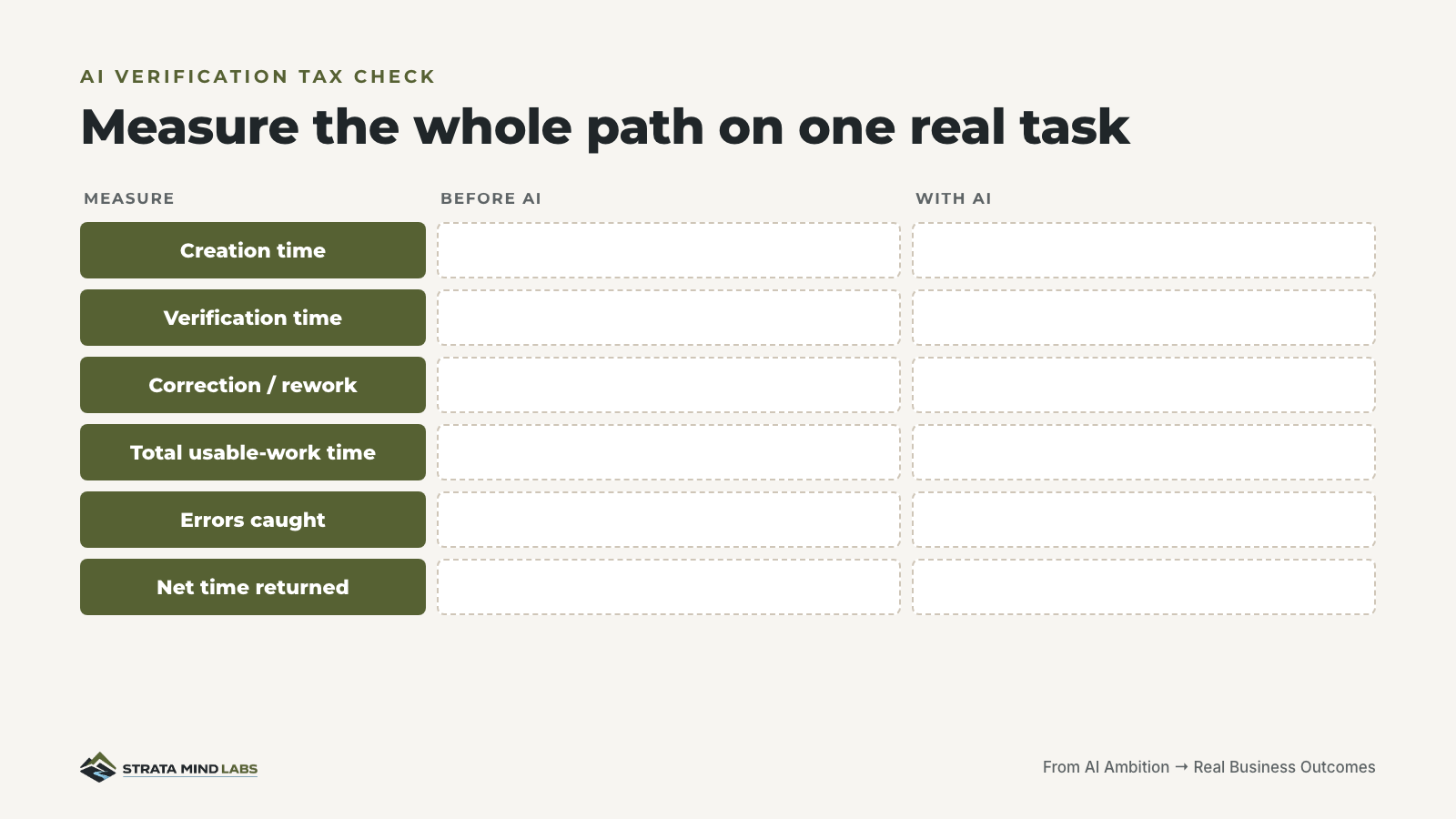
Pick one task and fill this in honestly. Leave a cell blank before you invent a number.
Five prompts to run the first pass yourself
Run these in order on one real workflow. The rule that matters: the model doesn't get to invent timings.
Map the full workflow
Copy this prompt
I am going to describe one task we perform with AI. Map the full workflow from trigger to final usable result. Separate AI generation, human verification, correction/rework, approvals and final action. Do not assume a step is removed just because AI performs the first draft. Flag missing information.
Identify the verification work
Copy this prompt
Review the workflow above and list every fact, assumption, business rule, source, calculation, policy, customer detail or exception a person still has to verify before the output can be used. Group the checks into: data/context, policy/rules, judgment and consequence/risk.
Calculate net time returned
Copy this prompt
Using only the timing data I provide, calculate old total work time, AI generation time, verification time, correction/rework time, new total usable-work time and net time returned. Show both absolute minutes saved and percentage reduction. Do not invent missing numbers.
Reduce avoidable verification
Copy this prompt
For each verification step, recommend whether it could be reduced through better data access, retrieval, integration, deterministic rules, validation, confidence thresholds or workflow redesign. Keep human review where judgment, accountability, empathy, negotiation or high consequence justifies it.
Design the next experiment
Copy this prompt
Design a small test that reduces one avoidable verification step without increasing risk. Define the baseline, change, human checkpoint, success metric, failure condition and evidence we should collect before expanding it.
What to do this week
A fair limit on all this
This isn't a claim that AI usually creates more work than it saves, or that most AI output is wrong. There's no universal Verification Tax percentage either. The evidence supports something narrower: AI can shift work toward checking, quality assurance and judgment, and most businesses aren't measuring that shift. Create, Check, Fix, Use and Net Time Returned are planning tools, not laws.
CIO Question of the Day
How much time did AI actually save your team after someone checked the work?
Sources
- Catalini, C. (2026, October 2). AI is making verification the bottleneck for companies. Harvard Business Review. https://hbr.org/2026/10/ai-is-making-verification-the-bottleneck-for-companies
- Choi, J. H., & Xie, C. L. (2026). Human + AI in accounting: Early evidence from the field. Journal of Accounting Research, 64(3), 1333-1373. https://www.gsb.stanford.edu/faculty-research/publications/human-ai-accounting-early-evidence-field
- He, H., Agarwal, S., Denisov-Blanch, Y., Azaletskiy, P., Koyejo, S., & Vasilescu, B. (2026). AI writes faster than humans can review: A longitudinal study of an enterprise 2x mandate (arXiv:2607.01904). arXiv. https://arxiv.org/abs/2607.01904
Measure verified output, not generation speed.
New briefings land as soon as the signal is worth your time.